Просмотр новости
Найдите то, что Вас интересует
 Спутники
 РН
РН SpaceX
 Роскосмос
 NASA
NASA
СпутникиРНSpaceXРоскосмосNASA
AI has completely transformed how companies build their websites — and how customers get information from those sites. AI overviews, such as those seen on Google, have cut the click-through rates for content that was formerly top-ranked by an incredible 58%.
AI has completely transformed how companies build their websites — and how customers get information from those sites. AI overviews, such as those seen on Google, have cut the click-through rates for content that was formerly top-ranked by an incredible 58%.
![Free Resource: Website Optimization Checklist [Download Now]](https://no-cache.hubspot.com/cta/default/53/00d9cc96-eff7-4cea-8ff3-583374c3dcd5.png)
That decline in traffic is creating major challenges for companies that are slow to pivot to make their websites AI-ready. But as we’ve seen time and time again, those who are willing to adapt in the right way will set themselves up to navigate this challenge successfully. Many have already begun making this pivot, adjusting their website content and back-end data for better integration with AI tools.
In my own world of content marketing and growth strategy, I’m seeing plenty of brands eager to make this pivot. But too often, they aren’t actually ready for it. Why? Because to get an AI-ready website, you have to start with AI-ready data. Here are my six reasons why.
Why Clean Data Matters 1. AI can’t understand what your website doesn’t explain.Let’s start with the basics. All those AI-generated summaries that now show up on Google? They don’t come out of nowhere. They’re drawing directly from what existing websites have to say on a particular topic. Similarly, when evaluating internal data, AI tools won’t help you with information that isn’t clearly defined — such as the fact that 49% of global marketers don’t have a documented unique value proposition.
If your website has missing or inconsistent data, the AI tools that 42% of Americans now use to search for information will be left guessing. This isn’t just about what data is available on your site, but also structuring it in a way that gives AI models the context they need. If that information isn’t there, how is the AI ever going to know it’s something you want it to look for?
Your website’s internal data should clearly explain the purpose of each page. Metrics for your website need to be clearly defined so that the AI understands what KPIs it is trying to track and optimize. When you give better inputs to AI with clearly labeled and organized data, those tools can then provide more accurate outputs. Everything you want AI to use — both internal and external-facing — needs to be explained.
2. Clean data makes every customer interaction smarter.A big part of why a growing number of customers are shifting to AI over traditional search is that AI can do a much better job of personalizing the experience. This takes what we’ve always tried to accomplish in content marketing and delivers it at scale (with an even greater level of personalization). AI can tailor its responses to each individual based on their preferences and history, whether they’re looking for a new book to read or a business to use.

However, when it comes to personalizing responses drawn from your website, AI can only do so effectively when the underlying data is reliable. If your website contains duplicate or outdated information, AI will deliver poor or even irrelevant recommendations. When someone goes to your site to learn more, they’ll be disappointed instead of delighted.
Because of this, part of making your website AI-ready requires doing a deep data audit. Checking and correcting any duplicated, outdated, or outright incorrect information ensures that every AI interaction — whether through a third-party AI platform or your own AI chatbot — feels connected and accurate.
3. Search is changing (and structured data matters).As we’ve already touched on, a big part of how AI is changing websites hinges on search and discoverability. AI-powered search favors websites with well-organized information. Clearly structured content makes it easier for third-party AI tools to interpret your pages correctly — and then deliver that content to your prospective customers.
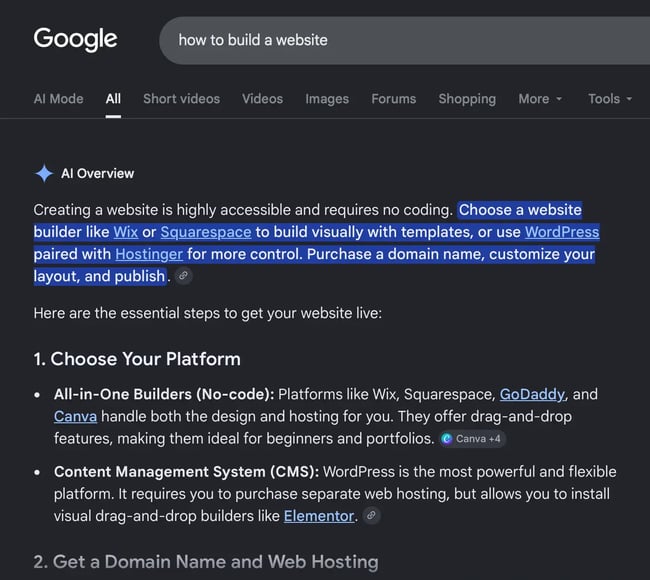
In reality, this is just a variation of the content marketing best practices I’ve seen in my own work for years. Clear page structure on a website makes it easier for human users to navigate and understand. Many of those same structural best practices (such as using clear headings and dividers or incorporating lists or bullet points to make information easy to understand) similarly influence how helpful your content is for AI tools.
As we move further into the AEO age, it’s not just about having high-quality information about your site, but about ensuring it is organized in a way that makes it more likely to be surfaced by AI. Tools like the Adobe AI Content Visibility Checker offer a quick way to see how easy it is for AI to cite your website. By adjusting your content’s organization to be more AI-friendly, you can greatly improve your chances for discoverability.
4. Your content is only as good as the information behind it.Strong AI-generated content starts long before anyone writes a prompt. If the source material you’re providing is weak, the AI-generated content is going to fall flat, too. Accurate data keeps your messaging consistent across every page, so that no matter which page an AI draws from to provide an answer, you can be confident in its outputs.
This ties back to making sure your data is accurate and up to date, but it also covers the quality of the writing used to present that content. I love this article from Harvard Business Review, which highlights how poor grammar and jargon can make something as simple as a toaster unnecessarily complicated.
If you can’t communicate clearly, in a way that your everyday customers would understand, you won’t be able to communicate in a way that gives good information to AI, either. Strong source material for AI chatbots and tools depends just as much on clear, high-quality writing as on accurate information. Clean up your content, and AI will be able to provide worthwhile info from you to your customers.
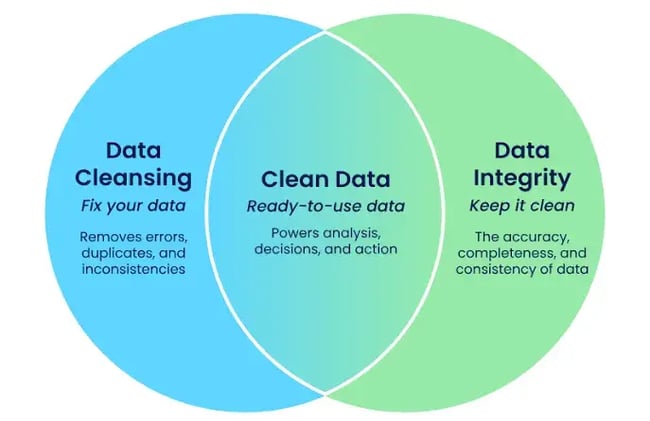
5. Small data problems become big AI problems.The biggest reason you need to clean up your website data and content is because of what AI can do with those issues. AI isn’t going to fix these problems. Instead, it treats them as valid data points that it uses for its own outputs.
If your website has a bunch of tiny data problems, AI will scale them up, just like it would with high-quality data. Those tiny errors can spread quickly and begin affecting your customers sooner than you realize. Fixing and standardizing data is essential.
Depending on the scope of your data, it can be helpful to use platforms like EY, which analyzes 50% of Fortune 500 datasets annually to transform them into AI-ready assets. Structuring this fragmented data reduces the risk associated with your own internal AI implementation. It helps internal-facing AI gather relevant insights from your website so you can make better optimizations for external-facing initiatives.
Regularly auditing your data to fix issues before they affect your customers is crucial. It’s way easier to fix your data foundation than it is to potentially try to correct thousands of AI outputs. Make sure existing data is AI-ready and that you have systems in place to ensure new data and information are equally valid.
6. The companies getting the most from AI started with better data.The companies that are currently getting the most from AI — both for their websites and other parts of their business — gave themselves a head start because they had high-quality data and well-organized information.
For example, Amazon’s capital expenditures have skyrocketed due to its AI investments, but at the same time, its use of unified supply chain and shopping data has driven back-end efficiency improvements, giving it a massive lead in utilizing AI features on the customer-facing sections of its website.
This type of organized data makes it far easier to adopt new AI tools. This also creates more opportunities for future AI implementations. As these companies continue to improve their existing information, they will likely see even greater gains.
Time to get your data ready.Now, if your website data isn’t where it needs to be yet, playing catch-up can feel daunting. But if there’s one thing I’ve learned through my work as a growth strategist, it’s that you’re rarely so far behind that you can’t catch up.
This is especially true when it comes to making your website AI-ready. Cleaning up your data and content so they provide AI with good information can be challenging, but it’s worth the task. You’ll be better equipped to use AI to optimize internal KPIs and deliver a more useful customer-facing experience.
| # | Наименование новости | Тональность | Информативность | Дата публикации |
|---|---|---|---|---|
| 1 | AI Overviews are killing the web search, and there's nothing we can do about it | 0 | 17.47 | 07-02-2026 |
| 2 | Why website growth teams are suddenly talking to their CFOs | 0 | 10.42 | 10-08-2026 |
| 3 | ИИ произвел настоящую революцию в SEO. Если раньше для сайта ... | 0 | 7 | 02-07-2026 |
| 4 | 7 AI Myths That Keep Your Business From Growing | 0 | 8.06 | 22-07-2026 |
| 5 | Website development SEO: Best practices guide | 0 | 15.1 | 13-08-2026 |
| 6 | Мнения: ИИ лишает людей видимости | 0 | 7.62 | 26-07-2026 |
| 7 | Your AI Traffic Is Hiding: A Practical Guide to Tracking ChatGPT, Claude, and More | 0 | 11.9 | 22-06-2026 |
| 8 | AI Website Builders: How They Work and Which to Use | 0 | 5.63 | 10-06-2026 |
| 9 | How AI is redefining the way we find content | 0 | 6.22 | 27-01-2026 |
| 10 | Introducing AI Visibility: Track How Your Site Appears in AI Search | 0 | 4.76 | 07-07-2026 |