Просмотр новости
Найдите то, что Вас интересует
 Спутники
 РН
РН SpaceX
 Роскосмос
 NASA
NASA
СпутникиРНSpaceXРоскосмосNASAIn July 2025, Greece, Türkiye and Cyprus experienced one of the most devastating months of wildfires in recent years, fueled in Greece by a record heatwave above 45C, drought, and strong winds (IFRC, 2025).
In July 2025, Greece, Türkiye and Cyprus experienced one of the most devastating months of wildfires in recent years, fueled in Greece by a record heatwave above 45C, drought, and strong winds (IFRC, 2025).
According to the General Directorate of Forestry, 612 forest fires erupted in June alone—rising to 624 by early July (Anadolu Agency 2025). According to MODIS burned area data, as many as 177 forest fires occurred in Turkey in July alone, devastating approximately 60,000 hectares of land. The most affected by the 2025 wildfires in Turkey are the western and northwestern provinces such as Izmir, Bursa, Çanakkale, Manisa, Bilecik, and Hatay in the southeast. Major cities like Izmir and Bursa saw mass evacuations, and both urban and rural communities were directly threatened as fires engulfed villages and approached the outskirts of cities. More than 50,000 individuals were evacuated nationwide between late June and July due to wildfires spreading rapidly, especially around Izmir and Bursa.
In total, at least 17 lives were lost, including 10 firefighters and rescue workers operating in Eskişehir in northwestern Türkiye, who died as extreme winds closed in on their exit route (Anadolu Agency 2025, Echo Flash, 2025, Al Jazeera, 2025). Many firefighters continue to work in difficult conditions trying to control the widespread blazes.
In Türkiye, particularly across the Aegean and Mediterranean regions, the dominance of highly flammable Calabrian pine (Pinus brutia Ten.) forests, whose cones can disperse seeds over wide areas during high-intensity fires, further exacerbates wildfire spread while simultaneously enabling post-fire regeneration. In contrast, fires occurring in the southeastern regions are predominantly attributed to stubble burning practices in agricultural fields.
In Greece, fires swept through Attica, Crete, Evia, and Kythera in Greece, forcing the evacuation of at least 32,000,- including 5,000 tourists on Crete (IFRC, 2025; Le Monde, 2025). Tens of thousands of acres of farmland, homes, and resorts were destroyed, with half of the island of Kythera burned (Giannopoulos, 2025). At least 13 firefighters were injured, and widespread property losses disrupted daily life and tourism.
Cyprus, too, experienced its worst wildfires in decades. Intense heat, wind, and drought conditions sparked massive fires north of Limassol, leading to the tragic deaths of two people fleeing the village of Monagri. Approximately 125 square kilometers—about 1% of the island—were destroyed, forcing evacuations from 14 villages (Euronews, 2025; Reuters, 2025).
At the time of writing, the fires were still ongoing, with new major events reported in August across Greece, killing one person and leading to what was called one of the worst days of the summer (BBC, 2025). Five major fires have already burned nearly 19,800 hectares, including 7,200 hectares of the already impacted Chios island (12 August), more than 3,200 hectares around Patra (15 August), 1,500 hectares of vegetation near Lavrio in East Attica (8 August), 2,500 hectares of vegetation on Zakynthos (15 August), and over 5,200 hectares of in Preveza, Ipiros (12 August) (BBC, 2025).
To analyse whether and to what extent human-induced climate change exacerbated these conditions and what role vulnerability and exposure played in the historic event, researchers from Türkiye, Greece, the Netherlands, Sweden, Denmark, the United States and the United Kingdom undertook an attribution study on the fire weather conditions as well as the preceding dryness.
While the summer months June to August are usually the months with most fires, the fire season in the so-called biogeographic Mediterranean region, including most of Türkiye west of 38 degrees and Greece east of 17 degrees. The region has similar vegetation and fire behaviour and includes most of the affected areas.
To capture the extent and duration of the extreme fire weather across the region, we will use the cumulative daily severity rating (DSR). The DSR is a scaled power transformation of the Canadian Fire Weather Index (FWI), and reflects how difficult a fire is to suppress once ignition has occurred; it is commonly used for assessing fire weather on multi-day timescales. In addition we calculate the Vapour Pressure Deficit (VPD) which refers to the difference between the amount of moisture the air can hold and the amount it actually holds. In simple terms, it shows the drying effect on vegetation due to hot and dry air, and is a measure of acute fire weather risk. In addition to these two fireweather metrics, on 3 (DSR) and 7 (VPD) day timescales, we also analyse whether there is a trend in rainfall in the winter preceding the fire season (October to April) and whether the weather patterns at the time most fires started, of a ridge of high pressure over Greece with winds coming from the North has changed in its likelihood of occurrence.
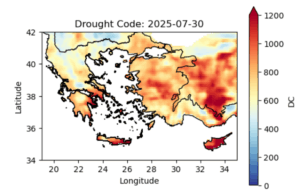
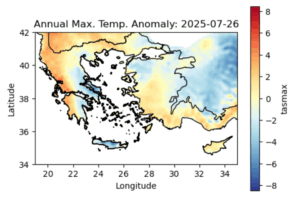 Figure 1: Left, the drought code, an indicator of the drought conditions in the regions of the fires considered here on the 30th July, 2025. Right, the maximum daily temperature on 26th July, 2025, compared to the average annual maximum temperature in the 1990-2020 period.
Main Findings
Figure 1: Left, the drought code, an indicator of the drought conditions in the regions of the fires considered here on the 30th July, 2025. Right, the maximum daily temperature on 26th July, 2025, compared to the average annual maximum temperature in the 1990-2020 period.
Main Findings