Просмотр новости
Найдите то, что Вас интересует
 Спутники
 РН
РН SpaceX
 Роскосмос
 NASA
NASA
СпутникиРНSpaceXРоскосмосNASAThe Venice Biennale, often described as the Olympics of the art world, has long served as more than an exhibition. It acts as a cultural barometer a place where shifts in aesthetic...
The Venice Biennale, often described as the Olympics of the art world, has long served as more than an exhibition. It acts as a cultural barometer a place where shifts in aesthetics, politics, technology and collective anxiety begin to surface before entering the mainstream.
But this year, the Biennale became defined less by individual artworks than by the tensions surrounding them.
Opening week was marked by protests, political disputes, resignations and debates over legitimacy itself.
The return of the Russian Pavilion after years of absence, controversies surrounding the Israeli Pavilion, Australia’s withdrawal and later reinstatement of Khaled Sabsabi, and reports of jury resignations tied to objections over evaluating certain national pavilions transformed Venice into something larger than an art exhibition.
For decades, the art world has debated how political art should be and how much space should remain for aesthetics alone. Venice 2026 suggested that distinction may no longer hold.
Art is no longer observing political and cultural conflict from a distance. Increasingly, it is becoming one of the arenas in which those conflicts unfold in real time.
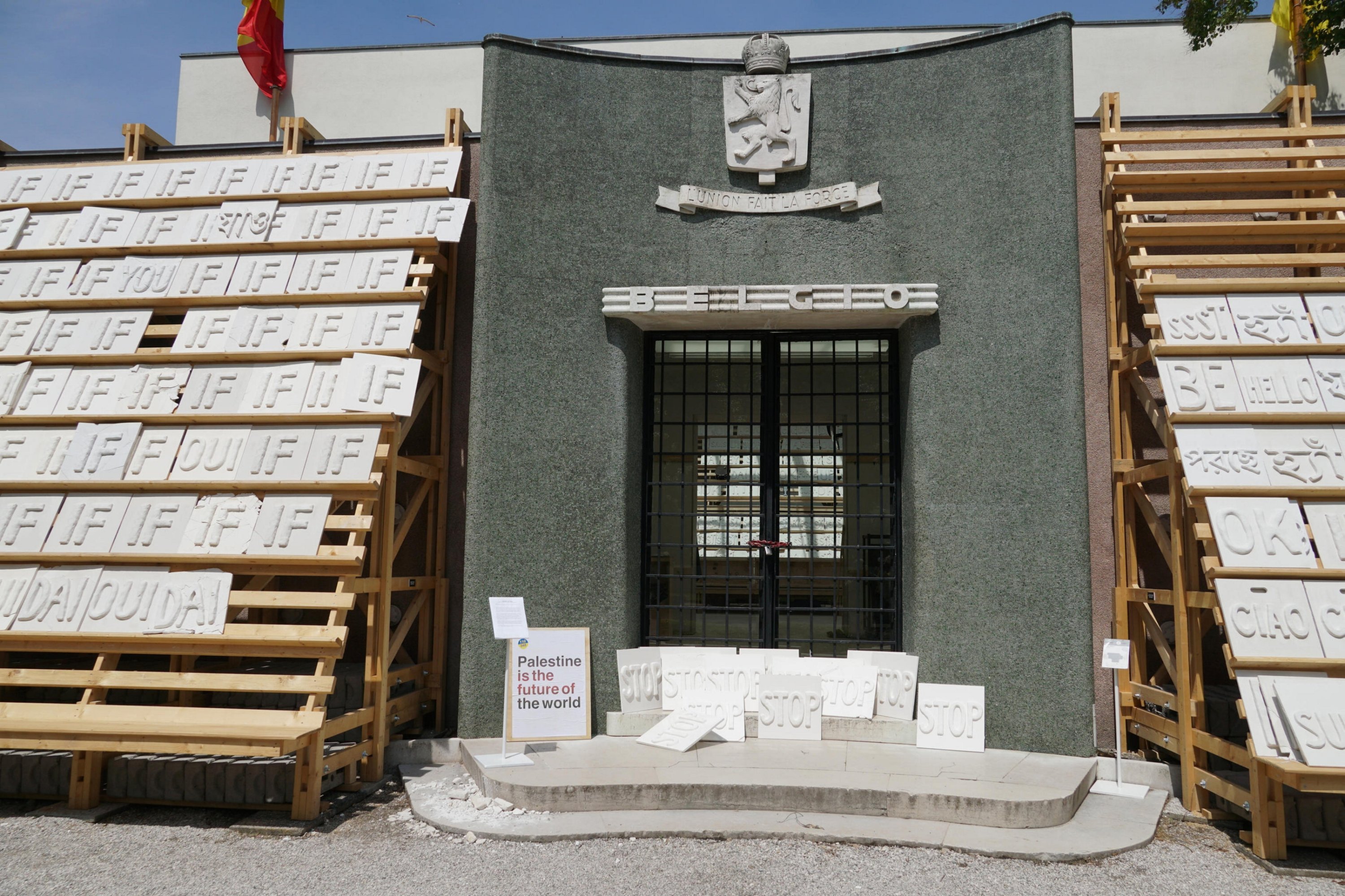 Posters and signs in support of Palestine are displayed on the door of the Belgian pavilion, which is closed to the public due to a pro-Palestine strike prior to the 61st Venice Art Biennale, Venice, Italy, May 8, 2026. (EPA Photo)
In previous editions, themes such as migration, fragility, displacement and nomadism were often discussed inside highly luxurious environments, creating a visible contradiction between subject matter and atmosphere.
Conversations about collapse unfolded alongside collector dinners, private yacht events and market speculation.
This year felt different.
Reality entered the room.
The most powerful pavilion at Venice may not have belonged to any country at all. It may have been reality itself.
The shift also raised a broader question for the future of large-scale international exhibitions: if geopolitical legitimacy becomes inseparable from cultural participation, which countries or institutions will audiences demand to exclude next?
And can the art world continue presenting itself as politically neutral while operating inside increasingly polarized global conditions?
Beyond politics, another strong signal emerged throughout the Biennale: the return of the body.
Perhaps unsurprisingly, this shift arrives at a moment of global emotional exhaustion.
Audiences today begin almost every morning with political crisis, war footage, economic anxiety and algorithmically amplified outrage. In such an atmosphere, the body itself starts to feel like both an escape and proof of reality.
The attention surrounding Florentina Holzinger and the Austrian Pavilion reflected more than shock value or spectacle.
In a cultural moment dominated by artificial intelligence, synthetic imagery, filters and algorithmic perfection, the physical body has regained unusual power.
Not the idealized body, but the vulnerable, excessive, risky and imperfect one.
Holzinger’s performances marked by physical extremity, nudity, danger and sensory intensity reminded audiences of something digital culture often suppresses: the unpredictability of being human.
The body felt fragile again. Fallible again. Real again.
That may also explain why these performances spread so rapidly across social media despite standing in opposition to polished digital aesthetics.
In the AI era, audiences are not only nostalgic for authenticity. They are increasingly nostalgic for physical intensity itself.
The return of the body did not stop with the performer. Increasingly, it extended toward the audience itself.
That impulse appeared elsewhere across the Biennale.
The Japanese Pavilion asking visitors to carry dolls while moving through the exhibition transformed viewers into participants rather than spectators.
Interactivity is no longer simply a curatorial device.
In an era of infinite scrolling and endless visual consumption, memorability increasingly depends on participation.
Aesthetics alone are no longer enough.
For cultural work to endure today, it must create psychological, emotional or physical involvement.
The exhibition must happen to the viewer, not simply in front of them.
The Biennale’s relative distance from artificial intelligence may have been the clearest signal of all.
At a moment when AI dominates nearly every economic, political and cultural conversation from governments to ordinary daily life Venice appeared surprisingly cautious about placing artificial intelligence at the center of its curatorial language.
That absence felt significant.
The faster technology advances, the more culture appears to move toward tactility, ritual, nostalgia, craft and physical presence.
Rather than producing emotional distance, technological acceleration may be intensifying the search for experiences that still feel materially and psychologically real.
Venice 2026 ultimately revealed something uncomfortable about the current cultural moment: the more artificial the world becomes, the more aggressively people search for reality.
| # | Наименование новости | Тональность | Информативность | Дата публикации |
|---|---|---|---|---|
| 1 | Standout exhibition in Venice: 'Silence' speaks volumes | 0 | 13.89 | 27-04-2026 |
| 2 | Hyperallergic’s Guide to the 2026 Venice Biennale | 0 | 12.14 | 23-04-2026 |
| 3 | Wimbledon 2026: Where sport, style, tradition come together | 0 | 10.97 | 10-07-2026 |
| 4 | The Most Glamorous Journey of 2026: From Paris to the Amalfi Coast by Train | 0 | 11.1 | 19-04-2026 |
| 5 | Where to go when home is too hot: Rome opens cultural havens | 0 | 10.85 | 31-07-2026 |
| 6 | Frieze New York 2026 punta sulla natura come relazione | 0 | 5 | 20-05-2026 |
| 7 | Biennale, il fondo rischi non copre lo stop Ue: accantonati solo 300mila euro | 0 | 10.34 | 22-07-2026 |
| 8 | Wimbledon 2026 ends with historic moments, records | 0 | 15.28 | 15-07-2026 |
| 9 | Mostra del Cinema di Venezia 2026, chi sono i 5 italiani in gara | 0 | 12.53 | 24-07-2026 |
| 10 | Mostra de Venise 2026 : Stéphane Brizé, Cédric Kahn, Nanni Moretti et Werner Herzog en lice pour le Lion d’or | 0 | 15.02 | 23-07-2026 |