Просмотр новости
Найдите то, что Вас интересует
 Спутники
 РН
РН SpaceX
 Роскосмос
 NASA
NASA
СпутникиРНSpaceXРоскосмосNASAhttps://glassphotonics.com/all-products/grey-field-polariscopes/gfp2600-product-line/
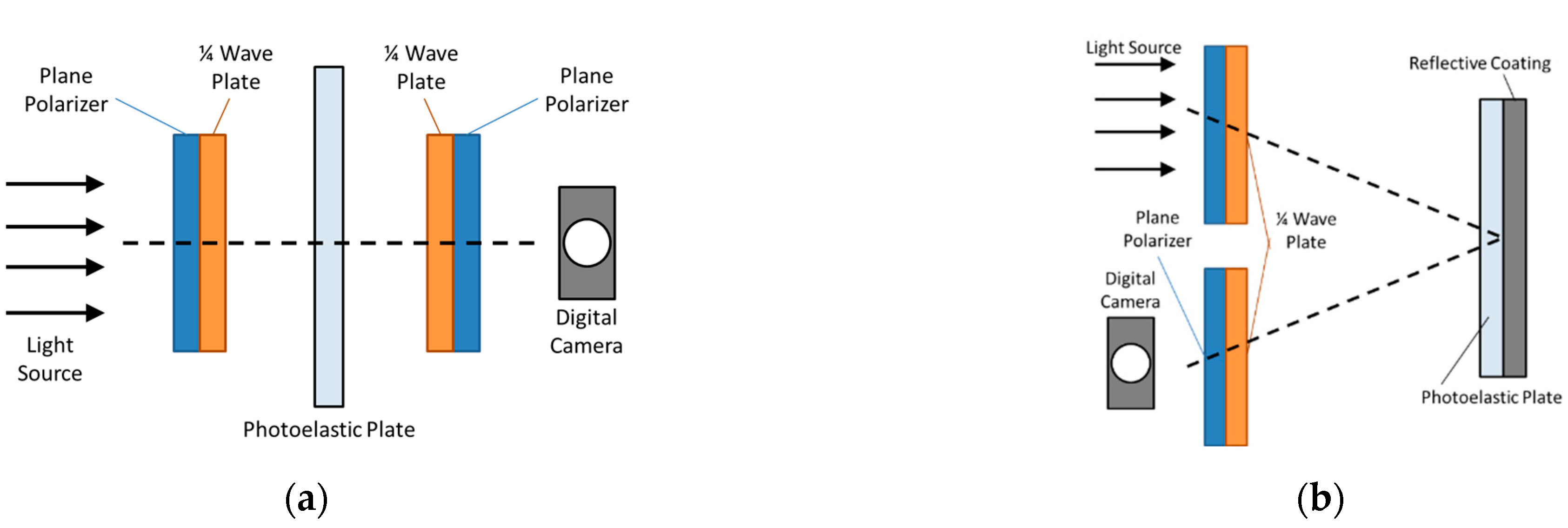
In this link you can see a photoelasticity instrument that is all-in-one, and compact. Traditional photoelasticity (left hand side, (a), in this picture) is not compact and has an awkward apparatus setup where there are polarising filters in front of the subject specimen , and polarising filters behind the subject specimen. This makes sense for glass, as light transmits through glass and therefore you would need an analyzer and camera/sensor to detect the polarized light that passed through the transparent specimen. But this product is not a traditional photoelasticity apparatus, its like a standalone camera with an integrated polariscope that you can point at glass and suddenly get stress analysis information!
The reason the website says this photoelasticity apparatus is so compact and works is because it uses kaleidoscope optics. (as stated on the product description in the glassphotonics website: " kaleidoscopic optics")
But I don't understand what that is!! And I've tried a literature review and gotten nowhere. Look at fig 1 of this paper if you want a schematic of a kaleidoscope integrated with a polariscope
Is it like reflective photoelasticity? (right hand side (b), in the previous picture). Even then, how are they getting light to reflect off glass, glass is transparent so why would light be reflected?
And if light is transmitted through and there is nothing to receive the transmitted light through the other side of the transparent glass, how are they receiving any polarized light that's been through the glass??
There is this paper published by stress photonics talking about how they used reflective photoelasticity to analyse stress in a car windshield, but they applied a reflective coating/substance in the inner surface of the glass to allow reflection of light. My question is how does the advertised product (the GFP-2600) work, that definitely does not use reflective coatings or require it, because you can see they use the apparatus on float glass freshly manufactured and being transported on rolling pins in the factory fresh from annealing. It is used as in-situ real time stress monitoring. So there is no shot of a reflective coating applied to the float glass there, because it's freshly produced right and why would they ruin the glass with an opaque reflective coating that is constantly spraying float glass?
I'm so confused, I may be very wrong as I am just a layman. Please someone help me out! Or point me in the right direction, I have tried contacting the company themselves but they have ignored me.
Science Advisor
Gold Member
Hi Tom,
For fig 1 of this article, (polariscope with kaleidoscope optics, like the GFP-2600) https://link.springer.com/article/10.1007/BF02428172, how does it receive the reflected light if light in mirrors is reflected at such a large angle? It seems like you would need to have your sensors/receivers a lot farther to the right of the light source to be able to catch the reflecting light.
But in thw GFP-2600, it os just like a video camera apparatus and only has one integrated unit with all the working stuff inside. And no analyser filter needed to be outside of the camera system.
I think I just need to wrap my head around this to get it, so in the paper it says that the objective lens was "produced by sectioning a conventional convex lens into quadrants and separating the quadrants by a small amount". And the objective lens seems to act like a beam splitter? Because two light beams emerge after passing through it somehow (I don't understand that).
I also don't get the part I highlighted with the red arrows, light is shone onto the specimen and there are two light beams reflected off it separated by roughly 30 degrees? If there is one light source how did 2 light beams get reflected off the specimen and in two different directions?
Science Advisor
Gold Member
| # | Наименование новости | Тональность | Информативность | Дата публикации |
|---|---|---|---|---|
| 1 | How does a cloud chamber respond to 2-slit interference? | 0 | 10 | 13-08-2026 |
| 2 | What happens to a fluid drop in a vacuum? | 0 | 7.9 | 20-08-2025 |
| 3 | New contactless method reveals how mirror-image materials respond differently to light | 0 | 8.13 | 11-08-2026 |
| 4 | Are classical optics and quantum mechanics double slit experiments fundamentally the same? | 0 | 10 | 15-08-2026 |
| 5 | Эксперимент: Имеем две поверхности отражающие свет: в изогнутом и плоском ... | 0 | 5.1 | 04-08-2026 |
| 6 | Special relativity and diffracting beams | 0 | 5 | 04-06-2026 |
| 7 | What Medium Does Light Travel Through in Space? | 0 | 10 | 15-08-2026 |
| 8 | A question about special relativity | 0 | 5 | 21-05-2026 |
| 9 | I don't understand the Michelson–Morley experiment | 0 | 10 | 01-09-2026 |
| 10 | Why Do Events Freeze For Me at the Speed of Light? | 0 | 5 | 18-12-2025 |