Просмотр новости
Найдите то, что Вас интересует
 Спутники
 РН
РН SpaceX
 Роскосмос
 NASA
NASA
СпутникиРНSpaceXРоскосмосNASABerlin-based company GEFERTEC has launched arcTitan, a wire-arc additive manufacturing (WAAM) system built specifically for titanium processing, combining a fully enclosed inert gas atmosphere with a plasma-based deposition process. The company says the system achieves stable, reproducible process control by holding oxygen levels inside the build chamber to between 10 and 15 parts per million…
Berlin-based company GEFERTEC has launched arcTitan, a wire-arc additive manufacturing (WAAM) system built specifically for titanium processing, combining a fully enclosed inert gas atmosphere with a plasma-based deposition process. The company says the system achieves stable, reproducible process control by holding oxygen levels inside the build chamber to between 10 and 15 parts per million throughout the entire build.
Purpose-built for a difficult material
Titanium’s high strength-to-weight ratio and corrosion resistance make it a preferred material for aerospace and energy applications, but its sensitivity to atmospheric contamination during processing has long complicated additive workflows. GEFERTEC’s answer is a sealed build chamber flooded with shielding gas, removing the need for external enclosures or auxiliary gas systems, paired with a plasma-based arc process the company says allows tighter control over heat input and more consistent part quality.
“The greatest challenge in the additive manufacturing of titanium is ensuring reproducible process conditions,” said Johannes Zuckschwerdt, GEFERTEC’s managing director. “With the arcTitan, we have therefore developed a system in which the build chamber, welding process and peripheral equipment have all been designed specifically for this material.” GEFERTEC says every relevant subsystem, from gas management and sensor technology to wire feeding and parameter control, was engineered around titanium’s specific requirements rather than adapted from a general-purpose machine.
The arcTitan offers a 2 x 0.7 x 1 meter build envelope and a maximum deposition rate of 3 kg per hour, and GEFERTEC describes the system as modular, allowing configurations to be tailored to individual end users.
GEFERTEC positions arcTitan as being of particular interest to aerospace and energy companies, two sectors where titanium’s weight and corrosion advantages are most commercially valuable and where certification standards make repeatable process conditions especially important.
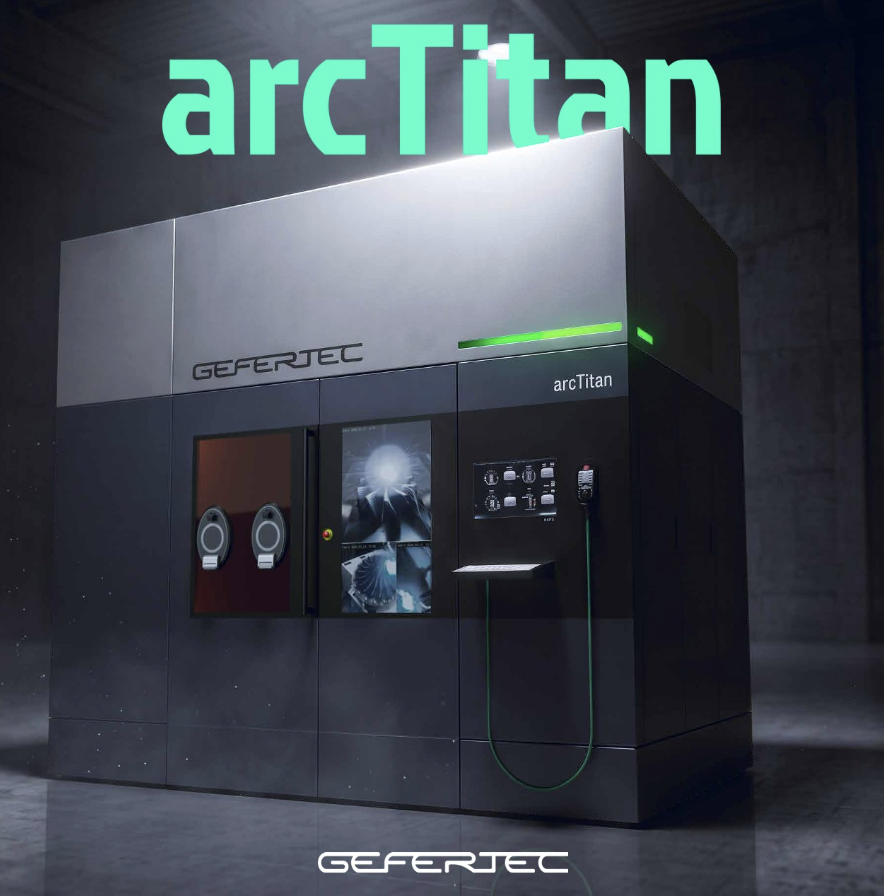 arcTitan, a Sealed-Chamber WAAM System Built for Titanium. Image via GEFERTEC.
Part of a four-machine WAAM family
GEFERTEC positions arcTitan as one tier in a broader machine lineup rather than a one-off product. The company’s current range spans four systems: the arc10X, a versatile industrial platform for general WAAM production; the arc80X, built for larger components with build volumes up to 8 m³; arcTitan, purpose-built specifically for titanium, aluminum, and nickel-based alloys; and arcLab, a smaller, budget-oriented system aimed at research and training environments.
All four share a common feature set, including GEFERTEC’s 3DMP process monitoring, automated ignition-error correction, and Siemens SINUMERIK ONE control, and the company describes the whole range as CE-certified, scalable, and built to integrate into existing manufacturing workflows.
That structure suggests arcTitan isn’t a standalone experiment but the reactive-material tier of a segmented product strategy, where customers select a machine based on build size and material rather than buying one general-purpose system and configuring it after the fact. GEFERTEC has not disclosed when arcTitan will be commercially available or which customers, if any, are already testing the system.
 arcTitan, a Sealed-Chamber WAAM System Built for Titanium. Image via GEFERTEC.
Specializing the Machine to Win the Material
GEFERTEC’s strategy with arcTitan is to stop treating titanium as an add-on option box and instead build a standalone system engineered end to end for one material. That matters because titanium’s biggest AM adoption barrier is process repeatability under regulatory scrutiny, and aerospace and energy buyers are more likely to qualify a dedicated system than a general machine with a titanium mode.
Other WAAM specialists have followed the same logic of narrowing focus to win high-value titanium work. Cranfield University spin-out WAAM3D built its reputation on exactly this kind of material-specific engineering, showcasing a titanium tank for aerospace manufacturer Thales Alenia Space that saved 200 kg of material, cut costs by 65%, and reduced CO2 and energy use by 80% compared with conventional processes.
Norsk Titanium took a similar path from the metal-supplier side rather than the machine-builder side: Spirit AeroSystems partnered with Norsk Titanium to produce titanium parts for Boeing aircraft using Rapid Plasma Deposition, a wire-fed DED variant, demonstrating the approach at scale for large aerospace structures.
GEFERTEC’s bet is that owning the full system, rather than the material expertise alone, is what turns titanium WAAM from a research capability into a qualifiable production process.
3D Printing Industry is inviting speakers for its 2026 Additive Manufacturing Applications (AMA) series, covering Energy, Healthcare, Automotive and Mobility, Aerospace, Space and Defense, and Software. Each online event focuses on real production deployments, qualification, and supply chain integration. Practitioners interested in contributing can complete the call for speakers form here.
To stay up to date with the latest 3D printing news, don’t forget to subscribe to the 3D Printing Industry newsletter or follow us on LinkedIn.
Explore the full Future of 3D Printing and Executive Survey series from 3D Printing Industry, featuring perspectives from CEOs, engineers, and industry leaders on the industrialization of additive manufacturing, 3D printing industry trends 2026, qualification, supply chains, and additive manufacturing industry analysis.
Featured image shows arcTitan, a Sealed-Chamber WAAM System Built for Titanium. Image via GEFERTEC.