Просмотр новости
Найдите то, что Вас интересует
 Спутники
 РН
РН SpaceX
 Роскосмос
 NASA
NASA
СпутникиРНSpaceXРоскосмосNASAIndia’s competitive-exam coaching industry is entering a new phase as Prime Minister Narendra Modi’s free online coaching push meets a rapidly expanding private test-prep market. With the $14.8 billion industry projected to reach $23–26 billion by FY30, major players are already moving beyond Kota and other traditional hubs into Tier-2 and Tier-3 cities. The shift could make preparation more accessible for students, but also intensify competition among coaching companies as they balance digital access with the demand for quality physical classrooms, teachers and infrastructure.
Prime Minister Narendra Modi on India’s Independence Day last week announced a plan to provide free online coaching to youth preparing for competitive examinations.
The push to take competitive-exam coaching online could reshape India’s education economy, potentially loosening the grip of Kota, Delhi and other coaching hubs that have long drawn millions of students seeking a shot at government jobs and top colleges.
The government plans to offer free online coaching for competitive exams while training 10 million young people in artificial intelligence, potentially shifting a high-cost, city-centric system towards the digital realm.
Also Read: PM Modi announces AI skilling for one crore youth, free coaching in Independence Day address
A $14.8 billion exam-prep economyThe stakes are significant for an industry that has already grown into a large education market. According to Redseer Strategy Consultants, India’s test-preparation market is estimated at about $14.8 billion in FY26 and is projected to expand to $23–26 billion by FY30, growing at an annual rate of 12–15%.
For students who cannot afford to move away from home, or pay for private coaching, the announcement could make competitive-exam preparation more accessible, said Nitin Kukreja, CEO, ALLEN Career Institute Pvt. Ltd.
“The Prime Minister’s announcement will prove to be a valuable opportunity for the youth. It will make the path to competitive examination preparation easier and more accessible for students across the country,” Kukreja said.
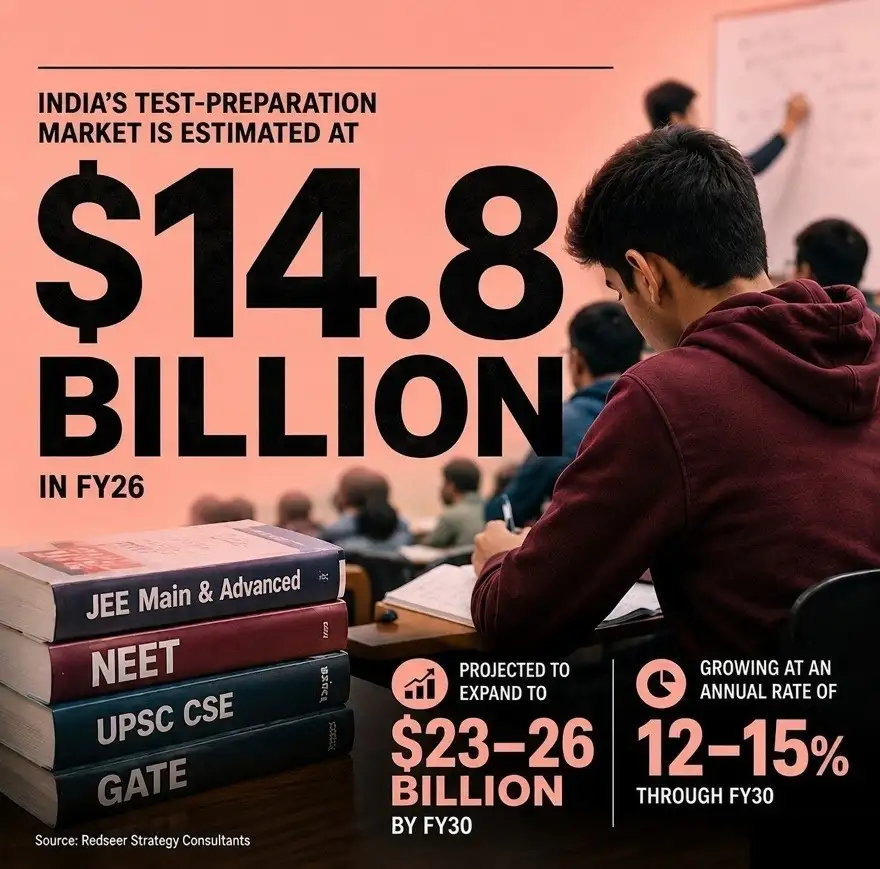
India's test preparation market is estimated at $14.8 bln in FY26
However, the impact may be more of a mixed bag for coaching centres. It remains an exciting wait also to see what the Indian government's new plan does for particularly the established big names, which mint crores of money every month and raise big investments, in their journey to take the centres beyond Kota and other such hubs.
PM Modi's coaching centres call & impact for businesses“For coaching centres initially it may result in a dip of business but it also opens windows of opportunity in the form of public private partnership and high quality mentoring. I still do not see any substitute for teacher driven learning,” said Prof DP Vajpayee, director, online coaching platform Dias Technologies/Dias India Edutech.
Also Read: Education minister reviews implementation of PM's free online coaching initiative
The announcement comes as the private coaching industry is undergoing a transformation of its own, with large players expanding beyond traditional hubs and taking coaching closer to students.
From Kota to the student’s doorstepThe shift is already visible in the expansion plans of major coaching companies. Aakash Educational Services Ltd (AESL) is targeting smaller markets, while ALLEN has also pointed to growing demand from students outside the traditional coaching hubs.
AESL launched a pan-India campaign in April that included a “Career Rath” scheduled to visit 251 cities across 28 states, underlining the importance of Tier-2 and Tier-3 markets in its expansion strategy, according to an ET Brand Equity report.
Kanika Kumar Nijhawan, senior vice president, marketing, AESL, told ET Online that the shift towards smaller cities is structural.
“Today’s students in tier-2 and tier-3 cities aspire to achieve the same levels as their peers in metropolitan cities, and they are actively pursuing the availability of good coaching without having to move out,” she said.
Rising family incomes, greater awareness of career options, improving digital connectivity and growing aspirations have together helped expand the market for quality coaching, Nijhawan said. A wider pool of students across the country is also aspiring to enter professional degrees such as medicine and engineering, she added.
Also Read: Citywide safety inspections at coaching centres; hundreds of buildings sealed: Delhi Mayor
ALLEN has also pointed to the growing pool of NEET aspirants in Uttar Pradesh, which it said has now become the largest state in terms of NEET exam takers.
The trend is also visible in ALLEN’s student outcomes. In 2025, 51% of its IIT selections and 63% of medical college selections came from students belonging to Tier-Z towns, based on the Pay Commission’s classification of towns, the company told ET Online.
The expansion of smaller-city markets does not, however, mean that traditional hubs such as Kota are going away. Aakash said such centres would continue to serve their purpose, even as students gain access to organised local coaching and technology-enabled learning closer to home.
The classroom remains importantThe expansion into smaller cities does not necessarily mean a move away from physical coaching.
Companies continue to invest in centres, suggesting that classrooms remain an important part of the model even as students get more options closer to home.
For students and parents, a physical centre offers a fixed study routine, face-to-face interaction with teachers, doubt-solving and the competitive environment that comes from studying alongside peers.
That is why Aakash believes there may not be one model that works for everyone.
“Good physical centres should always be valued since they offer structured learning and mentoring as well as interactions among peers,” Nijhawan said, adding that digital tools can support practice and revision, while school partnerships can improve accessibility.
ALLEN, meanwhile, operates its own centres, saying this allows it to maintain education quality and safety standards. The company is also extending partnerships with schools and operates an online-first app.
It does not favour the franchise model, arguing that education quality and safety parameters can be harder for the institution to control when centres are operated by franchisees.
The government's programme, however, could bring more students into the digital learning ecosystem, said Amitabh Sen Gupta, senior director, Manav Rachna Online.
“Government programmes can provide learners with a starting point, while EdTech platforms can support them with structured courses, expert guidance, practical learning and continued academic support,” he said.
But taking coaching to every town isn’t easyFor coaching companies, the challenge is more than simply opening more centres. It is also about ensuring that a student in a smaller city gets a learning experience comparable to what is available in Kota or Delhi.
Finding good teachers, setting up quality infrastructure, understanding local requirements and earning parents’ trust can all take time.
ALLEN said the availability of high-quality teachers and infrastructure can initially be a challenge in smaller towns. The company has a teacher-training programme capable of training up to 1,000 teachers a year, along with standardised processes for infrastructure, safety and compliance.
The company said institutions that invest in governance and processes would be better placed to sustain expansion.
Aakash similarly said growth in smaller cities requires balancing convenience with consistency in academic quality. Attracting and training competent teachers, maintaining teaching standards and understanding local requirements are among the challenges, it noted.
Regional coaching institutes continue to play a role in the expanding market, particularly because of their understanding of local communities and education needs, according to Aakash.
At the same time, ALLEN said national institutions can bring greater investments in teaching resources, pedagogy, technology, infrastructure, safety and compliance, as well as exposure to national-level competition.
The challenge, then, is to expand without allowing quality to become uneven. Both companies highlighted the difficulty of attracting and training good teachers and maintaining consistent academic standards as they move into smaller cities.
The government's free coaching initiative therefore enters a market that is already expanding beyond its traditional hubs. For students, it could provide another way to access preparation without leaving home; for private coaching companies, it comes as they are already adapting to a more geographically dispersed market.
| # | Наименование новости | Тональность | Информативность | Дата публикации |
|---|---|---|---|---|
| 1 | Nutraceuticals, get it right from the start | 0 | 8.4 | 12-08-2026 |
| 2 | India’s space industry hunts for its SpaceX moment | 0 | 6.97 | 03-07-2026 |
| 3 | India's private space industry shoots for the stars | 0 | 6.01 | 17-07-2026 |
| 4 | India’s Eye in the Sky: The Rise of a State-Deep Tech Startup Space Partnership | 5 | 7 | 05-06-2026 |
| 5 | India roundup: R&D hubs, domestic tooling, OSAT investments, and AI hubs are powering India’s chip push | 0 | 14.21 | 03-08-2026 |
| 6 | From hidden wearables to AI tools: How companies are tackling campus hiring fraud | 0 | 7 | 03-07-2026 |
| 7 | Portfolio careers gain ground as white-collar gig work surges in India | 0 | 7 | 20-06-2026 |
| 8 | India's gig internet workforce to grow to 17-21 million by 2030: Redseer | 5 | 7 | 16-07-2026 |
| 9 | The AI race isn't about bigger models—it's about India | 0 | 6.69 | 21-07-2026 |
| 10 | India’s EV components market set to surge eightfold to ₹3.55 lakh cr by 2032: Report | 7 | 7 | 10-07-2026 |