Просмотр новости
Найдите то, что Вас интересует
 Спутники
 РН
РН SpaceX
 Роскосмос
 NASA
NASA
СпутникиРНSpaceXРоскосмосNASANext Stop: Fast Buses, Better Service identifies 50 priority bus corridors for improvements across the five boroughs and launches the City’s next generation of rapid bus service along five key routes.
Governor Kathy Hochul and Mayor Zohran Kwame Mamdani unveiled “Next Stop: Fast Buses, Better Service,” a sweeping bus action plan to build the next generation of bus service in New York City.
The plan marks a historic partnership between the New York City Department of Transportation (NYC DOT) and the Metropolitan Transportation Authority (MTA) to transform how New Yorkers experience the city’s buses — with investments that will make service faster, more accessible, and more comfortable from curb to destination, according to officials.
Next Stop: Fast Buses, Better Service identifies 50 priority bus corridors for improvements across the five boroughs and launches the City’s next generation of rapid bus service along five key routes.
Together, the Governor and Mayor of New York said these investments will shorten commutes, improve reliability, expand accessibility, and create a bus system worthy of the city that depends on it.
“Every day, millions of New Yorkers rely on buses to get around this city, but for far too long, making their journeys faster and their lives easier has seemed out of reach. That all changes today,” Governor Hochul said. “New York is in the midst of a transit renaissance, with historic investments being made to improve the lifeblood of our city.”
New Yorkers take 2.75 million trips on New York City buses each day, making the system the busiest in the nation — carrying more riders than the bus systems of Los Angeles, Chicago, San Francisco, and Philadelphia combined. But New York’s buses remain the slowest of any major U.S. city, averaging just eight miles per hour.
Improving bus service is central to Governor Hochul and Mayor Mamdani’s promise to make New York City more livable for working people. Bus riders are disproportionately working-class, women, and people of color, and are more likely than subway riders or drivers to live in households earning less than $100,000 annually.
Next Stop: Fast Buses, Better Service identifies 50 priority corridors where NYC DOT and the MTA will target investments to address the city’s slowest and most delay-prone bus routes. Improvements along routes will begin this year.
Five corridors in Brooklyn, Queens, and the Bronx have been selected as the first phase of New York City’s next generation of rapid bus routes. The corridors were selected because they connect New Yorkers to jobs, schools, subway service, and major destinations while supporting current and future housing and economic growth.
Beginning in 2026, NYC DOT and the MTA will advance these projects with dedicated, protected bus lanes, frequent all-day service, upgraded stations with sheltered waiting areas and public space improvements modeled after the best rapid bus systems around the world, said officials.
Bus Reliability, The Rider ExperienceThe MTA will work together to improve service reliability by ensuring scheduled trips are completed, modernizing depot operations, and strengthening bus maintenance.
Through the MTA’s historic $68 billion 2025-2029 Capital Program, fully funded by Governor Hochul and the state legislature in the FY26 Enacted Budget, the authority will purchase approximately 2,500 new buses, replacing 40% of its aging fleet.
The MTA will also implement all-door boarding in 2027, with a complete transition to tap-and-ride.
To make bus stops safer, more comfortable, and more accessible, NYC DOT and the MTA will:
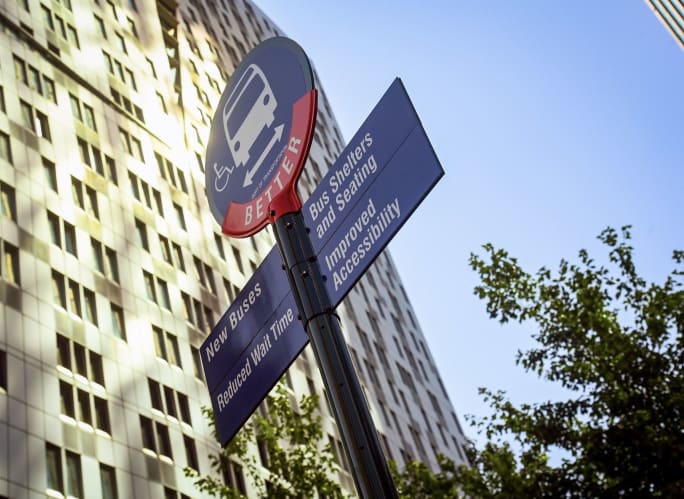
To ensure accountability, NYC DOT and the MTA will publicly release performance data within six to 12 months after projects are completed, measuring impacts on travel times, reliability, and rider experience, while identifying opportunities for further improvements.
Credit:
Marc A. Hermann
Keeping buses moving requires keeping bus lanes free of illegal traffic.
Automated Camera Enforcement (ACE) has increased bus speeds by up to 30% while reducing collisions by 20%.
To build on those gains:
Next Stop: Fast Buses, Better Service also establishes a more robust, rider-centered approach to community engagement.
Working alongside the Mayor’s Office of Mass Engagement (OME) and other City agencies, NYC DOT and the MTA will hold community events, conduct surveys, and partner with advocacy organizations and community groups before the projects begin. Public education campaigns will help riders understand upcoming improvements and service upgrades.
To ensure accountability, NYC DOT and the MTA will publicly release performance data within six to 12 months after projects are completed, measuring impacts on travel times, reliability, and rider experience, while identifying opportunities for further improvements.