Просмотр новости
Найдите то, что Вас интересует
 Спутники
 РН
РН SpaceX
 Роскосмос
 NASA
NASA
СпутникиРНSpaceXРоскосмосNASAFrom political advertising to polling, here are a few tips.

A few days before the June primaries, thousands of Maine voters received a text message encouraging them to support a slate of three Democratic candidates in the race for governor.
“Stand with the slate for a better Maine,” it said. “Troy Jackson, Hannah Pingree and Shenna Bellows have cross-endorsed each other in next week’s Dem primary for governor.”
The message encouraged voters to rank the three candidates in the top spots on their ranked-choice ballots, and included a link to a news story. At the end, the message was signed “VR.”
The lack of clear identification of who paid for and sent the message quickly prompted a complaint to the state from the campaign of competing candidate Nirav Shah. And it likely generated questions from the voters who received the message.
In the next few months, more political text messages will be flooding the phones of Maine voters. So how can you find out who’s sending them when it’s not always clear?
Here are a few things to know about what’s required of the groups behind these messages, and how you can find out more.
Who can send political texts?Political ads, including text messages, can come from candidates or groups supporting them. State law says that text messages sent with the assistance of mass distribution technology must clearly state the name of the person who made the expenditure if the text expressly advocates for the election or defeat of a candidate or contains a link to a website that does so.
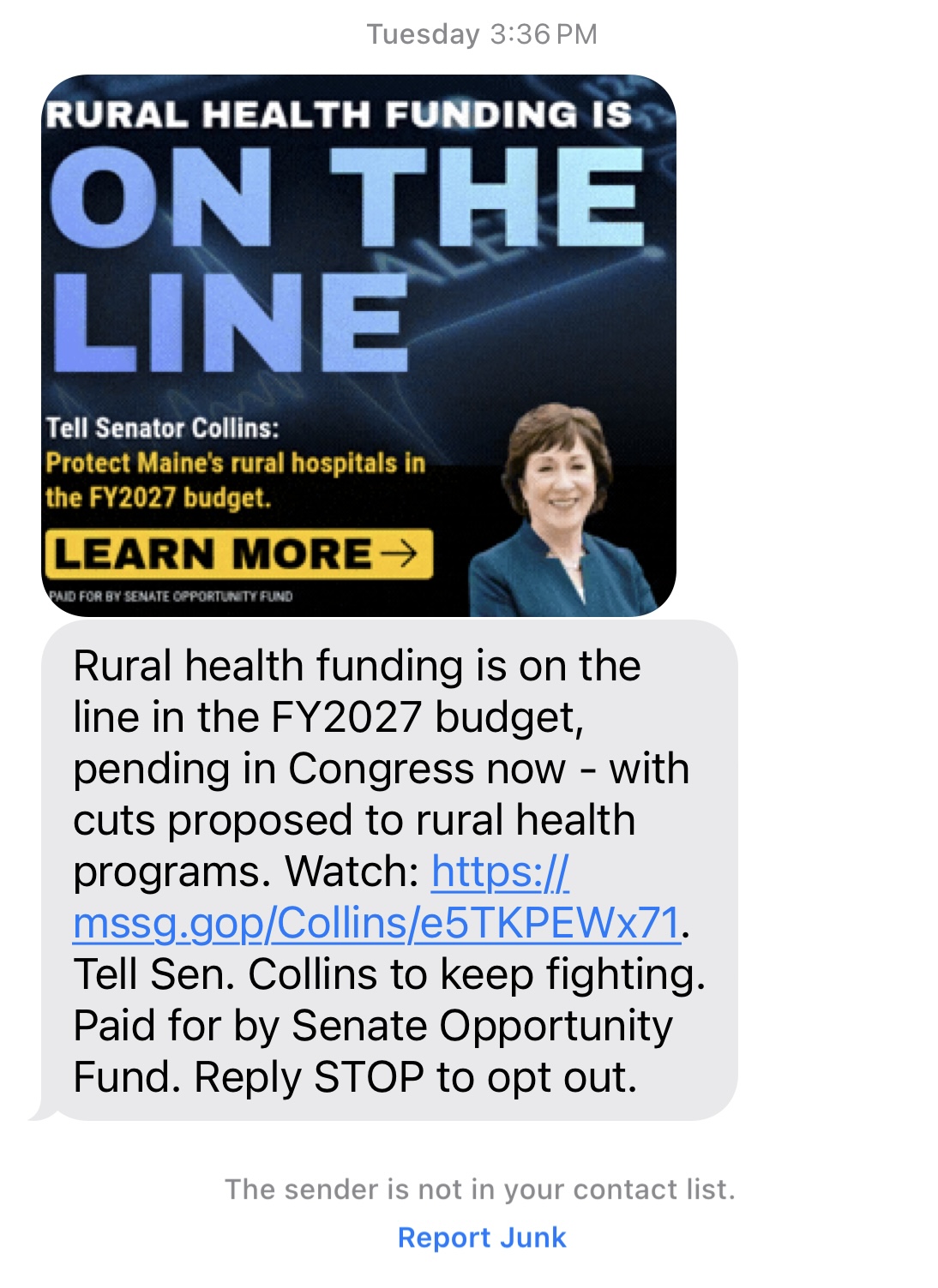 This recent text message ad from the conservative Senate Opportunity Fund includes the disclosure required in state law. (Screenshot)
Any group that raises or spends more than $2,500 in a calendar year to influence a state or local election is required to register with the state as a political action committee. Groups that raise or spend more than $5,000 on a statewide ballot question must register as ballot question committees.
These groups are also required to file campaign finance reports with the Maine Commission on Governmental Ethics and Election Practices. Party committees and candidates’ political committees also must register and file reports detailing their contributions and expenditures.
Registrations and campaign finance reports can be viewed on the ethics commission’s website. In addition to financial information, the filings include the names and contact info for people leading the groups, and information on whether they support or oppose specific candidates or questions.
For federal races, candidates and PACs must register and file reports with the Federal Election Commission. The threshold for these PACs to register is raising or spending more than $1,000 per calendar year. Their reports can be found on the FEC website.
Are there penalties for groups that don’t follow the rules?Yes. Groups that don’t follow the disclosure rules can face financial and legal penalties. In the case of the June 6 text message the Shah campaign complained about, the ethics commission is currently evaluating next steps and whether a penalty should be assessed.
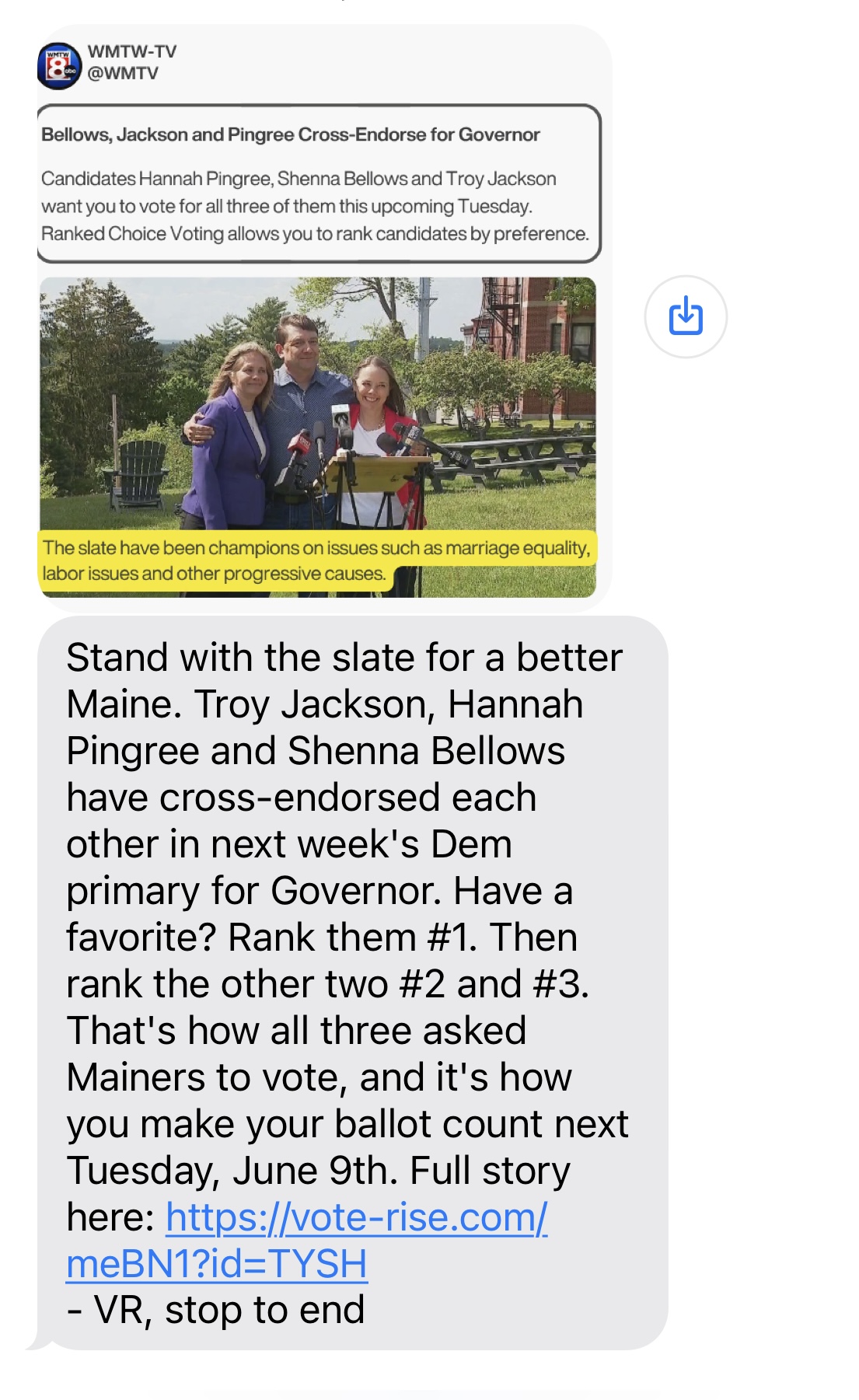 This text message, sent by the group VoteRise, is the subject of a complaint before the Maine ethics commission due to its lack of clear identification of who paid for it. (Screenshot)
VoteRise, the California-based group behind the message, apologized and said it was relying on rules in other states when it sent the message. Because the group’s name was included in the link to the news article, they believed that was sufficient, according to an ethics commission report.
Subsequent messages sent on June 8 and 9 included “Paid for by VoteRise.”
The commission is weighing whether to assess a financial penalty for the lack of disclosure in the first message. Under the law, a financial penalty of up to the amount of the expenditure can be assessed — in this case, $705.
The commission is also looking at whether the group, which is registered with the FEC, should have registered as a PAC with the state as well. The cost for the three text messages totaled just over $2,100, but if additional funds were raised or spent for the purpose of influencing Maine elections, that could put VoteRise over the $2,500 threshold.
A PAC that doesn’t register on time may be subject to a $2,500 fine and assessed additional penalties for a late-filed initial campaign finance report. Penalties for campaign finance violations in Maine can be hefty.
The largest financial penalty assessed by the ethics commission to date was a $500,000 penalty for a group of ballot question committees in 2017 that failed to register and file campaign finance reports related to a statewide initiative to establish a casino in York County. The groups and the state later settled on them paying only $100,000 to avoid litigation.
What about polls and surveys sent via text?Communications for research purposes like polling generally fall outside the types of financial activity that needs to be reported under Maine campaign finance law, so it’s up to the group behind the survey what they want to disclose. State law explicitly excludes polls conducted by phone from the requirement to disclose who paid.
Many pollsters conduct surveys via text message, though there are some downsides, said David Paleologos, director of the Suffolk University Political Research Center. It’s more difficult to get nuanced answers and people often times don’t complete the surveys when they’re sent via text versus conducted over a live call, Paleologos said.
But text polling is also cheaper and can generate more answers more quickly.
When evaluating whether to complete a text survey, there’s no one sign that can tell you how legitimate it is, according to Ashley Koning, director of the Eagleton Center for Public Interest Polling at Rutgers University. But there are some characteristics to look for.
“The right question is not whether the poll arrived by text, but whether the pollster will tell you who conducted it, who paid for it, what exactly they asked, who they sampled, and how they weighted it,” Koning said in an email. “Anyone worth trusting will answer these questions. And if they do, then individuals should absolutely participate in the survey.”
The most reliable polling organizations are usually academic institutions or reputable news outlets, Koning said. The polling group should also give you a way to get in touch, via a website or phone number. And they should never ask you for money, a volunteer commitment or sensitive personal information such as a Social Security number.
Keep in mind it’s not always possible to tell if you are responding to a poll or doing voter identification work for a campaign. That text from an unknown number may be from a company a campaign hired to help them identify supporters, Paleologos said.
“It helps them strategize,” Paleologos said. “Then they’ll say, ‘Let’s take that list of undecideds and send them all direct mail or contact them from the campaign.'”
Just because a survey is being conducted by a campaign or an interest group doesn’t make it illegitimate, Koning said, though respondents might take a look at the types of questions being asked. If they are loaded or one-sided, that’s a red flag.
“Campaigns do serious message testing, and that is real research,” Koning said. “The distinction is whether the sponsor genuinely wants to know the answer or if it is instead intentionally trying to manipulate/spread falsities (often called a ‘push poll’) or fundraise.”
| # | Наименование новости | Тональность | Информативность | Дата публикации |
|---|---|---|---|---|
| 1 | A megadonor from Illinois spent big in Maine politics this year and came up empty | 0 | 36.43 | 17-08-2026 |
| 2 | Who could replace Graham Platner in Maine’s Senate race? Here are the names being floated. | 0 | 5 | 07-07-2026 |
| 3 | Here’s how the Maine convention to replace Graham Platner will work | 0 | 5 | 10-07-2026 |
| 4 | Maine Democrats largely stand by Graham Platner amid D.C. worries | 0 | 35.91 | 06-06-2026 |
| 5 | How each Maine county is picking its delegates to the convention to replace Graham Platner | 0 | 7 | 15-07-2026 |
| 6 | What would Medicare for All mean for Maine, and where do Susan Collins and Troy Jackson stand? | 0 | 35.51 | 13-08-2026 |
| 7 | Why Democrats are running against the ‘Epstein class’ | 0 | 36.43 | 23-06-2026 |
| 8 | Paul LePage discusses Iran war without giving clear take on Trump’s actions | 0 | 35.51 | 13-08-2026 |
| 9 | Maine Democrats buoyed by voter turnout — a troubling sign for Republicans | 0 | 38.14 | 10-06-2026 |
| 10 | 10 candidates to seek 3 Portland council seats | 0 | 40.87 | 27-07-2026 |