Просмотр новости
Найдите то, что Вас интересует
 Спутники
 РН
РН SpaceX
 Роскосмос
 NASA
NASA
СпутникиРНSpaceXРоскосмосNASABackground India guarantees every woman delivering in a public health facility an absolutely free and zero-expense birth, including caesarean section, under the Janani Shishu Suraksha Karyakram. That guarantee sits alongside a conditional cash transfer and a national hospitalisation insurance scheme. Institutional delivery is now near universal, yet households still pay at the point of birth. Policy and implications The 2025 national household health survey records average out-of-pocket medical expenditure of 2,299 rupees per childbirth in a government facility, against 37,630 rupees in a private facility, a category that explicitly includes hospitals empanelled under the national insurance scheme. Reported insurance coverage more than doubled between the two most recent survey rounds while public-facility payment at birth rose in nominal terms. This brief argues that the failure is architectural. An enforceable guarantee requires four elements: a defined benefit, a price, a claim, and a published compliance rate. India’s maternity guarantee has the first only. No facility is paid for honouring it and none is measured against it, so the entitlement operates as an expectation rather than as a financing instrument. The cash transfer, on a rate card set two decades ago, no longer covers the average public-facility bill it was designed to offset. Recommendations Convert the entitlement into a purchased per-case product routed through the existing national claims platform; publish facility-level zero-bill compliance as a routine indicator with a dated national target; fix medicines and referral transport as the two dominant leak points; extend protection across the antenatal and postnatal episode rather than the inpatient admission; and impose zero balance billing on empanelled private obstetric care. Conclusions Because the entitlement promises zero expenditure, any positive figure represents a failure of delivery rather than a question of price inflation.
Policy Brief
[version 1; peer review: awaiting peer review]
https://orcid.org/0000-0003-4906-1405
https://orcid.org/0000-0003-4906-1405
University of North Texas College of Public Affairs and Health Sciences., Denton, Texas, USA
Shyamkumar Sriram
Roles: Conceptualization, Data Curation, Formal Analysis, Funding Acquisition, Investigation, Methodology, Project Administration, Resources, Software, Supervision, Validation, Visualization, Writing – Original Draft Preparation, Writing – Review & Editing
OPEN PEER REVIEW
REVIEWER STATUS AWAITING PEER REVIEW
out-of-pocket expenditure; maternal health financing; financial risk protection; institutional delivery; strategic purchasing; universal health coverage; health insurance; India
Corresponding author: Shyamkumar Sriram Competing interests: No competing interests were disclosed.
Grant information: The author(s) declared that no grants were involved in supporting this work.
Copyright: © 2026 Sriram S. This is an open access article distributed under the terms of the Creative Commons Attribution License, which permits unrestricted use, distribution, and reproduction in any medium, provided the original work is properly cited. How to cite: Sriram S. Free on paper, paid at the bedside: closing the enforcement gap in India's zero-expense maternity entitlement [version 1; peer review: awaiting peer review]. F1000Research 2026, 15:1352 (https://doi.org/10.12688/f1000research.188237.1) First published: 11 Aug 2026, 15:1352 (https://doi.org/10.12688/f1000research.188237.1) Latest published: 11 Aug 2026, 15:1352 (https://doi.org/10.12688/f1000research.188237.1)
India has largely met its coverage objectives for childbirth without meeting the financial protection objectives intended to accompany them. Institutional deliveries accounted for about 96.2 per cent of all births in the 2025 national household health survey, antenatal care reached roughly 98 per cent of women in both rural and urban areas, and postnatal care was reported by 92 and 95 per cent respectively.1 The maternal mortality ratio stands at 87 per 100,000 live births, down only one point from the preceding cycle, and district-level estimates show substantial subnational heterogeneity behind that national average.2,3 On the coverage indicators that dominated two decades of maternal health policy, the transition is essentially complete.
Three instruments were built to make that transition affordable. The Janani Suraksha Yojana, launched on 12 April 2005, pays a conditional cash transfer to women delivering in an accredited facility, at a higher rate in ten designated low-performing states.4 The Janani Shishu Suraksha Karyakram, launched on 1 June 2011, goes considerably further: it entitles every woman delivering in a public health institution to an absolutely free and no-expense delivery including caesarean section, with free drugs and consumables, diagnostics, blood, diet during the stay, transport from home to facility, between facilities on referral and back home again, and exemption from all user charges, irrespective of poverty status, age or parity.5 The Ayushman Bharat Pradhan Mantri Jan Arogya Yojana, launched in 2018, adds hospitalisation cover of up to 500,000 rupees per eligible family per year.6
The maternity guarantee is therefore unconditional, universal within the public sector, and absolute rather than capped. It is the clearest financial protection promise in Indian health care.
In practice the guarantee is not being met. In 2025, average out-of-pocket medical expenditure per childbirth in a government hospital or public health facility was 2,299 rupees, with a median of 801 rupees.1 Under the terms of the guarantee, both figures should be zero.
This brief asks why an absolute statutory entitlement fails to produce the outcome it promises, locates the failure in design rather than in intention or fiscal capacity, and sets out the purchaser levers that would close the gap without new legislation. The analysis is deliberately confined to maternity. India’s general out-of-pocket burden has been examined at length, including earlier work by this author critically evaluating whether insurance-based routes to universal health coverage deliver financial protection to the poor.7 Maternity differs in three respects that make it uniquely tractable: the benefit is absolute rather than a capped package, universal rather than means-tested, and attached to a clinically predictable episode whose inputs can be specified and priced in advance. If financial protection cannot be delivered under these conditions, the constraint is not money.
A health financing guarantee becomes operational only when four elements are present simultaneously. There must be a defined benefit, specifying what the patient is owed. There must be a price, so that the cost of honouring the benefit is known and can be met. There must be a claim, a transaction through which a provider is paid for having honoured it. And there must be a published compliance rate, so that failure is visible and consequential. Remove any one and the guarantee degrades into an expectation borne by the patient.
Table 1 applies this test to India’s three maternity instruments. The result is stark. The entitlement scheme has a benefit definition of exemplary clarity and nothing else. It is funded through general National Health Mission programme heads rather than paid per case, so no facility is made financially whole for supplying free drugs, diagnostics, diet, blood and transport, and no facility is identified when it does not. The cash transfer has a price but no benefit definition anchored to cost. The insurance scheme has price, claim and adjudication, but its benefit boundary is the inpatient admission, which excludes the antenatal and postnatal care the maternity guarantee nominally covers.
The transfer was designed to change where women give birth, not to cover what birth costs, and on its own terms it worked.8 The scale published on the National Health Mission scheme page, 1,400 and 1,000 rupees for rural and urban women in low-performing states and 700 and 600 rupees in high-performing states, is the scale established in the scheme’s 2006 revision.4 Two decades on, with the place-of-birth transition complete, the instrument’s purpose has expired while its rate card has not moved. The rural low-performing-state transfer of 1,400 rupees now sits below the 2,299 rupee average bill a woman incurs in the very facility the transfer was designed to draw her towards.1
Table 2 places the two most recent survey rounds side by side, and Figure 1 shows the divergence directly. Average public-facility childbirth expenditure was 1,410 rupees in 2017 to 2018 and 2,299 rupees in 2025, a nominal increase of about 63 per cent.1,9 Over the same interval reported health insurance coverage rose from about 14 to about 47 per cent of the rural population and from about 19 to about 44 per cent of the urban population.1 Enrolment rose substantially over the same interval without any corresponding reduction in expenditure at the point of birth. This is consistent with earlier national analyses documenting a rising rather than falling burden on institutional delivery over the preceding decade.10,11
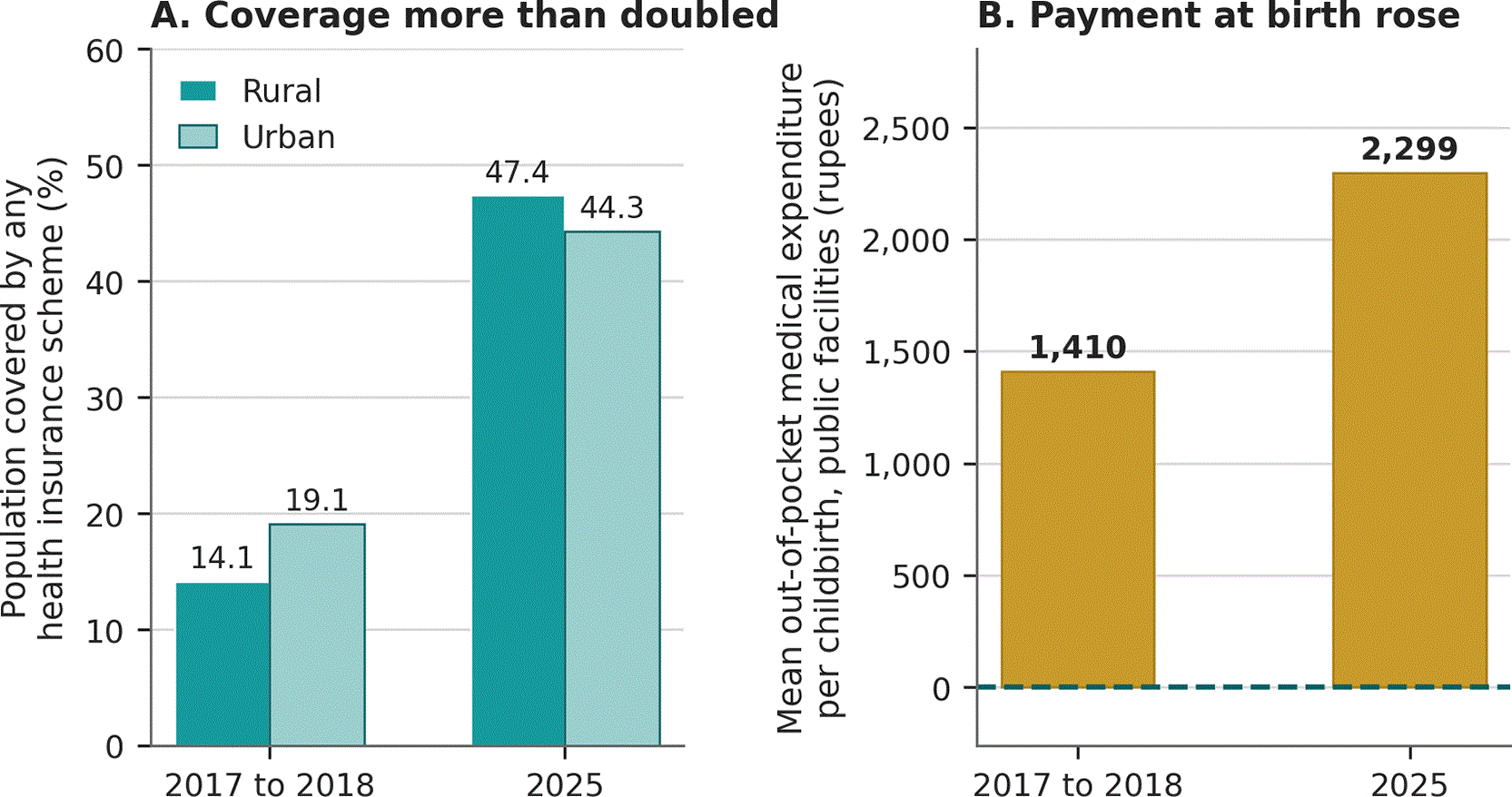
Paired panels showing the proportion of the population covered by any health insurance scheme alongside mean out-of-pocket medical expenditure per childbirth in public facilities. Data from references 1 and 9.
The nominal comparison must be handled carefully. The two rounds differ in sampling design and questionnaire structure, and the consumer price series was rebased from 2012 to 2024 equals 100 in February 2026, although linking factors and back-series data were published alongside the new series, so a deflated comparison is constructible.12 It is not presented here, because a general price index is a poor deflator for a specific bundle of maternity inputs, and because nothing in the argument turns on the real-terms magnitude. If prices had risen at the midpoint of the Reserve Bank’s 4 per cent inflation target throughout, cumulative price change over roughly seven years would be in the order of 30 to 35 per cent, which would leave a real increase but a smaller one than the headline suggests.
The real-terms magnitude is in any case secondary to the compliance question. The entitlement does not undertake that maternity costs will rise more slowly than prices; it undertakes that they will be zero. Any positive figure, deflated or otherwise, therefore represents a failure to deliver what the policy specifies, and the more useful question is why expenditure is occurring at all rather than how quickly it has grown.
Three features of the residual burden matter for design.
First, it is concentrated in identifiable inputs. A community study in rural West Bengal found that all components of the entitlement were known to only 12.9 per cent of recently delivered women, and identified medicines and transport as the two principal drivers of out-of-pocket spending in public facilities.13 A national cross-sectional analysis reached the same conclusion, that care in public facilities is in practice not free.14 The residual burden therefore falls on a small number of specific and purchasable inputs.
Second, it is clinically patterned, as Figure 2 shows. Analysis of the 2019 to 2021 national family health survey, covering 145,386 institutional births, found that relative to non-caesarean birth in a public institution, caesarean section in a public institution was associated with additional expenditure of 4,208 rupees (95 per cent confidence interval 3,828 to 4,588), non-caesarean birth in a private facility with 18,224 rupees, and caesarean section in a private facility with 39,660 rupees.15 Caesarean section is the amplifier in both sectors, and it is the procedure the entitlement names explicitly.16
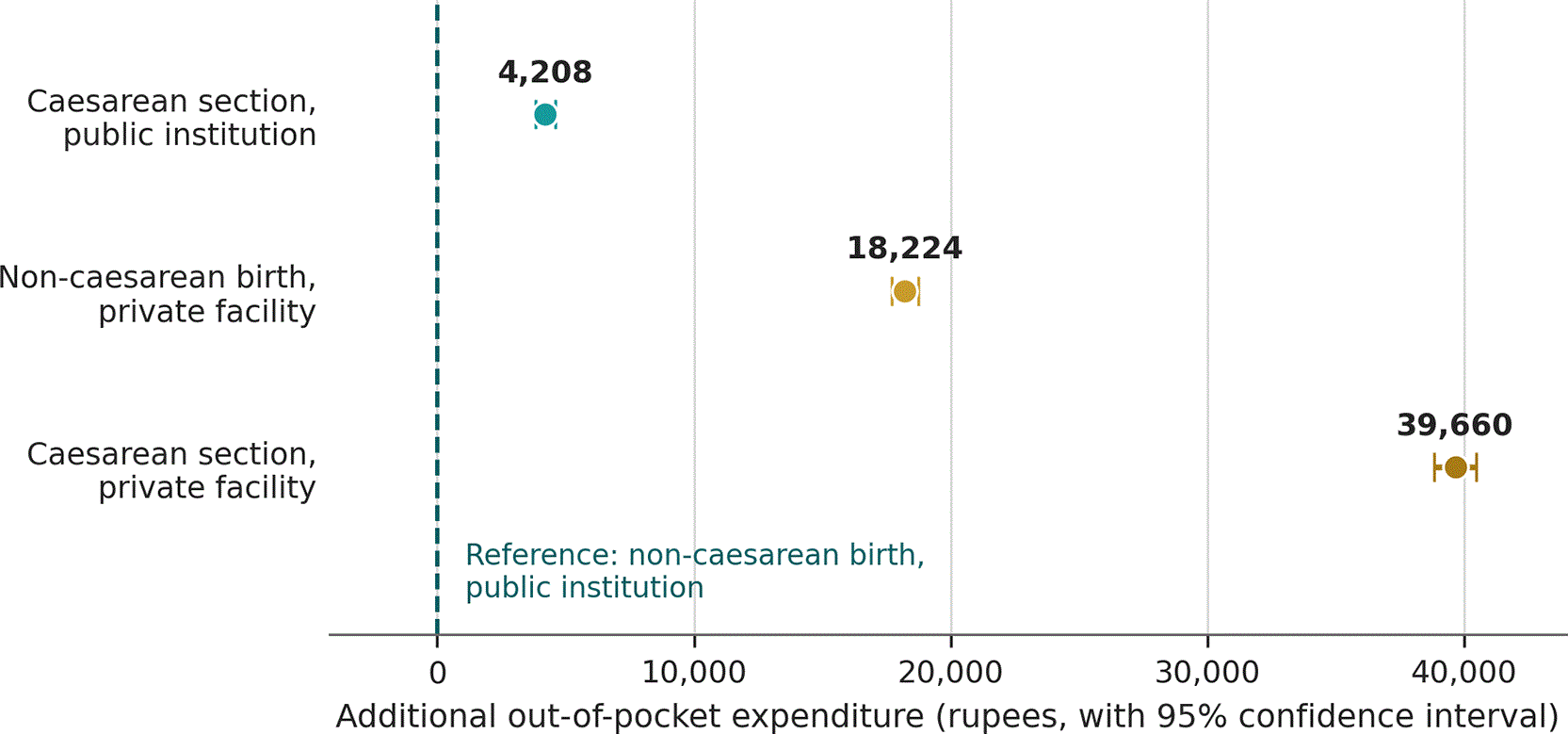
Point estimates with 95 per cent confidence intervals for caesarean section in a public institution, non-caesarean birth in a private facility and caesarean section in a private facility, each relative to non-caesarean birth in a public institution. Data from reference 15.
Third, protection does not track need. In the same analysis, median expenditure among women in the lowest asset quintile delivering in public facilities was 1,771 rupees, so the poorest still pay.15 Health insurance was insufficient to reduce private-sector expenditure, with median expenditure marginally higher among insured than uninsured women in that sector.15 Government insurance has similarly been found not to shield households from distress financing around either caesarean or non-caesarean delivery.17 Neither finding is new: critical evaluation of India’s flagship insurance schemes for the poor identified impoverishing out-of-pocket expenditure persisting alongside their coverage a decade ago.7 Households met these costs from savings in 84.8 per cent of cases and by borrowing in 17.5 per cent, and catastrophic maternal expenditure, impoverishment and distress financing around childbirth are long-documented.15,18–22
The variation in performance is the strongest evidence that the target is reachable within existing resources. A multi-district study in Haryana found the proportion of women reporting no expenditure for public-sector delivery ranging from 23 per cent in one district to 94 per cent in another.23 National survey analysis shows median public-facility expenditure varying by an order of magnitude across states, with north-eastern states clustering at the top.15 Districts that already deliver near-total compliance are not better funded in any systematic way. They are better managed, and management responds to measurement.
Government facilities still handle 61.7 per cent of all childbirths, but composition is shifting, as Figure 3 sets out. In urban areas private hospitals, including empanelled ones, accounted for 50.8 per cent of births against 47.0 per cent in government facilities in 2025, and the rural private share rose from about 21 to 28.8 per cent between rounds.1,9 Because the 2025 survey explicitly classifies hospitals empanelled under the national insurance scheme within the private category, the observed private-sector mean of 37,630 rupees and median of 32,000 rupees describe empanelled and non-empanelled care together.1 Households are moving steadily into the segment where the guarantee does not bind and expenditure is roughly sixteen times higher.
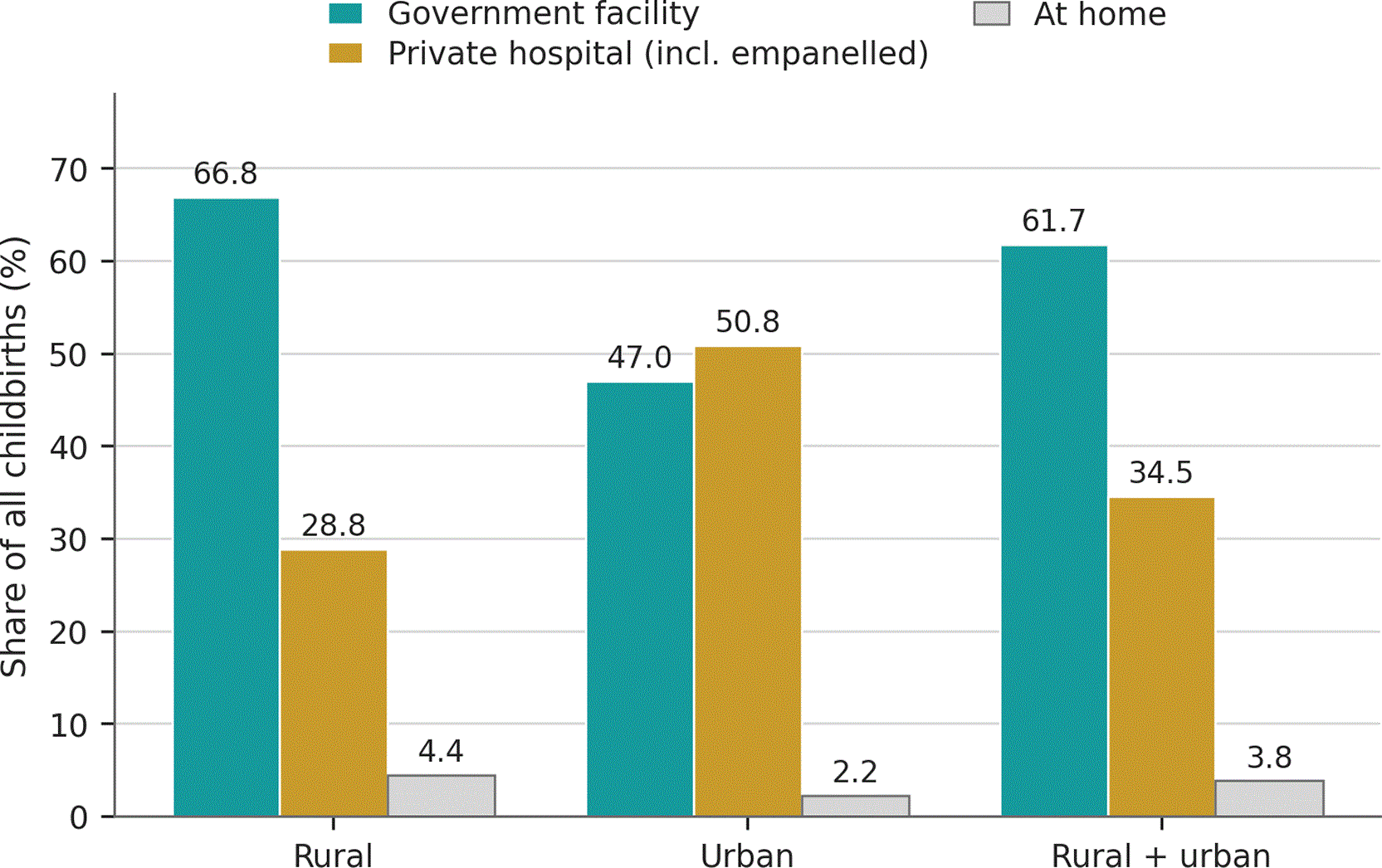
Percentage distribution of all childbirths across government facilities, private hospitals including government-empanelled hospitals, and home births, shown separately for rural, urban and combined populations. Data from reference 1.
The official indicator understates the problem by construction. Out-of-pocket medical expenditure is defined as total medical expenditure net of reimbursement, where medical expenditure comprises physician and surgeon fees, medicines, diagnostic tests, bed charges and related medical items.1 Transport, attendant food and lodging, and forgone earnings fall outside it. The entitlement’s transport and diet guarantees are therefore precisely the components the headline indicator cannot see, and 2,299 rupees is a floor rather than a ceiling.
More fundamentally, no routinely published indicator anywhere in the health information system reports whether a given public facility delivered a zero-expense birth. Compliance with the country’s most explicit financial protection guarantee is not a managed performance variable.
Three broad options exist. The first is to raise and index the cash transfer so that it covers observed costs. This is administratively simple but treats the symptom, reimburses after the fact, leaves the woman to find money at the point of care, and pays the same amount whether or not the facility complied. The second is to extend insurance to cover normal delivery in public facilities. This imports a working claims architecture but duplicates an existing entitlement, risks displacing births into the higher-cost empanelled private sector, and does not reach antenatal or postnatal care. The third, recommended here, is to convert the existing entitlement into a purchased product, which supplies the three missing elements without disturbing the benefit definition that is already correct.
Table 3 sets out the recommendations with responsible actor, instrument, indicator and horizon.
1. Convert the entitlement into a purchased per-case product. Define two maternity bundles, uncomplicated vaginal birth and caesarean section, priced from facility-level costing, and pay them to public facilities per case through the national claims platform the insurance scheme already operates. Make payment conditional on a zero-bill attestation signed by the woman at discharge. Every public-sector birth then generates a priced, adjudicated claim record. This requires no new statute, only a rerouting of existing programme funds.
2. Publish facility-level zero-bill compliance. Add “proportion of institutional deliveries with zero out-of-pocket expenditure, medical and non-medical” to routine health information reporting, published monthly at facility level and disaggregated by delivery mode, social group and wealth quintile. Set a national target of 90 per cent zero-bill public-sector deliveries by 2030 with an interim milestone of 75 per cent by 2028. A guarantee without a published compliance rate is unenforceable.
3. Fix medicines and referral transport first. Guarantee availability of delivery-package drugs and consumables through a maternity-specific buffer stock with automatic facility-level reorder triggers, and move referral transport from reimbursement to a contracted, dispatch-verified service with published response times. These are the two largest identified leak points and the cheapest to close.13
4. Match the coverage boundary to the clinical episode. The entitlement already extends in principle across the antenatal period and up to six weeks postpartum, but financing follows the inpatient admission. Extend free-at-point-of-use antenatal diagnostics and postnatal follow-up through the same case payment so that protection covers the episode rather than the stay.
5. Impose zero balance billing on empanelled private obstetric care. Make zero balance billing an explicit condition of obstetric empanelment, publish per-facility mean and median out-of-pocket expenditure for empanelled maternity claims, and de-empanel repeat offenders. With over a third of births now in the private category and empanelled hospitals counted within it, this is where the largest absolute sums are paid.
6. Index the cash transfer or retire it. Either link the transfer to a published cost basis and index it annually, or redirect the fiscal space into supply-side purchase of the entitlement, where the residual burden now sits. A rate card set in 2006 is not a financial protection instrument in 2026.
7. Report maternity financial protection as a distinct statistical series. The national household survey should publish childbirth expenditure inclusive of non-medical components, alongside a maternity-specific catastrophic expenditure and impoverishment series disaggregated by facility type and state.
Several limitations qualify this analysis. The two survey rounds compared differ in sampling design and questionnaire structure, and the comparison presented is nominal, with the real-terms magnitude indeterminate for the reasons set out above. The official expenditure measure excludes non-medical costs and nets out reimbursement, biasing the level downwards. Much of the mechanism evidence is single-state, cross-sectional, and predates the national insurance scheme. No counterfactual establishes what expenditure would have been in the absence of the entitlement, which may well have suppressed costs that would otherwise have risen faster. The recommendations are design proposals and have not been costed against a specific fiscal envelope.
The central proposition is falsifiable, and should be tested rather than assumed. If case-based payment were introduced and zero-bill compliance did not improve, the diagnosis offered here would be wrong, and the binding constraint would lie in input supply, provider behaviour or informal payment norms rather than in payment architecture. Three steps follow. Facility-level costing of the maternity bundle is required to set a defensible case price, for which existing national health system cost data provide a starting point. A national zero-bill audit using exit interviews from a stratified facility sample would establish a baseline and validate the proposed indicator. And the conversion should be evaluated prospectively in a small number of states before national rollout, because the response of public providers to case-based payment for services they are already obliged to supply is genuinely uncertain.
This pattern is not confined to India. Many low- and middle-income countries have declared maternity care free by executive instruction while leaving the payment architecture behind that declaration untouched. The predictable result is that the declaration binds the patient’s expectations and not the provider’s incentives, and the gap is absorbed by the household. India’s case is instructive precisely because the promise is so clear, the coverage so nearly universal, and the residual payment so small in absolute terms. A residual of 2,299 rupees per birth is modest relative to the cost of the services already being provided, which suggests that the binding constraint is one of accountability rather than of fiscal capacity.
Ethical approval and informed consent were not required for this work. This policy brief involved no human or animal participants and no primary data collection. It draws exclusively on aggregate statistics published in the public domain by the Government of India, on published analyses of nationally representative surveys, and on the peer-reviewed literature. No individual-level, identifiable or restricted-access records were obtained, accessed or analysed at any stage, and no participant was recruited, contacted or observed. Under the United States federal policy for the protection of human subjects at 45 CFR 46.102, secondary analysis of publicly available, de-identified, aggregate information does not meet the definition of research involving human subjects, and review by an institutional review board is therefore not required under the human subjects research policy of the University of North Texas [INSERT INSTITUTIONAL POLICY URL]. Because no participants were involved, the question of written or verbal informed consent does not arise.
No primary data were generated in the course of this work. Every value reported in this brief is drawn from sources that are freely available in the public domain. The principal sources are the National Sample Survey 80th round (January to December 2025) and 75th round (July 2017 to June 2018) reports on Household Social Consumption: Health, and the Consumer Price Index press note with base year 2024 equals 100, all published by the Ministry of Statistics and Programme Implementation, Government of India; the Sample Registration System special bulletin on maternal mortality published by the Office of the Registrar General of India; the scheme guideline documents for the Janani Suraksha Yojana, the Janani Shishu Suraksha Karyakram and the health benefit package of the Ayushman Bharat Pradhan Mantri Jan Arogya Yojana; and the peer-reviewed studies listed in the reference list. Estimates attributed to the National Family Health Survey 2019 to 2021 are taken from the published analysis cited at reference 15; no unit-level survey records were obtained, accessed or analysed at any point in the preparation of this brief.
The author used Anthropic’s Claude (Opus 5) for drafting assistance, language editing and the code used to generate the figures, and has verified all content against the primary sources and takes full responsibility for the article.
The author(s) declared that no grants were involved in supporting this work.
© 2026 Sriram S. This is an open access article distributed under the terms of the Creative Commons Attribution License, which permits unrestricted use, distribution, and reproduction in any medium, provided the original work is properly cited.
Current Reviewer Status:
AWAITING PEER REVIEW
AWAITING PEER REVIEW
?
Key to Reviewer Statuses VIEW HIDE
ApprovedThe paper is scientifically sound in its current form and only minor, if any, improvements are suggested
Approved with reservations A number of small changes, sometimes more significant revisions are required to address specific details and improve the papers academic merit.
Not approvedFundamental flaws in the paper seriously undermine the findings and conclusions