Просмотр новости
Найдите то, что Вас интересует
 Спутники
 РН
РН SpaceX
 Роскосмос
 NASA
NASA
СпутникиРНSpaceXРоскосмосNASA(1) 130,000 HARLAN FANS CAN’T BE WRONG. J. Michael Straczynski told Facebook followers today how well Harlan Ellison’s Greatest Hits is selling. For the last six months or so I’ve been using the last sales figures I had for Harlan Ellison’s … Continue reading →
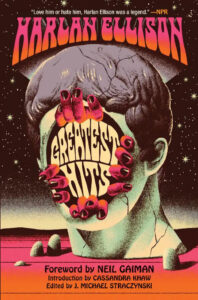
(1) 130,000 HARLAN FANS CAN’T BE WRONG. J. Michael Straczynski told Facebook followers today how well Harlan Ellison’s Greatest Hits is selling.
For the last six months or so I’ve been using the last sales figures I had for Harlan Ellison’s Greatest Hits (somewhere between 60,000 and 70,000 in print) because I hadn’t heard anything new in a while and I assumed that was the extent of it. Which, by the way, is still several orders of magnitude more than any of Harlan’s books have sold in over 20 years, especially once he began to self-publish rather than working with mainstream editors because of the greater artistic control afforded by the latter.
Per his assistant Sharon, who kept the records, the average for those books was only a few thousand here and there, with some even less.
So this evening I was emailing with the main editor at Union Square in charge of this particular effort, and discovered that the number is slightly more than the last I heard.
There are now 132,560 copies of Harlan Ellison’s Greatest Hits in print!
And it’s still selling! With most of those sales going to readers discovering Harlan for the first time.
Holy crap!
(2) GET YOUR B5 FIX FREE. Speaking of JMS, Slashdot signal-boosted news that Warner Brothers is releasing episodes of Babylon 5 for free on YouTube.
Cord Cutters News reports:In a move that has delighted fans of classic science fiction, Warner Bros. Discovery has begun uploading full episodes of the iconic series Babylon 5 to YouTube, providing free access to the show just as it departs from the ad-supported streaming platform Tubi… Viewers noticed notifications on Tubi indicating that all five seasons would no longer be available after February 10, 2026, effectively removing one of the most accessible free streaming options for the space opera. With this shift, Warner Bros. Discovery appears to be steering the property toward its own digital ecosystem, leveraging YouTube’s vast audience to reintroduce the show to both longtime enthusiasts and a new generation.
The uploads started with the pilot episode, “The Gathering,” which serves as the entry point to the series’ intricate universe. This was followed by subsequent episodes such as “Midnight on the Firing Line” and “Soul Hunter,” released in sequence to build narrative momentum. [Though episodes 2 and 3 are mis-labeled as #3 and #4…] The strategy involves posting one episode each week, allowing audiences to experience the story at a paced rhythm that mirrors the original broadcast schedule…
(3) EATING THE FANTASTIC. Scott Edelman invites listeners to polish off pierogi with Chris Kalb on Episode 275 of the Eating the Fantastic podcast.
My guest this episode is someone you know even though you don’t know you know him — because, among many others things, Chris Kalb, artist, art director, and pulp magazine maven, designed the podcast icon for Eating the Fantastic, so you met him when you clicked on that flying saucer hoovering up a donut, burger, and chicken leg with its tractor beam. He’s also designed covers for two of my short story collections — the horror collection These Words are Haunted, and my recent science fiction one, 101 Things to Do Before You’re Downloaded.

But Chris is a lot more than the projects he was willing to tackle for me. He’s a Charles M. Schulz Award-winning cartoonist and designer whose work has appeared in books and magazines, on TV and online, and in educational content for the last 35 years. His illustrations have appeared in such books such as ‘Scuse Me While I Kiss This Guy and Other Misheard Lyrics, Cooking Rocks: Rachael Ray 30-Minute Meals for Kids, and He Loved Me, He Loves Me Not. That last title, written by comedienne Lynn Harris, spawned the relationship super-hero Breakup Girl, whose subsequent internet advice column and web-comic (one of the first!) were adapted for TV by Oxygen when they launched in 2000.
 Chris Kalb
From 2001-2008, Chris was the designer of the Syfy Channel magazine during the station’s peak period. For the last 13 years, Chris has been using all of his combined talents in storytelling, art, design and coding to craft innovative classroom experiences for Amplify Education, a pioneer in digital curriculum.
Chris has also been a life-long fan of pulp characters such Doc Savage, The Spider, Operator #5, and G-8 and His Battle Aces. Beginning in 2007, he has been able to give back to pulp fandom as the art director and publisher of Age of Aces Books, reprinting the very best in aviation pulp fiction from titles like Daredevil Aces, Sky Birds, Wings, and Flying Aces.
We discussed the comic book company and superheroes he and his brother created when they were just kids, why he once thought Chris Ware was his nemesis, the Batman comic which influenced him the most, how his father caused him to fall in love with Doc Savage, the secret origin of his romantic advice superheroine Breakup Girl, the sophistication of pulp era writing, one theory as to why Doc Savage never made it as a successful comic book series, the college comic strip which won him a Charles M. Schulz Award, the problem the slabbing of pulps has caused within the collecting community, the pulp premium so rare none may have survived, and much more.
(4) CANCEL THAT. “Barack Obama clarifies remark on aliens being real: ‘I saw no evidence’” – Entertainment Weekly tells the story.
Barack Obama is clearing the air after causing an internet frenzy with some throwaway comments about the existence of aliens.
Over the weekend, the former U.S. president accidentally thrilled conspiracy theorists by participating in a rapid-fire question-and-answer segment that saw him quickly address whether or not extraterrestrials have visited Earth. The subject came up during his recent appearance on the No Lie podcast with host Brian Tyler Cohen.
“Are aliens real?” Cohen asked during a quick-fire round of questions, to which Obama replied: “They’re real, but I haven’t seen them.”
He then added, “They’re not being kept in Area 51. There’s no underground facility unless there’s this enormous conspiracy and they hid it from the president of the United States.”
The response was swiftly picked up by media outlets and picked apart online by suspicious social media users. The clip became so widespread that Obama took to Instagram on Sunday to offer some clarity.
“I was trying to stick with the spirit of the speed round, but since it’s gotten attention let me clarify,” he began. “Statistically, the universe is so vast that the odds are good there’s life out there. But the distances between solar systems are so great that the chances we’ve been visited by aliens is low.”
He added, “I saw no evidence during my presidency that extraterrestrials have made contact with us. Really!”…
(5) LUCIUS SHEPARD COLLECTION. A Deep Look by Dave Hook takes in “’The Best of Lucius Shepard’, 2008 Subterranean Press”. Here’s the short response; the long, detailed one is at the link.
The Short: The Best of Lucius Shepard, 2008 Subterranean Press, is in print in e-book and hardcover. It includes 18 short works of speculative fiction, ranging from short stories to novellas. It’s a hefty group of science fiction, fantasy and horror stories, coming in at 623 pages. My favorite is the superlative novelette “The Jaguar Hunter“, F&SF May 1985. Although my overall rating is a strong 3.81/5, or “Great”, I find the contents variable, with three stories in the merely “Good” or competent range that I would have omitted. You might feel differently. Regardless, recommended strongly.
(6) ROBERT DUVALL (1931-2026). The actor who won an Oscar for Tender Mercies (1983), Robert Duvall, died February 15 at the age of 95. He had a huge resume of excellent work. One of his signature roles was the family consigliore in the Godfather movies.
Duvall’s sff genre appearances included TV episodes of The Twilight Zone (“Miniature”), The Outer Limits (three episodes), Voyage to the Bottom of the Sea, The Time Tunnel and The Wild Wild West. He worked in sff movies like Countdown, Invasion of the Body Snatchers (1978), The Handmaid’s Tale (1990), Deep Impact, The Sixth Day, and George Lucas’ first feature THX 1138 (1971).
Inverse has an article about Duvall’s presence in THX: “55 Years Ago, Robert Duvall Starred In The Most Pivotal Sci-Fi Movie Of The 20th Century”.
…[In] 1971, before Star Wars and before what we now think of as a kind of modern age of sci-fi cinema, Robert Duvall led George Lucas’ first masterpiece. Today, THK 1138 is even more prescient and arresting than it was 55 years ago, and its excellence partly thanks to Duvall’s immortal performance….
… In an unspecified future, humans are heavily medicated and live tightly controlled lives. Duvall’s titular character, only given the designation THX 1138, works on an assembly line, ostensibly creating robots of some kind. Early in the film, 1138 is picked up for not taking his pills because he and his “mate,” LUH 3417 (Maggie McOmie), are trying to free themselves of an oppressive day-to-day life. Is all of this crystal clear, say, with the kind of exposition you get from something like The Running Man or The Hunger Games? No. Not at all.
His very first feature, George Lucas wrote and directed THX 1138, which he adapted from his 1967 short film, Electronic Labyrinth: THX 1138 4EB. Today, thanks to the success of Star Wars — and the critical and commercial failure of THX 1138 — this film is sometimes viewed as a stepping stone to the eventual mainstream sci-fi empire Lucas would later create. Few hardcore Lucas fans would say this is his best movie. And yet, it is almost certainly his most artistic and socially astute. And, on top of that, it might be one of Robert Duvall’s best performances, period….
(7) TODAY’S BIRTHDAY.
[Written by Cat Eldridge.]
February 19, 1937 — Terry Carr. (Died 1987.)
I’ll admit right now that I do not know Terry Car from any of his novels which are Warlord of Kor, Invasion from 2500 co-written with Ted White, and Cirque. I’ll certainly invite opinions on how they are. What I do know about him is from his most excellent and rather extensive work in the area of editing anthologies.
 Terry Carr with fans on the New York subway in 1966. Photo by and (c) Andrew Porter.
But first I must discuss his work as a fanzine editor, winning his first Hugo for the zine FANAC, co-edited with Ron Ellik, which they started in 1958. There were seventy-one issues (the last six were co-edited with his first wife, Miriam Carr). Read the first issue at Fanac.org. Terry would win a second Hugo for Best Fan Writer in 1973 at Torcon II. He would also be the 1986 Worldcon’s Fan Guest of Honor.
His work on anthologies began in the Sixties on the first seven volumes of World’s Best Science Fiction with Donald A. Wollheim. I’m reasonably sure that I’ve read at least some of them as the contents are quite familiar.
Also while working for Donald A. Wollheim at Ace Books, he was responsible for the acclaimed Ace Special series, bringing out R.A. Lafferty’s Past Master (1968), Ursula K Le Guin’s The Left Hand of Darkness (1969) and Alexei Panshin’s Rite of Passage (1968).
Now I know that I’ve read much of his next two anthology series as they were quite excellent. They came out almost out at the same time as the Seventies got under way, with Universe having an impressive run of seventeen volumes, and The Best Science Fiction of the Year with just a volume less.
He also had an anthology series devoted to original fantasy only, New Worlds of Fantasy which published three volumes stating in the Sixties. He did five volumes in the Fantasy Annual reprint series starting in the late Seventies.
His work would earn two Best Professional Editor Hugos (1985, 1987).
Lastly, he published in his regrettably brief lifetime a reasonably large amount of shorter fiction, over forty pieces. The Seventies collection The Light at the End of the Universe is the only sole look at his short fiction to date. Subterranean Press, where art thou?
(8) MEMORY LANE.
[Written by Cat Eldridge.]
February 19, 1960 — The Twlight Zone episode “Elegy”
The time is the day after tomorrow. The place: a far corner of the universe. A cast of characters: three men lost amongst the stars. Three men sharing the common urgency of all men lost. They’re looking for home. And in a moment, they’ll find home; not a home that is a place to be seen, but a strange unexplainable experience to be felt. — opening narration
On this date sixty-six years ago, Twilight Zone’s “Elegy” aired for this first time. It was the twentieth episode of the first season and was written by Charles Beaumont who you might recognize as the screenwriter of 7 Faces of Dr. Lao. Beaumont would die at just 38 of unknown causes that were assumed to be neurological in nature.
The cast for this Twilight Zone episode was Cecil Kellaway as Jeremy Wickwire, Jeff Morrow as Kurt Meyers, Kevin Hagen as Captain James Webber and Don Dubbins as Peter Kirby. These are not the character names in the short story it comes from in that, the caretaker of the cemetery and the most logical crewman are named Mr. Greypoole and Mr. Friden respectively. In the Twilight Zone script, their names are Jeremy Wickwire and Professor Kurt Meyers.
This episode was based on Beaumont’s short story “Elegy” published in Science Fiction Quarterly, May 1954. It’s available for Subterranean Press on their website as an epub in The Carnival and Other Stories for just $6.99.

(9) COMICS SECTION.
(10) GAY GHOST REAPPEARS. [Item by James Bacon.] I’ve written about the Gay Ghost and his fight in 1944 against domestic Nazis, religious and racial hatred and a future with barbed wire “work camps” all from 1944.
Republished 81 years later by DC comics last December.
I was surprised!
Sensation Comics #38 is best known for featuring Wonder Woman. Of the many other characters, Keith Everett, who was the Gay Ghost was quite unusual and questionable a character on many levels, but this issue features his fight against a domestic threat as Churches are desecrated with swastikas and Stars of David, in an attempt to stir up religious and racial hatred.
Offering a timely warning about contemporary America, echoing concerns of the 1940s
“A Blast From The Past: How a wartime issue of Sensation Comics offered a glimpse of a terrifying future” at Downthetubes.net.
…Sensation Comics #38, published in December 1944, marks the final appearance of the Gay Ghost in American Comics “Golden Age”. The creation of writer Gardner Fox and artist Howard Purcell, he would not be seen again until Secret Origins (Volume 2) #42 (July 1989). He later appeared in Animal Man #25 (July 1990).
Titled “Vandals Desecrate Churches”, the story sees swastikas and a Star of David daubed onto churches. We see Charles Collins taking an interest in the situation, and a local police officer tells him, “Boyish pranks or not, it is stirring up religious and racial hatred” and continues “just like the Nazis and Fascists did in Europe.” …
This was a very unusual but important story. The portrayal and discussion of domestic religious and racial hatred and what its portrayal of what is effectively a concentration camp was rare for the time. Indeed, concentration camps were only mentioned about forty times during the war period in American comics. But the concept of homegrown right wing Nazi-like behaviours was valid, given the activities of the German American Bund, a Nazi organisation with the Swastika on their flag.
(11) ANDERS-WRITTEN STAR TREK COMIC PLANNED. “The Future of ‘Star Trek’ Comics Is Ready for a New Next Generation”. Gizmodo is especially happy with this new story:
…Launching in October of this year, the main Star Trek series will be joined by Star Trek: Zero Point, written by someone very familiar to longtime io9 audiences: Hugo Award-winning novelist and site co-founder Charlie Jane Anders. Zero Point will be set during the time Seven of Nine has taken the Enterprise beyond the reaches of the known galaxy and will follow another familiar face: her partner Raffi Musiker, who has been tasked with leading a new crew aboard a starship tasked with a similarly risky endeavor: using a new predictive artificial intelligence built to (wearing a mysterious, but familiar face) be the vanguard defending the Federation from the threats of tomorrow before they even begin.
“I’ve loved Star Trek for as long as I can remember—literally, some of my earliest memories are of wearing a homemade Starfleet uniform and waiting to get beamed up,” Anders added in a statement to io9. “I’m putting all my favorite Trek things into this comic: problem solving, ethical dilemmas, identity crises, and above all, chosen family.”
“At the same time, I’m determined to write a Trek comic that newbies can read with no homework required: there are no easter eggs, no callbacks to deep lore,” Anders concluded. “Anyone who loves Becky Chambers or Martha Wells ought to be able to pick up this comic and get a fun science fiction story about artificial consciousness and exoplanets. Also, I’m talking to tons of physicists to get the most accurate science I can into this comic. I’m having the time of my life.”
Several more forthcoming Star Trek comic titles are announced in the same article.
(12) GOING WITH THE FLOW. Ecoticias reports the results after “NASA conducts the first test of its nuclear engine for interstellar travel”.
Getting to the outer solar system with today’s rockets is like driving across a continent in first gear. Engineers at NASA say they have just nudged space travel toward something faster. At the agency’s Marshall Space Flight Center they completed more than one hundred non-nuclear “cold flow” tests of a full-scale nuclear rocket reactor core, the first time hardware of this kind has been pushed this far since the 1960s.
The barrel-sized test article, roughly a 100-gallon drum, was built by BWX Technologies to copy the plumbing of a real reactor without any radioactive fuel. During the campaign, engineers pumped liquid hydrogen simulants through the core to see how the propellant would move and press against the walls under different conditions. Those details matter because unstable flow can trigger vibrations that damage an engine long before it ever leaves Earth.
According to NASA, the cold flow tests showed that the current reactor layout avoids destructive flow-induced oscillations and pressure waves, while producing a trove of data to check computer models. Test objectives included simulating real operating conditions and validating analytical tools that will guide the design of control systems for future engines.
(13) DATING GAME. Some new data coming in from the James Webb Space Telescope suggests that large galaxies might have formed much earlier in the universe’s lifetime than previously thought (or maybe that the universe is older than we previously thought it was): “Analysis of JWST Data Finds – Old Galaxies in a Young Universe?” at Slashdot.
Two astrophysicists at Spain’s Instituto de Astrofísica de Canarias analyzed data from the James Webb Space Telescope — the most powerful telescope available — on 31 galaxies with an average redshift of 7.3 (when the universe was 700 million years old, according to the standard model). “We found that they are on average ~600 million years old old, according to the comparison with theoretical models based on previous knowledge of nearby galaxies…”
“If this result is correct, we would have to think about how it is possible that these massive and luminous galaxies were formed and started to produce stars in a short time. It is a challenge.”
But “The fact that some of these galaxies might be older than the universe, within some significant confidence level, is even more challenging.”…
(14) ARE THE EXOPLANETS DIFFERENT BETWEEN THOSE AROUND BINARY STARS AND THOSE AROUND SINGLE STARS? [Item by SF Concatenation’s Jonathan Cowie.] It is estimated that approximately one third of the star systems in the Milky Way are binary or multiple stars, with the remaining two thirds being single stars. All well and good. And we are searching for exoplanets. Also all well and good. But there is the real possibility of selection bias. Here a word of explanation is required…
Humans (and that includes some SF fans) do tend to selection bias. Astronomers are acutely aware of selection bias if only due to the long-known Malmquist bias in which we can only see the brightest stars. For example, Deneb in the constellation of Cygnus is easily visible by eye despite being 2,000 light years away, whereas the nearest star (Proxima Centauri four light years away) is only visible through a telescope!
With regard to selection bias, exoplanet surveys have very much tended to focus on looking for planets around single stars (tending to neglect binaries), though planets orbiting binary stars have been found as well as orbiting around just hone star of a widely-spaced binary. Astronomers from Penn State University and California University have now removed this bias from the data to compare planets orbiting single stars with those from close (as opposed to widely) spaced binaries.
Correcting for bias, what they found was that there were far fewer exoplanets orbiting close-spaced binaries. Furthermore, those planets that are orbiting such binaries are significantly smaller than exoplanets orbiting single stars. These results suggest that there are significantly different planet formation and survival outcomes in closely-spaced binaries compared to single stars. It could be that a binary star’s companion disrupts the primordial gas/dust cloud out of which planets form.(?)
SFnally, what this means is that the famous <I>Star Wars</I> scene with two suns in the sky of an Earth-sized world is less likely, though not impossible. There can be Earth-sized planets around close binaries but there are markedly fewer of the larger super-Earths: about half that around single stars. Furthermore, in the distribution of planet size around binaries, there is no sub-Neptune cliff or radius valley (there are half the number of smaller than Neptune planets than Earth-sized or Neptune-sized planets seen around single stars) in the distribution of size of planets around close binaries.

The primary research is; Sullivan, K. et al. (2026) “The First Direct Occurrence Rate Estimates for Kepler Exoplanets in Small-separation Binary Star Systems: Planet Occurrence Is Suppressed in Binary Stars”. The Astronomical Journal, vol. 171, 53.

[Thanks to SF Concatenation’s Jonathan Cowie, Mark Roth-Whitworth, Kathy Sullivan, Nina Shepardson, James Bacon, Steven French, Mike Kennedy, Andrew Porter, John King Tarpinian, and Cat Eldridge for some of these stories. Title credit belongs to File 770 contributing editor of the day Daniel “Sing, Oliver!” Dern.]
Subscribe to get the latest posts sent to your email.