Просмотр новости
Найдите то, что Вас интересует
 Спутники
 РН
РН SpaceX
 Роскосмос
 NASA
NASA
СпутникиРНSpaceXРоскосмосNASAAround 1150 studies using data collected at ESO's observatories were published last year — the second year in a row that publications have exceeded 1100. It also marks the ninth consecutive year where observations at ESO's facilities have led to more than 1000 published studies annually. The ESO Library, Documentation, and Information Services Department have updated their publication statistics to include 2025 with a detailed breakdown of the contributions from each ESO facility [1].
As in previous years, data from ESO's Very Large Telescope (VLT) and the VLT interferometer (VLTI) have dominated in publications, contributing to around 670 studies in 2025. The facilities' broad range of instruments, plus the location at Paranal Observatory in Chile's Atacama Desert — a site with unique observing conditions including pristine dark skies — make them a flagship in ground-based astronomy. The Multi Unit Spectroscopic Explorer (MUSE) continues its six-year streak as the most productive VLT/I instrument, with data in over 200 papers. A highlight from MUSE last year was the publication of an ultra-detailed thousand-colour image of the Sculptor Galaxy. Another highlight from the VLT published last year used data from the Ultraviolet and Visual Echelle Spectrograph (UVES), the second most productive VLT instrument with over 120 papers in 2025, to find a planet in a perpendicular orbit to a pair of stars.
The survey facilities, ESO’s Visible and Infrared Survey Telescope for Astronomy (VISTA) and the VLT Survey Telescope (VST) [2], also found at Paranal Observatory, produced data for over 100 papers. Data from ESO's first observatory, La Silla, contributed to about 200 studies last year, an increase from 177 in 2024. This shows how the observatory remains at the forefront of research, especially thanks to instruments such as HARPS, High Accuracy Radial velocity Planet Searcher, on ESO's 3.6-metre telescope.
The Atacama Large Millimeter/Submillimeter Array (ALMA), co-owned by ESO, provided data for over 550 publications in 2025. Around half of these papers relied on observing time granted to astronomers based in Europe. Highlights of ALMA studies published last year include the discovery of oxygen in the most distant known galaxy and observations of the creation of a new solar system. Located next to ALMA, observations from the Atacama Pathfinder Experiment (APEX), which was operated and hosted by ESO until the end of 2025, led to around 45 papers last year. Of these, close to 20 used data obtained during ESO observing time.
A record number of publications employed data from the ESO Science Archive Facility, with around 530 papers relying partly or exclusively on archival data. This also made 2025 the year with the highest percentage of ESO publications using the archive, at 46%, underscoring the value of legacy observations in cutting-edge astronomical research. Furthermore, over a quarter of all 2025 publications relied on archival data alone, without any ESO observations obtained by the authors themselves.
The impressive publication numbers emphasise the significant role ESO plays in helping astronomers advance our understanding of the Universe. This is made possible thanks to the work of the wider astronomical community and ESO staff, the advanced technology of ESO’s facilities, and the continued support of ESO’s member states and of Chile.
Notes
[1] Papers can use data from more than one facility, therefore the total number cannot be calculated by adding all publications of the individual sites.
[2] The VST project was a joint venture between ESO and the Capodimonte Astronomical Observatory, part of the Italian National Institute for Astrophysics (INAF). As of 1 October 2022, this is a sole project of INAF, hosted by ESO at Paranal. Only papers based (entirely or partly) on ESO VST time are included in the statistics.
More Information
The statistics presented here are derived from the ESO Telescope Bibliography (telbib), a database of refereed papers published by the ESO users community. Telbib is developed and curated by the ESO Library, Documentation, and Information Services Department. While text-mining scripts are applied when screening the literature for ESO data papers, articles are carefully examined by the curators before they are added to the database to ensure that all telbib papers use partly or exclusively data from ESO facilities for which observing time was recommended by ESO. The public telbib interface provides visualisations of search results including on-the-fly graphs and predefined charts.
10 March 2026
Around 1150 studies using data collected at ESO's observatories were published last year — the second year in a row that publications have exceeded 1100. It also marks the ninth consecutive year where observations at ESO's facilities have led to more than 1000 published studies annually. The ESO Library, Documentation, and Information Services Department have updated their publication statistics to include 2025 with a detailed breakdown of the contributions from each ESO facility [1].
As in previous years, data from ESO's Very Large Telescope (VLT) and the VLT interferometer (VLTI) have dominated in publications, contributing to around 670 studies in 2025. The facilities' broad range of instruments, plus the location at Paranal Observatory in Chile's Atacama Desert — a site with unique observing conditions including pristine dark skies — make them a flagship in ground-based astronomy. The Multi Unit Spectroscopic Explorer (MUSE) continues its six-year streak as the most productive VLT/I instrument, with data in over 200 papers. A highlight from MUSE last year was the publication of an ultra-detailed thousand-colour image of the Sculptor Galaxy. Another highlight from the VLT published last year used data from the Ultraviolet and Visual Echelle Spectrograph (UVES), the second most productive VLT instrument with over 120 papers in 2025, to find a planet in a perpendicular orbit to a pair of stars.
The survey facilities, ESO’s Visible and Infrared Survey Telescope for Astronomy (VISTA) and the VLT Survey Telescope (VST) [2], also found at Paranal Observatory, produced data for over 100 papers. Data from ESO's first observatory, La Silla, contributed to about 200 studies last year, an increase from 177 in 2024. This shows how the observatory remains at the forefront of research, especially thanks to instruments such as HARPS, High Accuracy Radial velocity Planet Searcher, on ESO's 3.6-metre telescope.
The Atacama Large Millimeter/Submillimeter Array (ALMA), co-owned by ESO, provided data for over 550 publications in 2025. Around half of these papers relied on observing time granted to astronomers based in Europe. Highlights of ALMA studies published last year include the discovery of oxygen in the most distant known galaxy and observations of the creation of a new solar system. Located next to ALMA, observations from the Atacama Pathfinder Experiment (APEX), which was operated and hosted by ESO until the end of 2025, led to around 45 papers last year. Of these, close to 20 used data obtained during ESO observing time.
A record number of publications employed data from the ESO Science Archive Facility, with around 530 papers relying partly or exclusively on archival data. This also made 2025 the year with the highest percentage of ESO publications using the archive, at 46%, underscoring the value of legacy observations in cutting-edge astronomical research. Furthermore, over a quarter of all 2025 publications relied on archival data alone, without any ESO observations obtained by the authors themselves.
The impressive publication numbers emphasise the significant role ESO plays in helping astronomers advance our understanding of the Universe. This is made possible thanks to the work of the wider astronomical community and ESO staff, the advanced technology of ESO’s facilities, and the continued support of ESO’s member states and of Chile.
Notes[1] Papers can use data from more than one facility, therefore the total number cannot be calculated by adding all publications of the individual sites.
[2] The VST project was a joint venture between ESO and the Capodimonte Astronomical Observatory, part of the Italian National Institute for Astrophysics (INAF). As of 1 October 2022, this is a sole project of INAF, hosted by ESO at Paranal. Only papers based (entirely or partly) on ESO VST time are included in the statistics.
More InformationThe statistics presented here are derived from the ESO Telescope Bibliography (telbib), a database of refereed papers published by the ESO users community. Telbib is developed and curated by the ESO Library, Documentation, and Information Services Department. While text-mining scripts are applied when screening the literature for ESO data papers, articles are carefully examined by the curators before they are added to the database to ensure that all telbib papers use partly or exclusively data from ESO facilities for which observing time was recommended by ESO. The public telbib interface provides visualisations of search results including on-the-fly graphs and predefined charts.
LinksUta Grothkopf
Head of ESO’s Library, Documentation, and Information Services Department
Garching bei München, Germany
Tel: +49 89 3200 6280
Email: uta.grothkopf@eso.org
Bárbara Ferreira
ESO Media Manager
Garching bei München, Germany
Tel: +49 89 3200 6670
Email: press@eso.org
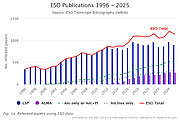
Number of papers published based on data obtained at ESO observatories (1996–2025)
The European Organisation for Astronomical Research in the Southern Hemisphere (ESO) is the pre-eminent intergovernmental science and technology organisation in astronomy. It carries out an ambitious programme focused on the design, construction and operation of powerful ground-based observing facilities for astronomy.
This Cookies Policy is intended to provide clarity by outlining the cookies used on the ESO public websites, their functions, the options you have for controlling them, and the ways you can contact us for additional details.
What are cookies?Cookies are small pieces of data stored on your device by websites you visit. They serve various purposes, such as remembering login credentials and preferences and enhance your browsing experience.
Categories of cookies we useEssential cookies (always active): These cookies are strictly necessary for the proper functioning of our website. Without these cookies, the website cannot operate correctly, and certain services, such as logging in or accessing secure areas, may not be available; because they are essential for the website’s operation, they cannot be disabled.
csrftoken
XSRF protection token. We use this cookie to protect against cross-site request forgery attacks.
1st party
Stored
1 year
user_privacy
Your privacy choices. We use this cookie to save your privacy preferences.
1st party
Stored
6 months
_grecaptcha
We use reCAPTCHA to protect our forms against spam and abuse. reCAPTCHA sets a necessary cookie when executed for the purpose of providing its risk analysis. We use www.recaptcha.net instead of www.google.com in order to avoid unnecessary cookies from Google.
3rd party
Stored
6 months
Functional Cookies: These cookies enhance your browsing experience by enabling additional features and personalization, such as remembering your preferences and settings. While not strictly necessary for the website to function, they improve usability and convenience; these cookies are only placed if you provide your consent.
preferred_language
Language settings. We use this cookie to remember your preferred language settings.
1st party
Stored
1 year
sessionid
ESO Shop. We use this cookie to store your session information on the ESO Shop. This is just an identifier which is used on the server in order to allow you to purchase items in our shop.
1st party
Stored
2 weeks
Analytics cookies: These cookies collect information about how visitors interact with our website, such as which pages are visited most often and how users navigate the site. This data helps us improve website performance, optimize content, and enhance the user experience; these cookies are only placed if you provide your consent. We use the following analytics cookies.
Matomo Cookies:
This website uses Matomo (formerly Piwik), an open source software which enables the statistical analysis of website visits. Matomo uses cookies (text files) which are saved on your computer and which allow us to analyze how you use our website. The website user information generated by the cookies will only be saved on the servers of our IT Department. We use this information to analyze www.eso.org visits and to prepare reports on website activities. These data will not be disclosed to third parties.
On behalf of ESO, Matomo will use this information for the purpose of evaluating your use of the website, compiling reports on website activity and providing other services relating to website activity and internet usage.
ON | OFF
Matomo cookies settings:
_pk_id
Stores a unique visitor ID.
1st party
Stored
13 months
_pk_ses
Session cookie temporarily stores data for the visit.
1st party
Stored
30 minutes
_pk_ref
Stores attribution information (the referrer that brought the visitor to the website).
1st party
Stored
6 months
_pk_testcookie
Temporary cookie to check if a visitor’s browser supports cookies (set in Internet Explorer only).
1st party
Stored
Temporary cookie that expires almost immediately after being set.
Additional Third-party cookies on ESO websites: some of our pages display content from external providers, e.g. YouTube.
Such third-party services are outside of ESO control and may, at any time, change their terms of service, use of cookies, etc.
YouTube: Some videos on the ESO website are embedded from ESO’s official YouTube channel. We have enabled YouTube’s privacy-enhanced mode, meaning that no cookies are set unless the user actively clicks on the video to play it. Additionally, in this mode, YouTube does not store any personally identifiable cookie data for embedded video playbacks. For more details, please refer to YouTube’s embedding videos information page.
Cookies can also be classified based on the following elements.
Regarding the domain, there are:
As for their duration, cookies can be:
Cookie settings: You can modify your cookie choices for the ESO webpages at any time by clicking on the link Cookie settings at the bottom of any page.
In your browser: If you wish to delete cookies or instruct your browser to delete or block cookies by default, please visit the help pages of your browser:
Please be aware that if you delete or decline cookies, certain functionalities of our website may be not be available and your browsing experience may be affected.
You can set most browsers to prevent any cookies being placed on your device, but you may then have to manually adjust some preferences every time you visit a site/page. And some services and functionalities may not work properly at all (e.g. profile logging-in, shop check out).
Updates to the ESO Cookies PolicyThe ESO Cookies Policy may be subject to future updates, which will be made available on this page.
Additional informationFor any queries related to cookies, please contact: pdprATesoDOTorg.
As ESO public webpages are managed by our Department of Communication, your questions will be dealt with the support of the said Department.