Просмотр новости
Найдите то, что Вас интересует
 Спутники
 РН
РН SpaceX
 Роскосмос
 NASA
NASA
СпутникиРНSpaceXРоскосмосNASAAbstract submission CALL FOR PRESENTATIONS/POSTERS We invite the submission of contributions for Environmental Crimes workshop HERE Abstract Submission Period: The system is open from 03 June 2026 to 29 July 2026. Authors are encouraged to submit abstracts that clearly reflect the content of the presentation or poster, presenting research, developments, or applications relevant to the …
The post Environmental Crimes joint workshop with ESA-JRC-UNODC appeared first on eo science for society.
September 29 @ 14:00 - October 1 @ 14:00 UTC+2 ESA-ESRIN
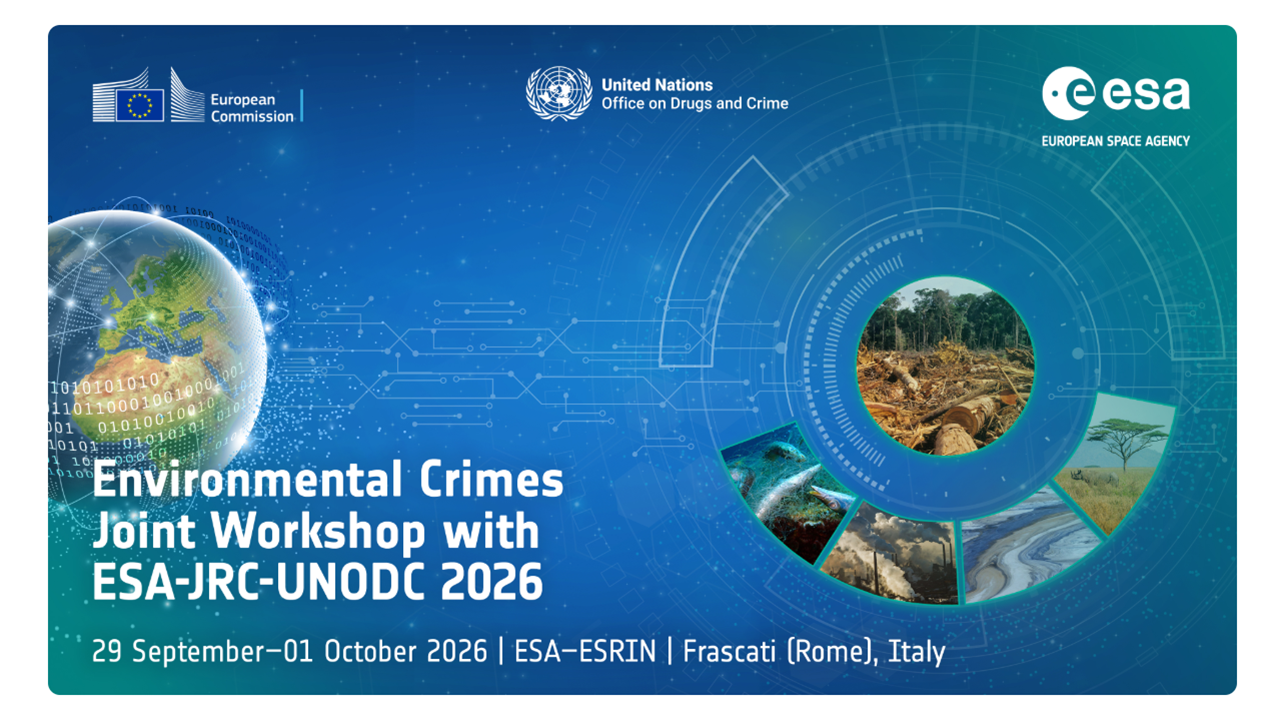
Environmental crime remains one of the fastest-growing forms of organised crime worldwide, with estimated annual growth rates of 5–7%. It is highly complex to detect, investigate and prosecute, as criminal networks often operate across borders and exploit differences in legal frameworks, enforcement capacities and national priorities. Environmental crime covers a wide and evolving range of offences, including illegal waste management and shipment, illegal logging and timber trade, illegal mineral mining, illegal fishing, unlawful water abstraction, pollution, habitat destruction, wildlife trafficking, illegal ship recycling, and serious breaches of chemicals, mercury and greenhouse-gas legislation.
Addressing these crimes requires strong international cooperation, both to dismantle transnational criminal networks and to support more harmonised, effective enforcement. In the European Union, the new Environmental Crime Directive entered into force in May 2024, with 21 May 2026 the deadline for transposing it into national law. The new Directive replaces the 2008 framework, expanding the list of criminal offences strengthening penalties and investigative tools.
Robust evidence and high-quality documentation are essential to detect, investigate and prosecute environmental offences. In this context, new technologies and analytical tools can play a decisive role. Recent advances in Earth Observation (EO), particularly satellite-based monitoring, have made it possible to access data with increasing spatial, spectral and temporal detail. EO-based intelligence can significantly enhance environmental crime investigations by strengthening monitoring, inspection and evidentiary capabilities. At the same time, its operational and legal use raises important challenges, including data access and quality, privacy considerations, cross-border data sharing, and the admissibility of geospatial evidence in judicial proceedings.
This workshop is a joint initiative of the European Space Agency (ESA), the Joint Research Centre (JRC) of the European Commission and of UNODC to foster a greater uptake of EO technology in environmental compliance assurance.
The Joint Research Centre (JRC) of the European Commission provides independent, science-based evidence and knowledge to inform European policy. Notably, it generates geospatial intelligence that enhances the European Commission’s capacity to implement and enforce EU environmental legislation. To promote environmental compliance assurance across EU Member States, the JRC actively identifies and disseminates best practices regarding the utilization of geospatial data. In this regard, the present workshop serves as a critical forum, uniting practitioners and the Earth Observation community to address key challenges in environmental compliance. Furthermore, the JRC hosts the Commission’s Knowledge Centre on Earth Observation (KCEO), which acts as the central focal point for integrating EO data into European Union policy.
The United Nations Office on Drugs and Crime (UNODC) supports Member States in preventing and countering crimes that affect the environment by strengthening criminal justice frameworks, enhancing investigative and analytical capacities, and fostering international cooperation. UNODC’s work covers a wide range of offences–including wildlife trafficking, forest crime, illegal mining and crimes in the fisheries sector and addresses their links with transnational organized crime, corruption, money-laundering and other enabling offences. Through this workshop, UNODC contributes a global law-enforcement and criminal justice perspective, together with extensive capacity building experience, to help integrate Earth Observation-based intelligence into operational workflows, cross-border investigations and evidence-based strategies to counter crimes that affect the environment.
Workshop Objectives
The workshop aims to:
This workshop is intended for researchers, governmental and non-governmental organizations, investigative teams, legal bodies, and international agencies that develop or use EO for environmental compliance assurance, and particularly enforcement activities.
These includes:
The workshop will be hosted at the ESA – ESRIN, Frascati (Italy), as an in-person meeting, with the possibility to follow the workshop remotely.
The workshop will be structured around the main aspects of environmental compliance assurance : promotion, monitoring, enforcement, and capacity building.
Abstracts can be submitted indicating one of these four areas.
EO technology serves as a powerful tool for raising businesses’ and duty-holders’ awareness of their compliance with environmental regulations by offering insights into the impact of their operations on the environment. For instance, EO data can help assess greenhouse gas emissions, land usage, water pollution levels, resources exploitation. This EO-derived data facilitates informed decision-making to ensure business operations are environmentally compliant. Presentations on EO-driven ‘preventive’ measures should be submitted within this thematic area.
Space technology can help assess and detect non-compliance with environmental regulations. Various types of sensors deployed in space offer extensive monitoring capabilities. For instance, spectrometers sensors can be used to measure atmospheric pollution, thermal infrared sensors to identify deforestation fires, optical sensors to detect wildlife poaching, and SAR sensors to track illegal fishing activities and oil spills, clear forest cuts, changes into mining sites among others. Such data can provide solid evidence and early alerts for enforcement in inspections, audits, investigations, and examination of public complaints. Presentations on EO and OSINT enabled ‘diagnostics’ should be submitted within this thematic area.
Enforcement provides the means to of stopping non-compliance with environmental rules, applying sanctions, and repairing environmental damage. It covers, amongst other things, official warnings, cease-and-desist orders, administrative or criminal proceedings, application of sanctions, and demands to take remedial action. Presentations on EO and OSINT-backed ‘corrective’ measures should be submitted within this thematic area.
Capacity building supports the effective uptake and operational use of EO and OSINT technologies for environmental compliance. It includes activities aimed at strengthening institutional, technical and analytical capacities among competent authorities, enforcement bodies, businesses and other relevant stakeholders. This may cover training, knowledge transfer, development of guidance, sharing of best practices, creation of user-friendly tools, and support to data interpretation and integration into existing compliance workflows. Presentations on EO- and OSINT-enabled approaches that enhance skills, cooperation and operational readiness for environmental compliance assurance should be submitted within this thematic area.
Thematic areas:| Abstract submission opening | 01 June 2026 |
| Abstract submission closing – EXTENDED | 29 July 2026 |
| Notification of acceptance | 03 August 2026 |
| Issue of Preliminary Programme | 04 August 2026 |
| Registration Opening | 04 August 2026 |
| Registration Closing | 01 September 2026 |
| Issue of Final Programme | at the workshop |
| Workshop | 29 September to 01 October 2026 |
European Space Agency – ESA
European Space Agency – ESA
National Research Council, Italy
European Space Agency – ESA
European Space Agency – ESA
European Space Agency – ESA
| # | Наименование новости | Тональность | Информативность | Дата публикации |
|---|---|---|---|---|
| 1 | Emissions Monitoring from Space and Ground Conference 2026 | 0 | 10.02 | 26-10-2026 |
| 2 | 2nd EO4Soil Symposium – Earth Observation for Soil Protection and Restoration | 0 | 9.85 | 04-11-2026 |
| 3 | ESA Polar Science Cluster Collocation Meeting 2026 ❄️ | 0 | 7.3 | 15-09-2026 |
| 4 | ESA’s 2026 Biomass MAAP Hackathon | 0 | 9.14 | 12-10-2026 |
| 5 | EO for a Sustainable Blue Economy User Consultation Meeting | 0 | 3.54 | 01-02-2027 |
| 6 | ESA’s EarthCODE Hackathon 2026 | 0 | 9.05 | 30-11-2026 |
| 7 | 4D Ionosphere 2026 | 0 | 7.68 | 20-10-2026 |
| 8 | 6th Space for Water Cycle and Hydrology Workshop: HYDROSPACE 2027💧 | 0 | 5.21 | 01-03-2027 |
| 9 | GDA goes Earth Action | 0 | 7.08 | 22-09-2026 |
| 10 | 8th ESA-ECMWF-EUMETSAT joint training in atmospheric composition | 0 | 6.7 | 19-10-2026 |