Просмотр новости
Найдите то, что Вас интересует
 Спутники
 РН
РН SpaceX
 Роскосмос
 NASA
NASA
СпутникиРНSpaceXРоскосмосNASAOnline supporters have cast Sunday's football match as a symbolic contest, reflecting the countries' sharply different foreign policies and fueling antisemitic conspiracy theories.
--
The post Why Argentina and Spain’s World Cup final became a proxy for the Israeli-Palestinian conflict appeared first on Jewish Telegraphic Agency.
Sunday’s World Cup final will see Argentina face off against Spain — setting up a showdown between two countries that have recently taken sharply opposing views on Israel.
Their stars, too, symbolize the split: Argentina’s Lionel Messi has drawn attention for his past ties to Israel, while Spain’s Lamine Yamal has made headlines by displaying a Palestinian flag after a crucial win.
Online discourse has now cast the match as something of a proxy for the Middle East conflict, and sparked more than a few anti-Israel and antisemitic conspiracy theories.
“Argentina is the only team among all participants that is openly and consistently pro-Israel,” wrote one X user, whose bio says they oppose the Islamic republic of Iran. “That’s why I’m rooting for them.”
Khabib Nurmagomedov, the former MMA fighter and vocal supporter of the Palestinian cause, posted a similar message to his Instagram story and wrote, “I know who I’m supporting.”
Sneako, the streamer who has spread antisemitic conspiracy theories and used Nazi slogans, weighed in a couple of weeks ago: “Argentina is the Israel of South America.”
Argentina’s President Javier Milei, a self-described “anarcho-capitalist” who took office in December 2023, has transformed Argentina’s foreign policy toward Israel, shifting the country from a more critical stance to one of its closest allies.
Prime Minister Pedro Sánchez of Spain, a socialist, has emerged as one of Europe’s most outspoken critics of Israel’s military campaign in Gaza and a leading advocate of Palestinian statehood.
Sánchez expressed pride after the Spanish forward Yamal was photographed in May celebrating a crucial win with a Palestinian flag. The 18-year-old FC Barcelona star, whose father is Moroccan, waved the flag while riding on an open-top bus during the club’s celebrations after winning the La Liga title on May 11.
“Lamine has merely expressed the solidarity with Palestine that millions of Spaniards feel,” Sánchez said at the time. “Yet another reason to be proud of him.”
Spanish actor Javier Bardem, a supporter who’s often shown on-camera during the team’s World Cup games, is an outspoken advocate for Palestinians. He has held up a Palestinian flag at multiple games during the tournament, and told another attendee during the recent semifinal, “Existencence is resistance.”
Spain has been among Europe’s most vocal critics of Israel’s actions in Gaza. In May 2024, it formally recognized a Palestinian state, joining a growing number of European countries advocating greater international recognition of Palestinian self-determination.
The partisan discourse has also taken a dark turn. The CEO of CyberWell, an Israeli nonprofit that tracks antisemitism online, wrote in a statement that the massive stage of the World Cup is being “exploited by those seeking to spread antisemitic conspiracy theories.”
Tal-Or Cohen Montemayor said posts criticizing Messi and Argentina often “do not explicitly mention Jews” but “invoke antisemitic conspiracy theories through indirect references.”
“The targeting of Lionel Messi, the invocation of the Protocols of the Elders of Zion, and claims that Jews control FIFA all rely on the same idea: that Jewish people are the secret master manipulators of the world,” said Cohen Montemayor.
Messi, Argentina’s captain, has largely avoided political statements throughout his career. Ahead of the World Cup semifinal against England, when much of the Argentine media repeatedly linked the match to the Falklands/Malvinas dispute between the coutnries, Messi kept his comments focused exclusively on football.
His relationship with Israel has instead been shaped through football and personal visits, including trips to Jerusalem, participation in matches involving Israeli teams, and professional ties with Israeli businesses.
A number of posts criticizing Messi and Argentina include photos of the mega-star during his visits to Israel, including a picture of him at the Western Wall from 2013. They also suggest that Argentina, which has won a handful of games with late comebacks, is guaranteed to win — with the help of referees or FIFA more broadly — because of the country’s support of Israel.
Fanning the flames of discord is a perception among other Latin American countries that Argentinians see themselves as distinct from the region, in part because a large majority of its population is descended from European immigrants. An Argentinian club was fined in 2023 after its fans made racist gestures toward fans of a Brazilian team. In 2024, Argentina players came under fire after they were heard chanting about the French squad: “They play for France, but their parents are from Angola. Their mother is from Cameroon, while their father is from Nigeria. But their passport says French.”
Both countries’ history with Jews is complicated and at times fraught: Argentina, which attracted substantial Jewish immigration at the turn of the 20th century, also became a refuge for Nazis fleeing defeat, and justice, after World War II. Jews were disproportionately targeted during the terrors of the country’s Dirty War in the 1970s, and the military regime was seeded with antisemitic beliefs. The investigation into the massive 1994 bombing of the Jewish community center, believed to be the work of Hezbollah, was notoriously mishandled.
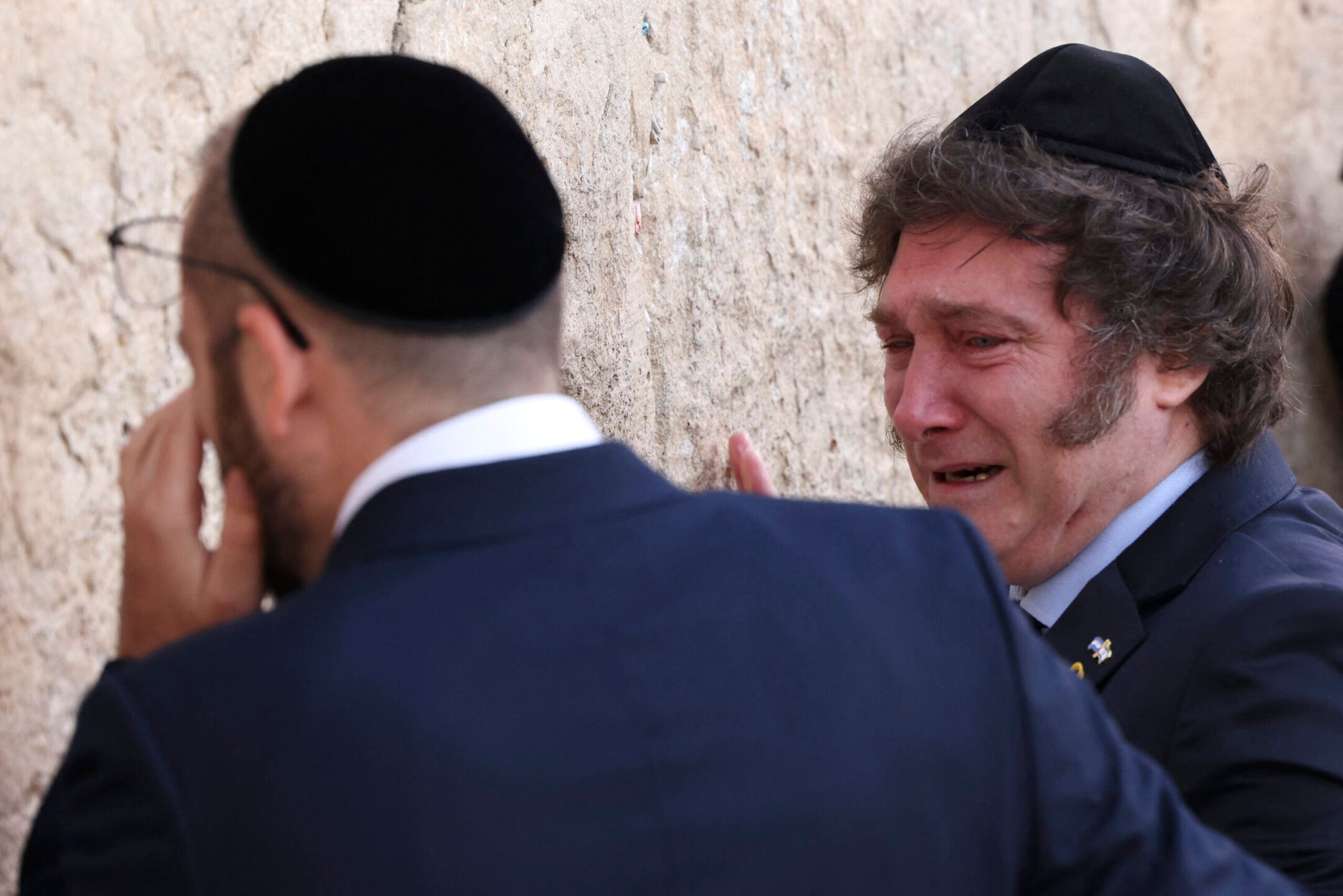
Argentina’s President Javier Milei, right, shown on visit to the Western Wall in Jerusalem’s Old City in 2024, has transformed Argentina’s foreign policy toward Israel, shifting the country from a more critical stance to one of close support. (Ronald Schemidt/AFP via Getty Images)
Spain since the 1970s has tried to redress its 15th and 16th centuries persecution, mass torture and expulsion of Jews by highlighting the country’s Jewish past and inviting Jewish immigration. Its fascist regime was ostensibly neutral but practically allied with Nazi Germany. More recently, it has reported a spike in antisemitic attacks.
Some Argentinians have shot back at the narrative that theirs is the pro-Israel team.
“No Argentinian that is a real Argentinian supports Israel,” one supporter said in a widely circulated video taken after the country’s semifinal win against England. “Don’t believe our f–ing president that has been put with money there.”
Others have pointed to Diego Maradona, the late, all-time Argentina soccer great who once told Mahmoud Abbas, “My heart is Palestinian.”
Argentina supporters and Messi loyalists cheered on the country during a recent watch party in Gaza.
In Israel, a recent poll by a magazine found that Argentina was the clear favorite among Israeli World Cup viewers, named by 38% of respondents as the team they hope wins the tournament.
Jewish entertainer and podcaster Jonah Platt offered a breakdown of “the Jew view” of the final four World Cup teams — Argentina, Spain, France and England — earlier this week, giving Argentina the highest score of “who Jews should root for.” Spain, whose government is “going for Western Europe’s gold medal in anti-Israel hysteria,” wrote Platt, was ranked last.
Reporting the stories that define our era. When history unfolds in real-time, the Jewish world turns to JTA. Your support ensures we can document the complexities of war and the resilience of Jewish communities with integrity.