Просмотр новости
Найдите то, что Вас интересует
 Спутники
 РН
РН SpaceX
 Роскосмос
 NASA
NASA
СпутникиРНSpaceXРоскосмосNASAThe American Ornithological Society (AOS) bestows the Wesley Lanyon Award every two years on an early-career ornithologist who authors the best integrative avian science review paper published in either AOS …
The post The American Ornithological Society (AOS) announces the winner of the 2025 Wesley Lanyon Award appeared first on American Ornithological Society.
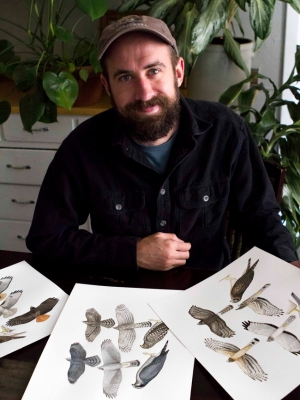 Bryce Robinson, Ph.D.
The American Ornithological Society (AOS) bestows the Wesley Lanyon Award every two years on an early-career ornithologist who authors the best integrative avian science review paper published in either AOS journal (Ornithology or Ornithological Applications). The award is given in honor of Wesley “Bud” Lanyon, who served as the 37th President of the American Ornithologists’ Union, one of the AOS’s predecessor societies. The 2025 AOS Wesley Lanyon Award is given to lead author Bryce W. Robinson for his 2024 paper, “Plumage polymorphism in raptors,” which was published in the AOS journal Ornithology. Dr. Robinson will convene a symposium on his research topic at the 2026 AOS Annual Meeting, this August in Amherst, Massachusetts.
“Dr. Robinson’s paper exemplifies the qualities of an outstanding review paper: It not only surveys the state of understanding of a field, it synthesizes that information to uncover previously obscure patterns, and articulates hypothesis tests for future research,” says Christie Riehl, Ph.D., Editor-in-Chief of Ornithology. “Dr. Robinson and colleagues surveyed the abundant, often confusing literature on plumage polymorphisms across birds of prey, providing a framework of hypotheses ranging from proximate mechanisms to ultimate selective pressures. The editorial board was impressed by the quality of the research and the writing, and by the thoughtful illustrations—each of which acts as its own mini-review. This paper is sure to serve as a fundamental reference for future studies on avian polymorphisms, and to guide and inspire new questions on this fascinating topic.”
The AOS journals seek to make high-quality ornithological research broadly available to researchers around the world. “Dr. Robinson’s work increases our knowledge on avian plumage variations helping to advance our understanding of birds,” Ornithological Applications Editor-in-Chief Judit Szabo, Ph.D., says.
Dr. Robinson earned his doctoral degree from Cornell University and the Cornell Lab of Ornithology in December 2025, advised by Irby Lovette, Ph.D., and Jen Walsh, Ph.D. He received his M.S. from Boise State University in 2016, and B.S. from the University of Utah in 2011. Dr. Robinson’s research integrates museum science with field ecology to study evolution and maintenance of trait diversity and plumage polymorphisms in raptors. He is also an ornithological illustrator and weaves his illustrations into many aspects of his work, including figures in publications as well as field guides. In January of 2026, Dr. Robinson started a new position as a postdoctoral researcher with the Birds of the World team at the Cornell Lab of Ornithology.
Abstract: Trait polymorphisms are a perennially popular topic of study in ecology and evolutionary biology. Plumage polymorphisms occur broadly in birds, with a particularly high rate among the raptors. The regularity of this heritable, melanin-based trait in raptors has prompted research into its potential connections to aspects of life history such as immune response, foraging ecology, and mating systems. Because raptors are a non-monophyletic grouping of multiple orders, they can further be leveraged to explore the eco-evolutionary drivers of recurrent plumage polymorphism phenotypes. Here we characterize plumage polymorphism throughout the raptors and review the existing literature on factors involved in its development and maintenance. We identify patterns and trends in this past body of research and discuss the opportunity to strengthen our understanding of plumage polymorphism through a holistic research approach. Specifically, we detail the likely benefits of applying genomic tools to plumage polymorphism research in raptors while encouraging both a focus on unstudied polymorphic species and on the potential interactions among multiple hypotheses that might promote plumage polymorphism.
Follow Dr. Robinson’s research: ORCID
Citation:
Robinson, B. W., I. J. Lovette, and J. Walsh (2024). Plumage polymorphism in raptors. Ornithology 141:ukae026.