Просмотр новости
Найдите то, что Вас интересует
 Спутники
 РН
РН SpaceX
 Роскосмос
 NASA
NASA
СпутникиРНSpaceXРоскосмосNASAThe Supreme Court declined to halt a Bombay High Court ruling on spectrum charges. This decision impacts Bharti Airtel and Vodafone Idea regarding past spectrum usage. The High Court had previously quashed the government's ₹3,300 crore demand. This levy was for spectrum held beyond 6.2 MHz between 2008 and 2012. The Centre has now appealed this judgment to the Supreme Court.
Synopsis
The Supreme Court declined to halt a Bombay High Court ruling on spectrum charges. This decision impacts Bharti Airtel and Vodafone Idea regarding past spectrum usage. The High Court had previously quashed the government's ₹3,300 crore demand. This levy was for spectrum held beyond 6.2 MHz between 2008 and 2012. The Centre has now appealed this judgment to the Supreme Court.
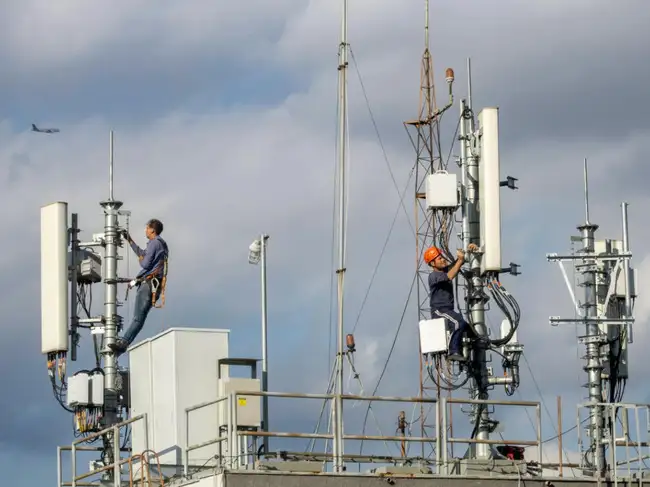 SC refuses to stay Bombay HC order quashing ₹3,300-cr spectrum levy
New Delhi: The Supreme Court on Friday refused to stay a June 8 Bombay High Court order that set aside the government's one-time spectrum charge (OTSC) demand raised against Bharti Airtel, Vodafone Idea and others for the 2008-2012 period.
A bench of justices BV Nagarathna and R Mahadevan, while issuing notices to the companies on the government's appeal, said it would consider whether to tag it with pending appeals filed by the telcos against a Madras High Court decision upholding the government demand. The apex court also refused to stay the Bombay HC order for the release of bank guarantees worth ₹3,300 crore. The high court held that the government was unable to justify its action of levying OTSC retrospectively.
Also Read: Telecom regulator rejects DoT views, stays firm on satcom spectrum fee
Challenging the Bombay HC's judgment, the government told the SC that the HC erroneously quashed its November and December 2012 decisions made after the Union Cabinet approved retrospective levy of OTSC for spectrum in the 900 MHz and 1800 MHz bands. In addition, the HC quashed the demand notices of January 2013 and June 2018, it said.
Additional solicitor general Vikramjit Banerjee argued that spectrum is a scarce public resource that must be priced at market value. "Spectrum belongs to the people. I hold it in trust. It's a privilege which is given to them. They are telecom companies. They should give a market rate," he said.
Telecom companies, while stressing the need for certainty in business, told the SC that they could not be subjected to substantial additional financial demands years after spectrum was allocated and payments were made under the licence regime.
According to the government, there is no illegality, arbitrariness or violation of licence and provisions of law in imposing OTSC as the same is strictly in accordance with law and with the provisions in the licence agreement with the telecom service providers. Besides, the revenue share under the Unified Access Service Licence and one-time spectrum charges operate in distinct fields, it said, justifying OTSC as a way to ensure equality and a level playing field among all telecom operators.
Also Read: HC quashes ₹23,600 cr retrospective spectrum dues on Airtel, Voda Idea
While revenue share is a recurring payment linked to spectrum usage and calculated as a percentage of the adjusted gross revenue, the one-time spectrum charge is intended to capture the economic value of additional spectrum held beyond the prescribed threshold, it said. Spectrum being a material resource of the public, the amounts to be recovered as OTSC were to be utilised for the common good, it said.
According to the appeal, the HC "erred" in holding that the enhanced revenue share payable by the licensees constituted complete consideration for spectrum allocated and, therefore, no additional charge could be levied.
( Originally published on Aug 07, 2026 )