Просмотр новости
Найдите то, что Вас интересует
 Спутники
 РН
РН SpaceX
 Роскосмос
 NASA
NASA
СпутникиРНSpaceXРоскосмосNASAChina’s wild Asian elephant population has grown steadily in recent decades as conservation efforts improve habitats and reduce human-elephant conflicts.
(ECNS) -- China’s wild Asian elephant population has grown steadily in recent decades as conservation efforts improve habitats and reduce human-elephant conflicts.
Asian elephants in China are mainly found in Yunnan Province, particularly in Xishuangbanna Dai Autonomous Prefecture and the cities of Pu’er and Lincang.
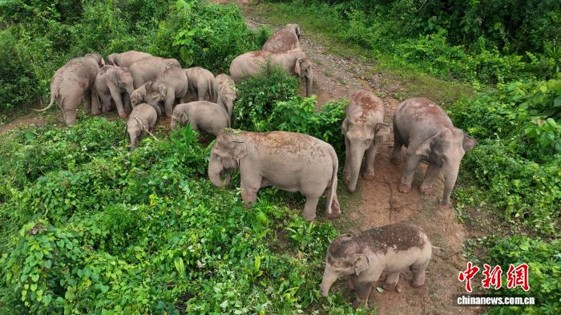
A herd of Asian elephants walks through a forest in Jiangcheng Hani and Yi Autonomous County, Pu’er, Yunnan Province. (Photo: China News Service/ Wang Zhengxi)
In 2021, a herd of wild elephants that traveled more than 1,400 kilometers attracted global attention and drew greater interest to China’s wildlife conservation efforts.
Yunnan has introduced a range of measures to promote coexistence between humans and Asian elephants, including habitat restoration, monitoring and early-warning systems, compensation for elephant-related losses, and the construction of protective facilities.
Through these efforts, China’s wild Asian elephant population has increased from about 150 in the 1980s to nearly 400 today, according to a report released by the National High-end Think Tank of Xinhua News Agency.
The report noted that China’s wild elephant population has continued to grow steadily, with five elephant calves born at Xishuangbanna Wild Elephant Valley, an Asian elephant conservation and education site, in 2026.
China’s wildlife conservation efforts have also gained broader public support. On World Elephant Day, which fell on August 12, various activities were held across Yunnan to raise public awareness of elephant conservation.

Rescued Asian elephant Yangniu enjoys her birthday cake at Xishuangbanna Wild Elephant Valley in Yunnan Province. August 12, 2026. (Photo: China News Service/ Bai Chenyue)
On the same day, Xishuangbanna Wild Elephant Valley held a special birthday celebration for Yangniu, an Asian elephant that was rescued and raised by humans after being abandoned by her herd as a newborn in 2015.
(By Helen Mo, intern Liu Shuangjing)


| # | Наименование новости | Тональность | Информативность | Дата публикации |
|---|---|---|---|---|
| 1 | На открытии COP15 в китайском городе Куньмин показали ролик про диких азиатских слонов | 0 | 0 | 14-10-2021 |
| 2 | CGTN: Мигрирующее стадо диких азиатских слонов в Юньнане останавливается на отдых | 0 | 0 | 09-06-2021 |
| 3 | Are Asian elephants losing their homes? The facts tell a different story | 0 | 11.55 | 16-08-2026 |
| 4 | Рост численности слонов в Зимбабве разрушает среду обитания диких животных | 0 | 0 | 11-11-2021 |
| 5 | Greetings from a wildlife park in central Sri Lanka that's a haven for elephants | 0 | 7.51 | 06-08-2026 |
| 6 | Население Китая в 2020 году увеличилось на 0,83% | 0 | 0 | 11-05-2021 |
| 7 | WWF: амурским тиграм становится тесно в Приморье | 0 | 0 | 18-10-2018 |
| 8 | Власти Китая больше не считают панду вымирающим видом животных | 0 | 0 | 09-07-2021 |
| 9 | 300 millones de trabajadores y una estrategia de décadas: así está disparando China su superficie forestal | 0 | 7.13 | 16-07-2026 |