Просмотр новости
Найдите то, что Вас интересует
 Спутники
 РН
РН SpaceX
 Роскосмос
 NASA
NASA
СпутникиРНSpaceXРоскосмосNASAAccess controls over US technology dominated talks around last week’s Pax Silica semiconductor and AI supply chain summit in Washington DC. It began with the addition of 10 countries to […]
The post 10 countries join Pax Silica but access to AI still an issue appeared first on Electronics Weekly.
Access controls over US technology dominated talks around last week’s Pax Silica semiconductor and AI supply chain summit in Washington DC.
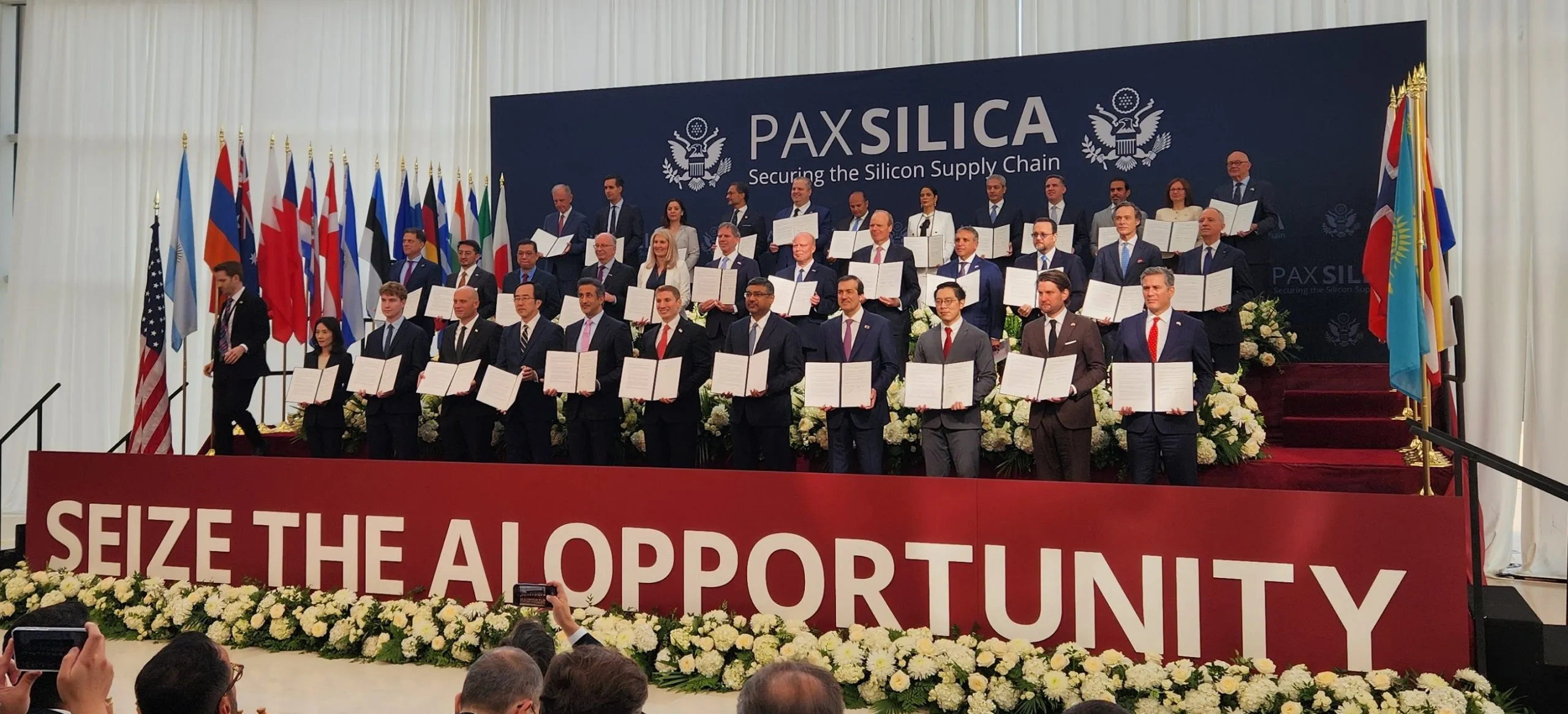 It began with the addition of 10 countries to the US-led initiative. They extend its influence in manufacturing and raw materials and bring membership to 24 countries.
But the closed-door meeting was overshadowed by the Trump administration’s application of a case-by-case approvals regime for OpenAI’s GPT-5.6 family. It joined the existing ban on foreign access to Anthropic’s Mythos and Fable models.
Indian media said its representative received assurances that “access will not be an issue” for programme members. But other diplomats sought more on how this would be managed.
“This ‘kill switch’ issue is a persisting concern. That was made very clear by a number of us. What we need is clarity from our American partners,” one delegate told Electronics Weekly.
The issue covers hardware and software. It has been a growing concern for US allies since the Biden administration sought to restrict the access of countries including EU member states to advanced Nvidia devices under its AI Diffusion Rule (albeit now abandoned by the Trump administration).
Pax Silica nevertheless continues to expand, although beyond the principle of seeding a technology supply chain with fewer dependencies on China, the agreement remains non-binding.
The EU raised its membership from observer to full. The Netherlands and Germany also joined, bringing key fab suppliers such as ASML in lithography and Carl Zeiss in optics under the programme’s umbrella.
Among other influential European economies, France and Denmark remain outside. Italy is expected to sign imminently. The UK was a founder in December 2025.
There major materials suppliers have joined. Kazakhstan is Central Asia’s largest mining economy. Most of its uranium offtakes are contracted to China and Russia but it has hefty deposits of tungsten, copper, and rare earth elements. Chile and Argentina are leading sources of copper and lithium.
Other signatories were Costa Rica, El Salvador, Greece, and Panama. Baltic innovation hub Estonia has become an observer.

Caroline Hayes is the editor of Electronics Weekly. She has been covering the electronics industry for over 30 years, edited UK and pan-European titles and contributed to UK and international online and print publications. Although specialising in the semiconductor market, she also has a keen interest in education, careers and start-up opportunities in the broader electronics industry.
| # | Наименование новости | Тональность | Информативность | Дата публикации |
|---|---|---|---|---|
| 1 | Wired for War: Pax Silica is AI slavery disguised as strength | -7 | 6 | 27-06-2026 |
| 2 | Reuters: США решили потребовать от других стран не работать с Китаем в сфере ИИ | 0 | 9.58 | 15-08-2026 |
| 3 | Data sovereignty emerges as the defining moat in the agentic AI era | 0 | 4.85 | 09-07-2026 |
| 4 | Don’t surrender data control in pursuit of intelligence | 0 | 5.35 | 28-06-2026 |
| 5 | Ardian Semiconductor invests in Vsora | 0 | 8.06 | 08-07-2026 |
| 6 | Washington tells allies to pick a side in the AI race | 0 | 20.36 | 17-08-2026 |
| 7 | OnTopic: AI data center providers seek power and bandwidth promise in co-packaged optics | 0 | 17.69 | 01-04-2026 |
| 8 | Nvidia's China-bound H20 AI chips face Beijing scrutiny over ‘tracking' and security concerns | 0 | 7 | 31-07-2025 |
| 9 | Embedded: Ambient Scientific integrates 10 AI cores in GPX10 Pro | 0 | 13.33 | 18-03-2026 |
| 10 | Nvidia's China-bound H20 AI chips face Beijing scrutiny over ‘tracking' and security concerns | 0 | 5 | 31-07-2025 |