Просмотр новости
Найдите то, что Вас интересует
 Спутники
 РН
РН SpaceX
 Роскосмос
 NASA
NASA
СпутникиРНSpaceXРоскосмосNASAAt this moment, power within U.S. higher education is overwhelmingly concentrated within governing boards and governments, particularly federal and state. To better protect higher education from political attacks intended to restrict or distort its work, that power needs to be spread out to two groups with deeper practical expertise and less uniform alignment with particular ideologies: actual workers on college campuses and accreditors.
For individual college campuses, we have to find ways to create robust centers of power and collective action for faculty and staff (as appropriate for their work category). Shifting some of the power concentrated within governing boards to higher education workers could happen via a number of channels but, given the likelihood that this will not be a board-driven decision, it will require external pressure on the boards to make changes. I reviewed research and polled several higher education boards experts in the United States as background for this post. One of the key pressure points to shift the power concentrated within boards would be for faculty, staff, students, and alumni to use their First Amendment rights to advocate for the future of higher education. In order for that to happen, we would have to restructure our environment to make it easier for faculty and staff to participate in collective action.1
1. Universities have also heavily curtailed students’ First Amendment rights but given the amount of focus others have provided that topic, I wanted to ensure that faculty and staff receive focus.
Creating the capacity for higher education workers to exercise their First Amendment rights would require bolstering the conditions that make collective action more likely, including access to robust mutual aid funds, education on labor rights, and zealous legal representation. I want to highlight the mutual aid point. A key reason workers give for not standing up against censorship and oppression is the potential loss of their job, and its commensurate benefits, and potential retaliation from their employer. Even when workers believe that ultimately they will be able to successfully sue their employer if they are fired, as several have recently done, a substantial portion of workers do not have robust enough savings to survive while legal proceedings advance. A structure that allows for collective action in other industries, up to and including strikes, is the existence of centralized funds that are made available to members. Robust mutual aid funds (coordinated at the state or national level), could foster an environment where faculty and staff are less willing to quietly go along with political repression. Empowering faculty and staff is a critical first step to being able to rebalance power distribution and advance additional remedies (e.g., reconstructing board membership to include more people with higher education expertise including faculty, staff, and students). Boards are unlikely to make changes like this on their own. The primary option to secure this change would be to find ways to strongly persuade them that this is a better alternative than their other choices.
Turning to government concerns, in U.S. higher education, we have a triad system used to hold colleges and universities accountable. The triad is comprised of the federal government, state governments, and accreditors. We have allowed one leg of the accountability triad, accreditors, to be severely weakened. While states and the federal government have increased their power over colleges and universities, accreditors have fallen back. This reality affects undergraduate and graduate education. Historically, accreditors were a key force in the push to racially integrate colleges and universities. Scholars note the way that the Southern Association of Colleges and Schools directly intervened to ensure that the leadership of states like Alabama were aware that failure to integrate would result in the loss of their accreditation and ability to do things like receive Title IV funds for federal financial aid. In our present moment, accreditors have allowed outright politicization of varied processes, including the University of Florida’s search for a new president which includes what could be described as a political litmus test, several Texas public universities’ restrictions on what can be taught and researched, and more. The Trump administration is currently proposing a complete overhaul of accreditation, which would allow for even further weakening of the system and the ability for less reputable organizations to become accreditors. To intervene, and shore up the accountability powers of accreditors, academic communities and other concerned stakeholders would need to provide robust public comments as the federal government presented new rules and regulations on college accreditation and be prepared to aggressively pursue legal action when the final rules are determined if there are violations of the law.
I have focused this piece on concrete solutions to reduce the concentration of power for everyday members of the academic community. Regardless of the method used, a greater dispersion of power and authority is a necessary step to ensure the capacity for free expression within the U.S. higher education system.
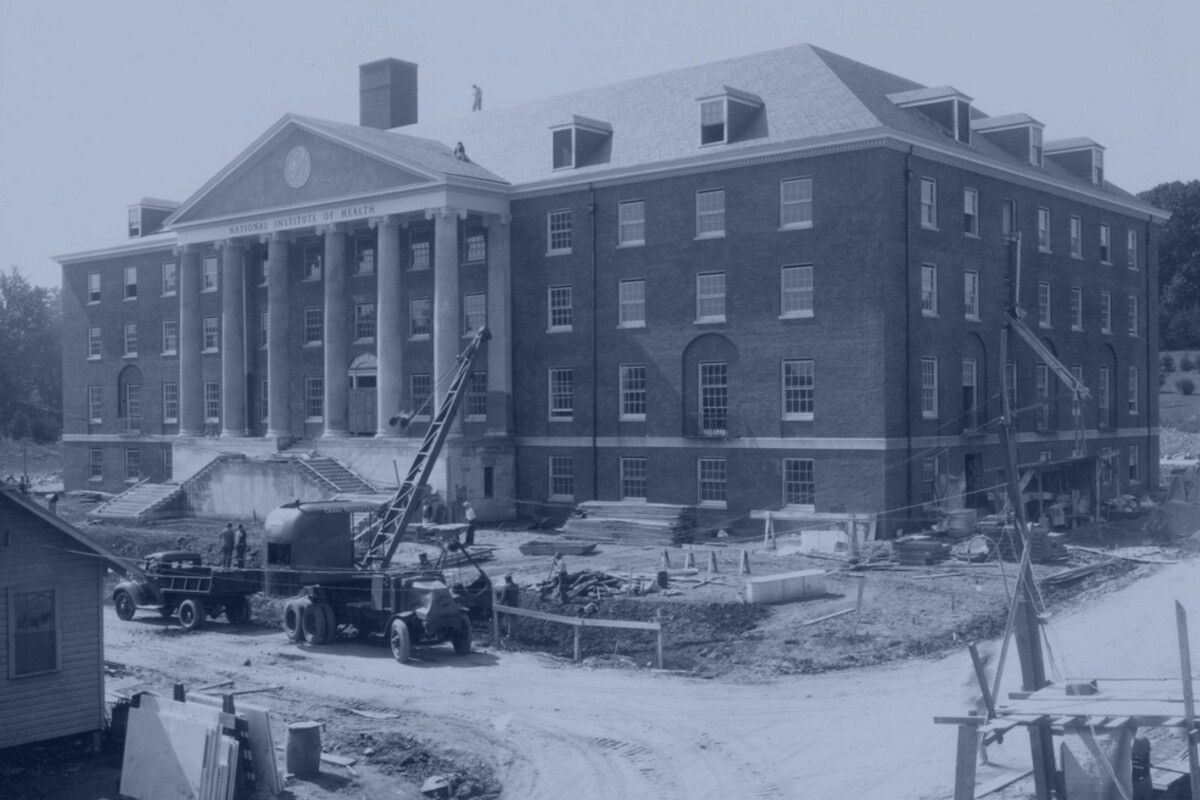 Construction of Building One of the National Institutes of Health, 1938
An initiative focused on strengthening our system of free expression to better protect democracy against authoritarian attacks
At this moment, power within U.S. higher education is overwhelmingly concentrated within governing boards and governments, particularly federal and state. To better protect higher education from political attacks intended to restrict or distort its work, that power needs to be spread out to two groups with deeper practical expertise and less uniform alignment with particular ideologies: actual workers on college campuses and accreditors.
For individual college campuses, we have to find ways to create robust centers of power and collective action for faculty and staff (as appropriate for their work category). Shifting some of the power concentrated within governing boards to higher education workers could happen via a number of channels but, given the likelihood that this will not be a board-driven decision, it will require external pressure on the boards to make changes. I reviewed research and polled several higher education boards experts in the United States as background for this post. One of the key pressure points to shift the power concentrated within boards would be for faculty, staff, students, and alumni to use their First Amendment rights to advocate for the future of higher education. In order for that to happen, we would have to restructure our environment to make it easier for faculty and staff to participate in collective action.
Creating the capacity for higher education workers to exercise their First Amendment rights would require bolstering the conditions that make collective action more likely, including access to robust mutual aid funds, education on labor rights, and zealous legal representation. I want to highlight the mutual aid point. A key reason workers give for not standing up against censorship and oppression is the potential loss of their job, and its commensurate benefits, and potential retaliation from their employer. Even when workers believe that ultimately they will be able to successfully sue their employer if they are fired, as several have recently done, a substantial portion of workers do not have robust enough savings to survive while legal proceedings advance. A structure that allows for collective action in other industries, up to and including strikes, is the existence of centralized funds that are made available to members. Robust mutual aid funds (coordinated at the state or national level), could foster an environment where faculty and staff are less willing to quietly go along with political repression. Empowering faculty and staff is a critical first step to being able to rebalance power distribution and advance additional remedies (e.g., reconstructing board membership to include more people with higher education expertise including faculty, staff, and students). Boards are unlikely to make changes like this on their own. The primary option to secure this change would be to find ways to strongly persuade them that this is a better alternative than their other choices.
Turning to government concerns, in U.S. higher education, we have a triad system used to hold colleges and universities accountable. The triad is comprised of the federal government, state governments, and accreditors. We have allowed one leg of the accountability triad, accreditors, to be severely weakened. While states and the federal government have increased their power over colleges and universities, accreditors have fallen back. This reality affects undergraduate and graduate education. Historically, accreditors were a key force in the push to racially integrate colleges and universities. Scholars note the way that the Southern Association of Colleges and Schools directly intervened to ensure that the leadership of states like Alabama were aware that failure to integrate would result in the loss of their accreditation and ability to do things like receive Title IV funds for federal financial aid. In our present moment, accreditors have allowed outright politicization of varied processes, including the University of Florida’s search for a new president which includes what could be described as a political litmus test, several Texas public universities’ restrictions on what can be taught and researched, and more. The Trump administration is currently proposing a complete overhaul of accreditation, which would allow for even further weakening of the system and the ability for less reputable organizations to become accreditors. To intervene, and shore up the accountability powers of accreditors, academic communities and other concerned stakeholders would need to provide robust public comments as the federal government presented new rules and regulations on college accreditation and be prepared to aggressively pursue legal action when the final rules are determined if there are violations of the law.
I have focused this piece on concrete solutions to reduce the concentration of power for everyday members of the academic community. Regardless of the method used, a greater dispersion of power and authority is a necessary step to ensure the capacity for free expression within the U.S. higher education system.
Universities have also heavily curtailed students’ First Amendment rights but given the amount of focus others have provided that topic, I wanted to ensure that faculty and staff receive focus.
Dominique J. Baker is an associate professor of education and public policy at the College of Education and Human Development and at the Joseph R. Biden, Jr. School of Public Policy and Administration at the University of Delaware.
Filed Under Tags