Просмотр новости
Найдите то, что Вас интересует
 Спутники
 РН
РН SpaceX
 Роскосмос
 NASA
NASA
СпутникиРНSpaceXРоскосмосNASAOzempic and GLP-1 are the gateway drugs to a truly healthy lifestyle. We have the means to massively lower the obesity rate in the population and make real changes in behavior. People thought this was impossible BUT it is not. We can get most people to a healthy weight and healthy lifestyle that includes weight ... Read more
Ozempic and GLP-1 are the gateway drugs to a truly healthy lifestyle. We have the means to massively lower the obesity rate in the population and make real changes in behavior. People thought this was impossible BUT it is not. We can get most people to a healthy weight and healthy lifestyle that includes weight training.
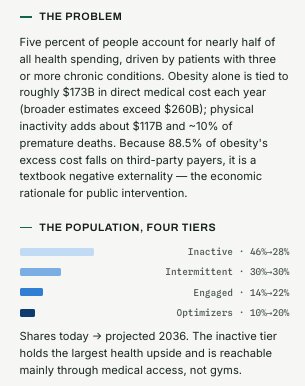
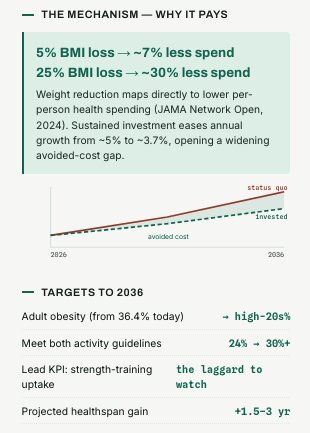
Chronic disease is on track to cost the US up to $47 trillion between 2024 and 2039 — about $2.2 trillion a year in medical costs plus nearly $900 billion in lost productivity by 2039 — with 5% of people driving nearly half of all spending. Crucially, the same analysis finds that better prevention and obesity management could prevent 150 million new chronic-disease cases, save 13.5 million lives, and avoid $7 trillion in costs over that window, with even modest behavior change worth ~$125 billion/year and optimistic scenarios ~$465 billion/year. And the mechanism is quantified, a 5% BMI reduction is associated with ~7% lower health spending, and a 25% reduction with ~30% lower spending. That’s the entire economic case in one chain — and it’s why this is prevention spending, not consumption.
 Screenshot
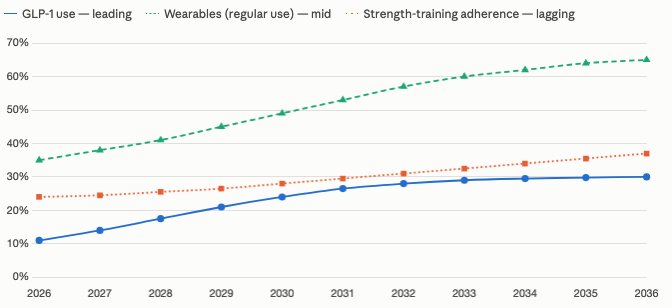
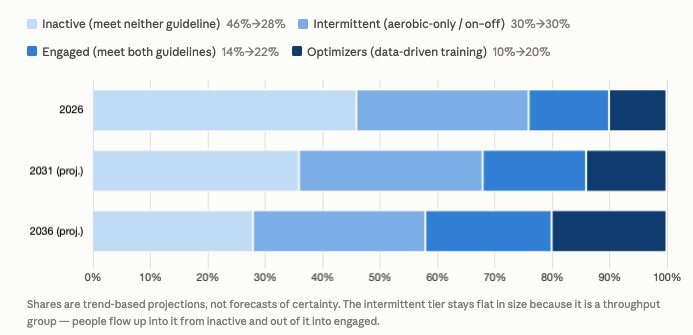
GLP-1 is the leading indicator — it moves first and fastest because it’s a prescription that requires one decision, not a sustained habit, so it inflects early and plateaus as it saturates the eligible population. Wearables are the middle signal, tracking gradual consumer diffusion. Strength-training adherence is the lagging indicator — it’s the hardest behavior to shift and the one most gated on the drug and the culture moving first. That ordering matters for policy: the drug pulls the behaviors, not the reverse, so the cheapest way to move the lagging curve up is to attach behavioral scaffolding to the leading one.
 Screenshot
 Screenshot
Suggested policy
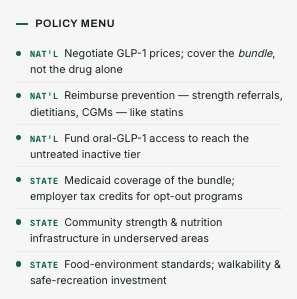
Negotiate GLP-1 prices down (Medicare/Medicaid coverage tied to a bundled program rather than the drug alone), fund oral-GLP-1 access to reach the inactive tier, and — the highest-ROI structural move — reclassify prevention as reimbursable so payers cover strength-training referrals, dietitian time, and CGMs the way they cover statins. The economic rationale is airtight because 88.5% of obesity’s cost increase falls on third-party payers, which is a textbook negative externality justifying public intervention.
 Screenshot
State policy, Medicaid coverage of the bundle, employer tax credits for opt-out wellness programs, community strength-and-nutrition infrastructure in the underserved areas where the inactive tier concentrates, school and municipal food-environment standards, and built-environment investment (walkability, safe recreation).
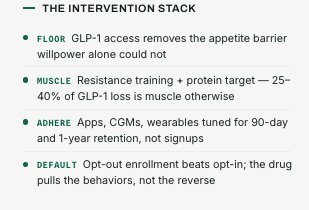
The design principle throughout is default/opt-out enrollment beats willpower, and bundle the drug with muscle-preserving training and protein so the weight lost is fat, not muscle.
 Screenshot
Screenshot
Screenshot
 Screenshot

Brian Wang is a Futurist Thought Leader and a popular Science blogger with 1 million readers per month. His blog Nextbigfuture.com is ranked #1 Science News Blog. It covers many disruptive technology and trends including Space, Robotics, Artificial Intelligence, Medicine, Anti-aging Biotechnology, and Nanotechnology.
Known for identifying cutting edge technologies, he is currently a Co-Founder of a startup and fundraiser for high potential early-stage companies. He is the Head of Research for Allocations for deep technology investments and an Angel Investor at Space Angels.
A frequent speaker at corporations, he has been a TEDx speaker, a Singularity University speaker and guest at numerous interviews for radio and podcasts. He is open to public speaking and advising engagements.