Просмотр новости
Найдите то, что Вас интересует
 Спутники
 РН
РН SpaceX
 Роскосмос
 NASA
NASA
СпутникиРНSpaceXРоскосмосNASAAt age 85, Rufus Edmisten has had one of the longest and most colorful careers of any living figure in North Carolina politics. As a young aide to U.S. Sen. Sam Ervin, he delivered the subpoena for the Nixon tapes in the Senate’s Watergate investigation. Then he came back to North Carolina and served as attorney general and secretary of state.
Published July 31, 2026 at 4:30 PM EDT
At age 85, Rufus Edmisten has had one of the longest and most colorful careers of any living figure in North Carolina politics.
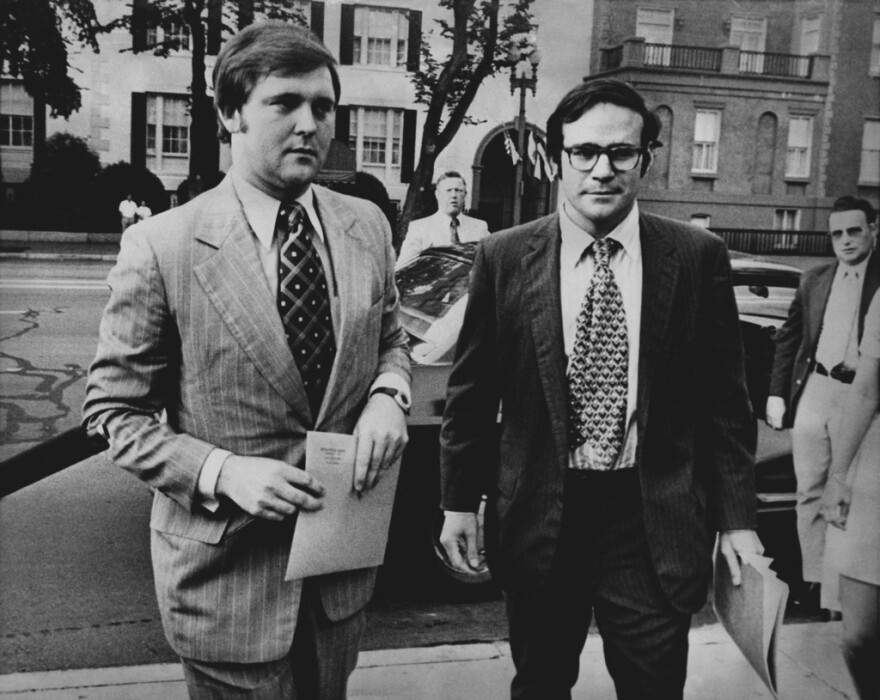
As a young aide to U.S. Sen. Sam Ervin, he delivered the subpoena for the Nixon tapes in the Senate’s Watergate investigation. Then he came back to North Carolina and spent a decade as attorney general, before making a run for governor and then becoming secretary of state in the ‘90s.
Edmisten joined the WUNC Politics Podcast to talk about that history and how today's politics compares to earlier eras like Watergate. He’s mostly retired now, co-hosting a popular gardening radio show and working on a book about civility that he plans to publish later this year.
This conversation has been lightly edited for brevity and clarity.
Vice President J.D. Vance recently said he thinks Watergate would be, in his words, a "12-hour news story" if it happened today. Do you think he's right? Has politics changed dramatically?
"Maybe so, but that doesn't reflect very well on him and the administration to say something like that. He has to remember that Watergate, at that time, was another attempt on the part of a president to subvert the Constitution, to overblow the powers of the executive branch. And Nixon, when you look at the tapes, he's a crook.
"I don't think that that J.D. Vance knows much about history. It pains me today, though, to see the total wreckage of the separation of powers system that was so carefully put together by the Founding Fathers."
AP Photo
/
Charles W. Harrity
Do you think Congress back then handled this kind of thing differently? Was Congress less deferential to the president, or was it the dynamics of you had Democratic majorities in Congress and a Republican president?
"Fifty years ago in the Senate and the House, you had all kinds of hearings before Watergate about excursions into the excesses of executive power. The Congress and especially the Senate revered their place in the constitutional order.
"There was a certain sort of civility in government at that time, where people were not screaming at one another. They were holding hearings and asking definite questions, not making stump speeches about how awful one another is. It's a totally different kind of venue today, where you have people at one another's throats for partisan gain. Very little hearings go on that are not brawls."
Your first book, That's Rufus: A Memoir of Tar Heel Politics, Watergate and Public Life came out a few years ago, on your career and life in politics. Tell me more about the new book you're writing.
"In this time when everybody's at one another's throats, and the advent of the — I call it almost evil, of the Internet and social media — something is wrong there. My premise is that you've got to learn to control the 'brain send button.' You don't really have to like someone to be civil. You can see somebody that you know is just a jerk, but you can be civil. You can even walk away. You don't have to tear somebody down.
"One of my examples is (former UNC System) President Bill Friday, one of the most civil people I've ever met. I'm using Gov. Jim Martin, the guy who whooped me when I ran for governor in 1984. I don't recall any time he ever said an ugly word about me, and I don't remember saying one about him. It can be done."
Given your experience — the front-row seat to Watergate, having faced your own minor scandal in the '90s as secretary of state — when someone in political life comes to you and they're facing some kind of political scandal, what's your advice on how to handle that with the kind of civility and grace that you're calling for in politics?
"I say, 'look, I feel your pain,' and then I say, 'the best thing for you to do is own up to it.' That little skirmish back when I was secretary of state ... I owned up to it, and I think I did the right thing.
"Trying to make the press your enemy is the wrong thing to do because you don't win, and you feel much better if you own up to it and try to show humility. It can get you over that. ... I always tell people, 'just look around and see if you were not a good deal of the problem, and fix yourself."
Listen to more of the conversation on the WUNC Politics Podcast, including how Loretta Lynn helped Edmisten get nicknamed “the Singing Attorney General” and how he landed his role in the Senate Watergate investigation.
| # | Наименование новости | Тональность | Информативность | Дата публикации |
|---|---|---|---|---|
| 1 | Stein pulls Department of Public Safety nomination, cites NC Senate's unwillingness to hold hearing | 0 | 5.46 | 10-08-2026 |
| 2 | North Carolina congressman Edwards quits reelection bid after committee finds inappropriate conduct | 0 | 5.74 | 05-08-2026 |
| 3 | North Carolina congressman Edwards quits reelection bid after committee recommends his censure | 0 | 6.69 | 05-08-2026 |
| 4 | NC legislature adjourns until election, and Democrats fear a 'lame-duck' session | 0 | 10.94 | 07-08-2026 |
| 5 | WNC Republicans to choose candidate to replace Rep. Chuck Edwards on November ballot | 0 | 11.72 | 06-08-2026 |
| 6 | Ossoff presses Clayton on who won 2020 election | 0 | 10.74 | 15-07-2026 |
| 7 | Ethics panel says Rep. Chuck Edwards violated ‘spirit’ of sexual harassment policies, recommends censure | 0 | 6.53 | 03-08-2026 |
| 8 | Ethics panel recommends House censure Rep. Chuck Edwards for conduct with two aides | 0 | 6.68 | 03-08-2026 |
| 9 | Нового директора нацразведки США Джона Рэтклиффа привели к присяге | 0 | 0 | 26-05-2020 |