Просмотр новости
Найдите то, что Вас интересует
 Спутники
 РН
РН SpaceX
 Роскосмос
 NASA
NASA
СпутникиРНSpaceXРоскосмосNASAChinese AI startup Moonshot AI's Kimi K3 has jolted the US technology industry, prompting companies to step up calls for Washington to promote open-weight AI models and ease regulation.A growing number of technology companies have backed an open letter from Microsoft urging the US government to eas
Chinese AI startup Moonshot AI's Kimi K3 has jolted the US technology industry, prompting companies to step up calls for Washington to promote open-weight AI models and ease regulation.
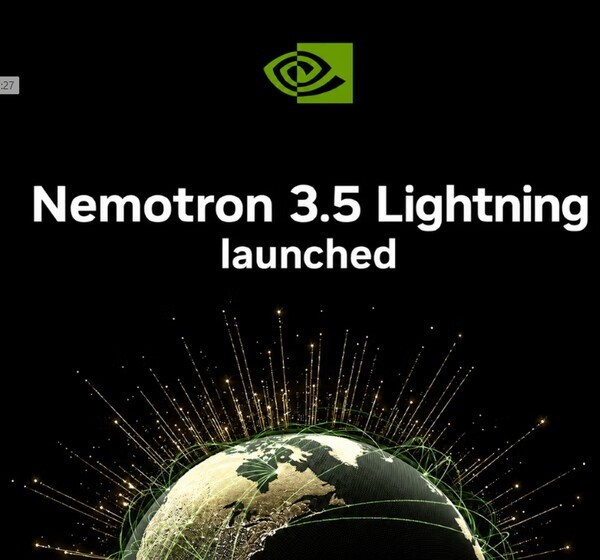
A growing number of technology companies have backed an open letter from Microsoft urging the US government to ease restrictions on open models and actively promote their development. Meta, which had been viewed as shifting strategically toward paid models after Llama, has released its open model Muse Glimmer. Nvidia, which has consistently advocated open models, has also unveiled Nemotron 3.5 Lightning, while reports have emerged that the company is preparing Nemotron 4, potentially the first US open model with 1 trillion parameters.
Meta's Muse Glimmer is a small model with 30 billion parameters, designed to run on consumer PCs and laptops. Distilled from Meta's frontier model Muse Spark, the smaller model offers reasoning, agentic capabilities, multimodal functions and coding capabilities.
What makes Muse Glimmer particularly significant is that it is an open model derived from Muse Spark. Meta is effectively returning its most advanced AI technology to the developer ecosystem. Meta CEO Mark Zuckerberg has also said the company will release the weights of Muse Spark 1.2, making clear that Meta has not abandoned its position as a leading advocate of open models.

Nvidia followed with the release of Lightning, the first model in its Nemotron 3.5 series. Nemotron 3.5 Lightning also has 30 billion parameters, while only 3 billion parameters are activated, making it a Mixture-of-Experts (MoE) model. It is the successor to the existing Nemotron 3 Nano 30B and, according to information registered on OpenRouter, is derived from Nemotron 3 Ultra, a large open MoE model with 550 billion parameters that Nvidia released in June. Nvidia's official materials list Nemotron 3 Ultra at 550 billion total and 55 billion active parameters.
The US IT publication The Information also reported that Nvidia is developing a new model family, Nemotron 4, with the goal of challenging the world's leading open-source models. People involved in the project reportedly said the largest model is expected to have at least 1 trillion parameters. The release date has not been determined, but the model could be unveiled as early as late fall, according to the report. Reuters also reported the same account, noting that Nvidia has not officially confirmed all of the reported details.
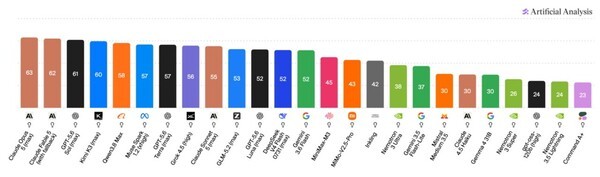
A 1 trillion-parameter model is not unusual among open models overall, but it would be exceptionally large for an open model released by a US company. Among Chinese open models, Moonshot AI's Kimi K2 was already in the trillion-parameter class. Kimi K3 has 2.8 trillion parameters, DeepSeek's flagship V4-Pro has 1.6 trillion, and Meituan's new open model LongCat-2.0 also has 1.6 trillion parameters. Kimi K3 is a 2.8-trillion-parameter MoE model with 104 billion active parameters, while DeepSeek lists V4-Pro at 1.6 trillion total and 49 billion active parameters. Meituan says LongCat-2.0 has 1.6 trillion total parameters and about 48 billion active parameters.
The shock wave from Moonshot AI's Kimi K3 extends beyond the AI industry. The US technology sector has become increasingly concerned that America's closed approach has not only allowed China to catch up in AI research but could soon allow China to overtake the US.
Even before Kimi K3, Google DeepMind CEO Demis Hassabis and OpenAI CEO Sam Altman, among others, said at the World Economic Forum in Davos, Switzerland, in January that the performance gap between Chinese models and US frontier models had narrowed to within six months. Kimi K3 appears to have dramatically narrowed that six-month gap, bringing China close to the US frontier.
The US government has said Kimi K3 was created through distillation of US frontier models and has considered banning its use amid concerns over cyber threats involving high-performance open models. But US technology companies broadly agree that banning open models is not a solution. Of particular concern to the US technology industry and academia is the possibility that the center of AI research could shift from the US to China.
US technology publication TechCrunch quoted Braden Hancock, co-founder of Snorkel AI and a research partner at the Laude Institute, as saying that the biggest impact of Chinese open models is not the possibility of embedding backdoors but "China owning the innovation." Laude Institute is a nonprofit foundation that supports open-source projects, startups and commercialization efforts aimed at turning computer science and AI research from universities and research institutions into real-world applications.
Open models are not developed and finished by a single company. Researchers and developers around the world can download, use, modify and improve them. As a result, once an open model developed in a particular country begins to be widely used by international researchers, experiments, papers and improvements can accumulate around that model. Hancock compared the process with the case of PyTorch.
PyTorch, a machine-learning and deep-learning framework, became an industry standard because it was open source, allowing contributions from a global community. Users continuously added improvements, enabling it to pull ahead of other deep-learning libraries and expand its influence. PyTorch was developed and released by Meta's AI research team, FAIR, originally Facebook AI Research.
In the same article, TechCrunch reported that the deeper concern among Hancock and other advocates of open models is the possibility that China could become the "locus of international research."
This does not simply mean that the number of global users of Chinese models will increase. Their concern is that while US AI companies pour enormous amounts of capital into developing closed models, rapidly advancing Chinese open models could shift AI innovation and research itself toward China.

In an interview with TechCrunch, Hancock claimed that "US graduate programs are already primarily building on open-weight Chinese models," and that roughly half of the papers students read for research come from Chinese institutions.
That means the foundation models on which researchers conduct the most experiments and write papers are increasingly Chinese models, while US graduate students studying and researching AI are also increasingly exposed to research and open models developed by Chinese institutions. That is happening because leading US AI laboratories have been reluctant to widely share their research results.
A new study released August 11, "Who Uses Open-Weight Models? China and the Shifting Geography of AI in Science," found that the share of open models used in scientific papers reached 44% in 2026, with the recent increase strongly associated with the emergence of high-quality Chinese open models. The study analyzed the full text of 21 million papers in the Semantic Scholar Open Research Corpus (S2ORC) through June 2026 and identified models that researchers explicitly stated they had used in their work.
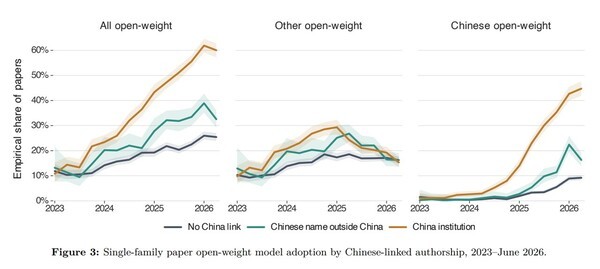
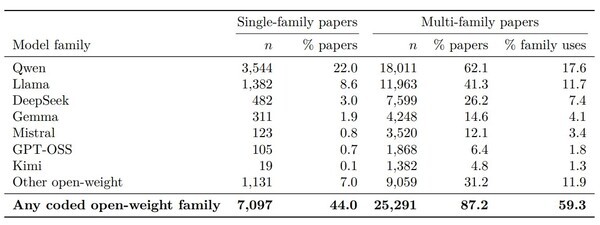
The study also divided research into two categories: studies using a single model family and those using multiple model families. Among papers using a single model family, the share of open models has steadily increased, reaching 44.0% in 2026. The study attributed the increase to the emergence of high-quality open models, particularly Chinese models, and said the figure has been pushed higher by Chinese researchers' extensive use of Chinese open models.
These concerns were already being raised late last year.
Andy Konwinski, co-founder of Databricks and co-founder of the Laude Institute, said the reason US AI research could fall behind China is not simply the performance of Chinese AI models, but also the increasingly closed nature of US AI research, which is weakening the structure through which ideas are freely shared within academia. He made the remarks in a November 14, 2025 TechCrunch article titled "Databricks co-founder argues US must go open source to beat China in AI."
Konwinski said that if researchers asked AI Ph.D. students at Berkeley and Stanford, they would say they had read twice as many interesting AI ideas from Chinese companies as from US companies over the previous year, citing the closed nature of US AI models as the reason.
Major US AI research companies including OpenAI and Anthropic continue to produce important innovations, but much of that innovation remains proprietary corporate intellectual property. It is not shared. Private companies, of course, cannot necessarily disclose the results of research produced with astronomical amounts of investment. Open models fill that role.
Through open models, research results can be shared and communities can conduct collaborative research, allowing ideas to gradually become concrete and more advanced. That process is difficult to find in US AI research, Konwinski said, describing the process through which scientists talk to one another and knowledge spreads as having "dried up."
He also argued that the Chinese government is encouraging domestic companies to open up AI research. China is encouraging companies including DeepSeek and Alibaba's Qwen to release AI technologies as open source, creating a cycle in which other research teams study and improve the publicly released technology before releasing their own advances.
The structure is important because it increases the likelihood of new innovations emerging, and Konwinski compared it with the Transformer, the core technology underlying today's generative AI. The Transformer was also disclosed in a research paper, allowing researchers around the world to study and build on it.
The concerns raised by Konwinski and Hancock point in the same direction. The US may currently have an edge in model performance, but the research ecosystem that creates the next generation of AI technologies could itself move to China. For that reason, Konwinski has argued that the US needs to become more open if it wants to stay ahead of China in the AI race.
Clem Delangue, CEO of Hugging Face, has made a similar argument. Restricting Chinese open models would not make AI safer, he said. Instead, it could hide risks, concentrate power in the hands of a few and make it harder for the next generation of developers, researchers, academia, nonprofits and governments to participate in AI safety.
Their argument is straightforward. The US can protect its frontier AI companies by blocking Chinese open models, but that would leave the US AI research ecosystem less open and, in the long term, would not prevent China from becoming the center of international AI research.
Blocking open models themselves is not the answer. But most of the high-quality open models worth using are Chinese models. The solution proposed by technology companies led by Microsoft is for the US government to ease regulations and actively promote policies that encourage development of open models in the US.
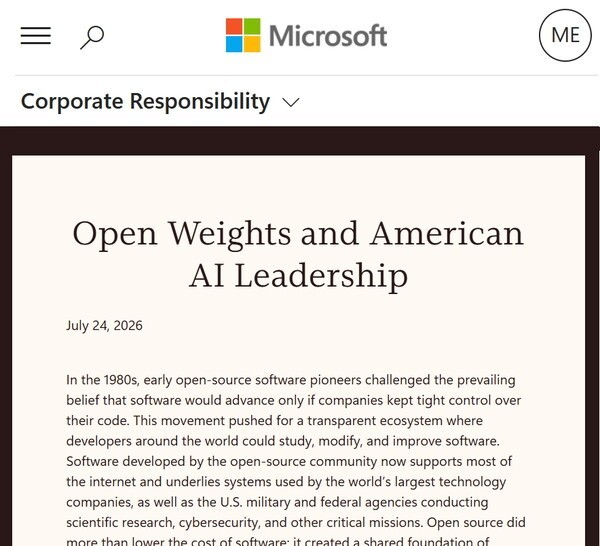
An open letter titled "Open Weights and American AI Leadership," led by Microsoft and signed by 25 technology companies including Nvidia and Meta late last month, made arguments broadly similar to those advanced by the researchers above. The letter was released July 24, 2026, and support has since expanded beyond the initial group.
The letter argues that the US should jointly address cyber threats associated with high-performance open models while recognizing open models as a way to strengthen US competitiveness and expand economic opportunities. It emphasizes that open models can promote "innovation and diffusion." The number of companies supporting the statement has continued to grow, rising from 25 at its initial announcement on July 24 to more than 270 companies and organizations as of the current count.
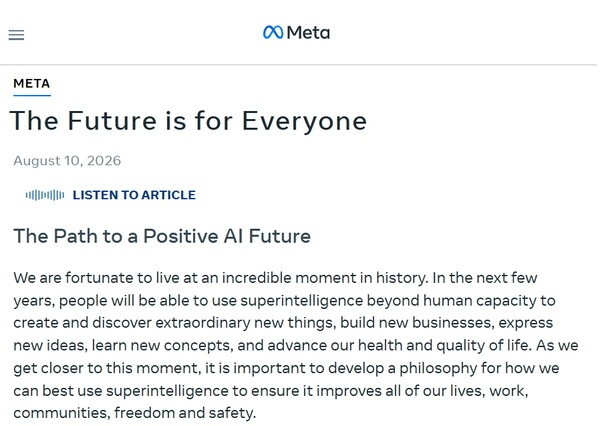
Alongside the release of Muse Glimmer, Meta CEO Mark Zuckerberg also argued in a lengthy essay titled "The Future is for Everyone" that the US should ease regulation of open AI. He warned that excessive regulation of open models could allow Chinese companies to move ahead of US companies in the open-model ecosystem, while also raising concerns about AI power becoming concentrated in a small number of companies or governments.
Some observers interpret Meta's move this way: AI leadership may ultimately belong not to the company with the highest-performing model, but to the ecosystem of developers and researchers that uses that model.
| # | Наименование новости | Тональность | Информативность | Дата публикации |
|---|---|---|---|---|
| 1 | Chinese AI model takes US tech industry by surprise with abilities rivaling Claude and ChatGPT | 0 | 7 | 17-07-2026 |
| 2 | China's Kimi K3 rattles US AI industry | 0 | 7 | 19-07-2026 |
| 3 | US aims to dominate AI but China’s open-source approach is unstoppable | 0 | 9.71 | 27-07-2026 |
| 4 | Major tech and AI companies warn the US government against curbing open-weight AI models | 0 | 12.36 | 24-07-2026 |
| 5 | China’s Kimi K3 and the rise of open-weight AI models | 0 | 11.07 | 23-07-2026 |
| 6 | Chinese AI model takes US tech industry by surprise with abilities rivaling Claude and ChatGPT | 2 | 7 | 18-07-2026 |
| 7 | Künstliche Intelligenz: „Vier Jahre amerikanische Bemühungen in Trümmern“: Chinas KI-Modelle streben an die Weltspitze | 0 | 20.41 | 26-07-2026 |
| 8 | As US weighs response to Chinese AI, industry urges against broad open-weight restrictions | 0 | 8.88 | 24-07-2026 |
| 9 | China is throwing a 1-2-3 punch at the global AI trade | 0 | 10.76 | 29-07-2026 |
| 10 | В OpenAI обеспокоились открытыми китайскими ИИ-моделями | 0 | 5 | 21-07-2026 |