Просмотр новости
Найдите то, что Вас интересует
 Спутники
 РН
РН SpaceX
 Роскосмос
 NASA
NASA
СпутникиРНSpaceXРоскосмосNASAResearch has long focused on understanding negative emotions like fear in animals. Now they’re trying to measure positive feelings like joy. It’s a challenge.
Can animals experience joy?
Well, of course — just look at my tuxedo cat, Tango. Every night, he waits atop the bed for his brother Teddy, a fat orange tabby that resembles a loaf of bread. When Teddy strolls by, Tango reaches out to snatch his brother’s tail with apparent glee.
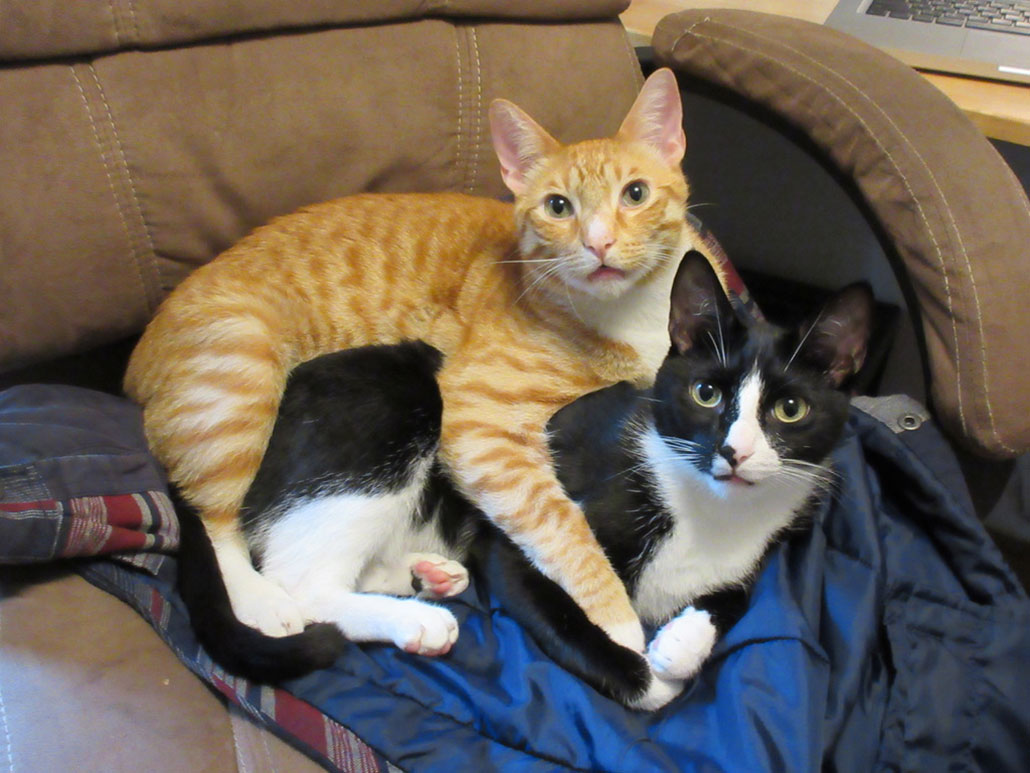 The author can see glee in her cats Tango (tuxedo) and Teddy (orange tabby), but she can’t be certain of any kitty emotions. It’s easy to misinterpret what she may be seeing.A. Dance
As animals ourselves, we think we see happiness in our fellow creatures all the time. Dogs romp in the park. Squirrels chase each other. Tango purrs his head off at night while attempting to sleep on my face. Yet I know that tail-snatch might not express glee. I can’t be certain what a creature that can’t speak to me is feeling. Sure, young squirrels could be playing. But adults are more likely to be chasing off a rival for their stored acorns or competing for a mate.
For decades, scientists haven’t paid much attention to good feelings in nonhuman animals. When they do study this, they call it “positive affect.” But they have struggled to identify or measure it. And they have been wary of anthropomorphism (giving human characteristics to nonhumans) and subjective topics like feelings.
Scientists were doubtful even after one study found that rats make a laughter-like sound when tickled. (Later studies found rats not just laughing, but also jumping for joy and playing hide-and-seek.)
Better tools to measure positive emotions could help. They’d let scientists more deeply investigate what causes happiness and how animals communicate it. And they could be used to support mental health among captive animals. The question has inspired a bold group effort to develop a “joy-o-meter.” This set of happiness tests, if it works, could help understand many critters, whether they walk, fly or swim.
Gordon M. Burghardt studied animal play for more than 40 years. He’s now retired from the University of Tennessee, Knoxville. He is not involved in the joy project, but he says it’s a good idea. He notes, “Positive affect is as much worthy of scientific study as studying pain and negative emotions.”
Defining joy“The overall goal of the project is to establish this serious, scientific approach to positive emotion in animals,” says Erica Cartmill. She’s a cognitive scientist at Indiana University Bloomington. Cartmill studies great apes. But she knew that they wouldn’t be enough to build happiness tests for all creatures. So she joined up with scientists who study dolphins and parrots.
The project quickly ran into challenges. “Studying emotions is actually really hard,” says Colin Allen. This team member is a philosopher at the University of California, Santa Barbara.
Submit your question here, and we might answer it an upcoming issue of Science News Explores
To keep it simple, Allen and the other scientists have focused on a strict definition of joy. For this project, they call “joy” an intense, brief, positive emotion triggered by an event. That event might be getting a favorite food or reuniting with a friend. Even with a strict definition, though, it’s tough. Animals vary a lot, even within the same species or group, they’re finding.
“You want to make sure that what you’re putting out there is based on reality, as opposed to just guessing what is happening in the animal’s mind,” says Heidi Lyn. She is a comparative psychologist at the University of South Alabama in Mobile. She is in charge of the project’s dolphin studies as well as some of the ape work.
Do our nearest relatives feel joy?The team began the work in apes, humankind’s closest relatives. Bonobos are known for playful behavior. Chimpanzees are considered more violent.
Wild chimps don’t have easy lives, says Gal Badihi. She’s a primatologist on the team. She spent three months following a chimp troop around in Senegal, in western Africa. Chimps deal with power struggles, competition and a constant search for food. Nonetheless, Badihi recorded moments that might be joyful.
For example, chimps played with infants. A baby called Youssa proved to be quite the goofball. He would hang upside down all the time. Other young chimps liked to drink from each other’s mouths or roll around giggling. When reuniting with their friends, chimps would hug and kiss. “The joyous moments kind of stick out because they are quite rare,” says Badihi.
Chimps often made a panting sound like a whispered laugh during those apparently positive or social behaviors. They also panted during situations where they wanted to communicate positive intent or stop a conflict. “It’s really similar to how we use laughter and smiles across social context as people,” Badihi says. (She now works at the German Primate Center in Göttingen.)
Behavioral biologist Daan Laméris is another team member. He tried to trigger possible joyful moments with a bonobo troop at ZOO Planckendael in Mechelen, Belgium. He brought new toys to the bonobo enclosure. His attempts illustrate how hard it is to predict what makes animals happy. Their favorites included a basketball, burlap sacks and T-shirts. (The bonobos like to tear the fabric.) But they ignored other toys, like tennis balls. And not all apes responded the same way to the joy triggers. The goal is to assess whether apes that play together tend to interact more later in the day. But Laméris isn’t ready to finalize his conclusions.
Primatologist Sasha Winkler is yet another member of the research group. She has succeeded in both causing and measuring signs of joy in bonobos. She worked with animals at the Ape Initiative in Des Moines, Iowa. Her approach was based on something scientists know, that depression can make people feel pessimistic. She used this connection to design a test of bonobo feelings. First, Winkler trained four adult bonobos to approach a black box in expectation of a tasty grape. And they learned to ignore a white box that held no such treat. If the researchers then offered a gray box, Winkler expected, an optimistic bonobo would be more likely to check it out, hoping for a goody.
Then she brought in the happiness trigger: the sound of baby bonobo laughter. Winkler and co-workers primed the apes with a sound recording of seven and a half minutes of either laughter or a neutral, windlike sound. Then they set out the boxes. After hearing baby giggles, the bonobos were more likely to approach the gray boxes. Winkler reported this in 2025 in Scientific Reports. “That was evidence that they feel better after hearing laughter,” says Winkler. She is now a postdoctoral fellow at Duke University in Durham, N.C.
The researchers are also conducting “windfall” experiments in multiple species. This type of test offers a happy surprise as the joy trigger. Lyn tackled this test with bonobos at the Ape Initiative and Jacksonville Zoo and Gardens in Florida. She used an unexpected bounty of treats as the trigger.
First, the experimenter showed a bonobo a grape. Then they hid the fruit between two overturned bins. Finally, the researcher revealed the grape for the ape to eat. So far, the treat was entirely expected.
But after repeating this five times, the researcher performed a magic trick. Unnoticed by the bonobos, there was a third container underneath the other two. And sandwiched between the two lower boxes were 10 grapes — jackpot!
That reveal was the windfall. In response, the Jacksonville bonobos made hooting sounds that ape researchers call “food peeps.” The Des Moines bonobos nodded their heads instead, so that might also be a joyful sign, Lyn says.
The team also set up a social windfall. They arranged video calls between bonobos and their keepers on an iPad. The happy surprise was the appearance of a keeper the bonobo hadn’t seen in a while. Again, the apes peeped or nodded, suggesting those behaviors might be about more than food. “Maybe they’re just ‘happy peeps,’” Lyn speculates.
Parrots that make snowballsThe ape results were looking promising. So the researchers began parrot and dolphin studies in 2024.
The parrots under study are keas. These big, smart birds live in the mountains and forests of New Zealand’s South Island. Ximena Nelson is a behavioral biologist in Christchurch, New Zealand, at the University of Canterbury. She already had plenty of reasons to suspect keas experience joy. In particular, she noticed they seem to love sunny, snowy weather. Nelson has seen them make snowballs and sled down the roofs of ski huts. “That is anthropomorphizing, there’s no doubt about it,” she says. “But I’ve spent a lot of time up in the mountains with these kea[s], and it’s a thing, I’m sure of it.”
These large green parrots, called keas, live in New Zealand. They appear to enjoy playing in sunny, snowy weather.John Downer Productions/digitalvision/getty imagesNelson’s previous research had revealed that these parrots make playful “warble calls” that are contagious. It’s like human giggle fits. Playing a warble recording to a wild kea — young or adult — sets off a playful response. “It will start, like, tap-dancing,” Nelson says. “They start playing, and they start warble calling.”
Nelson worked with zoologist Alex Grabham. They figured those warble calls would make an easy joy trigger for experiments with a kea flock. (Kea flocks are sometimes called a “circus.”) This flock was at the Willowbank Wildlife Reserve in Christchurch. But the team immediately hit a snag. Born and raised in human care, these parrots had never heard a warble call. And they hated it. When the researchers played the tape, the birds flew around making distress calls.
After some time back at the drawing board, Grabham returned to the circus with new potential joy triggers.
Keas make “warble calls,” which might be similar to human giggle fits. When scientists play such a warble call to a wild kea, it will start playing and making its own warble calls.
One was a favorite food for the kea windfall experiment. It was a variation on what Lyn had done with the bonobos. First the keas got a carrot, which they consider “sort of a ‘meh’ food,” Nelson says. Then another carrot, and another carrot. Then, the windfall: peanut butter!
Grabham hopes to use changes in keas’ body temperature as a measure of joy. Body temperature changes with stress, so perhaps it does with happiness, too.
Measuring biological markers like temperature, and not just behaviors, is important, says Sergio Pellis. He’s an expert in animal behavior and play at the University of Lethbridge in Canada. He’s not involved in the joy-o-meter project. “Just looking at the behavior from the outside may not be sufficient to make a judgment about how much the animals are enjoying this,” he says.
For example, Pellis says, sometimes horses and dogs look like they’re playing. But their levels of the stress hormone cortisol indicate they’re not having a good time.
As with Laméris’ apes, individual parrots had varying interest in joy triggers. They also differed in whether they wanted to take part in the experiments at all. One young kea called Megatron eagerly bounded along behind Grabham as he headed for a testing platform. But another, Mystique, tended to ignore the scientist’s calls. She’d rather push a leaf back and forth in the water.
That doesn’t mean it’s not possible to trigger and measure joyful behaviors, Grabham says. But “one experiment might not fit all.”
He’s still analyzing data from the circus at the wildlife reserve. Meanwhile, data from wild keas has shored up Nelson’s beliefs about their happiness in sunny, snowy weather. She sent a student with a video camera to tramp up and down New Zealand’s mountains and film the birds. In the resulting videos, the keas were four times more likely to warble if the sun shone.
“It is intriguing that keas make a warble song during play. And that it is four times more frequent when the sun is shining emphasizes the potential joyful aspect of the display,” says Nicky Clayton. She’s an expert in bird behavior and cognition at the University of Cambridge in England who was not involved in the study.
“Given the difficulties,” says Nelson, “I think we’ve actually made quite a lot of progress.”
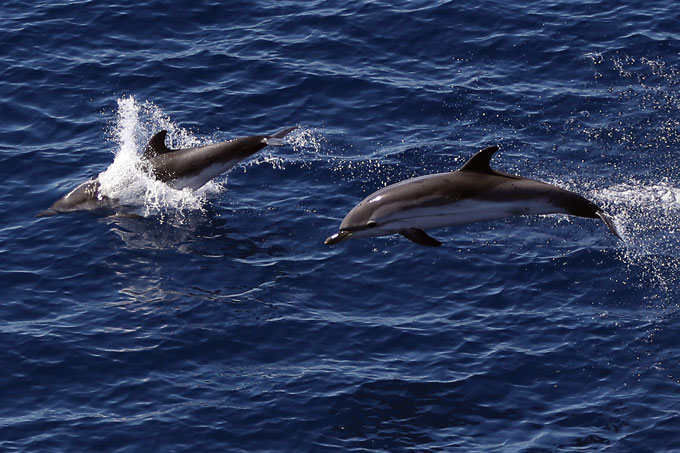 Dolphins often do things that look like fun, such as playing catch with seaweed. However, scientists have struggled to figure out if these activities induce positive feelings. A “victory squeal” after being given a fish or while swimming with other dolphins may provide a clue.VALERY HACHE/afp/getty images
Behind the dolphin’s smile
Dolphins often do things that look like fun, such as playing catch with seaweed. However, scientists have struggled to figure out if these activities induce positive feelings. A “victory squeal” after being given a fish or while swimming with other dolphins may provide a clue.VALERY HACHE/afp/getty images
Behind the dolphin’s smile
Like keas in the sun, dolphins sure look like they’re having fun. They leap through the bow waves of boats and play catch with bits of seaweed. But their characteristic “smile” is frozen in place. And it says nothing about how they feel.
Dolphins have a few things in common with great apes. For one, they’re intelligent. They also can sometimes be violent. They may kidnap females, kill baby dolphins or smack around harbor porpoises. And sometimes their play objects are unlucky sea turtles or seals.
Captive dolphins, too, are typically offered objects to play with. The Association of Zoos and Aquariums requires the facilities it certifies to provide animals with enrichment, such as toys. And here, a joy-o-meter could offer useful insight into the animals’ well-being. Not every toy offered provokes positive behaviors.
In a 2020 study, Lyn’s team provided new items like bubble generators or barrels coated in fake grass. The dolphins’ biggest response was to a meter-long (3-foot-long) block of ice. And it wasn’t a positive one — at least not at first. The two dolphins, Bo and Buster, initially fled, then returned to scope it out. Overall, dolphins tended to avoid the new objects — hardly a strong endorsement of their joy potential.
As with apes and parrots, vocal calls may be the key to understanding dolphin joy. Other dolphin researchers have defined a “victory squeal.” This is a sound the animals make when they catch a fish or receive a fish prize from their trainers.
The scientists suggest it reflects release of the reward chemical dopamine in the brain. Once trained, dolphins make the same sound after they complete a task, but before they get the fish reward. It’s as if they’re saying, “Yay, I did it!”
Lyn’s team has observed similar squeals in other situations. For instance, it’s happened when dolphins are surprised with a treat, like a toy or bucket of ice. She hopes to perform windfall experiments to measure if the dolphins squeal more in the moments after they get an joyful surprise, like a favorite toy.
Early data indicate that squeals may have a social function, too. If their trainers are also screaming with joy, the dolphins seem to make bigger or more frequent squeals. And they do it when socializing with other dolphins, such as swimming together. “It seems to very much be this sort of communicative pattern,” Lyn says.
While there’s still plenty more work to do, the project researchers are excited about the progress they’ve made and what’s to come. After scientists spent many decades focusing on unhappy feelings, kea researcher Nelson notes, “It’s just nice to turn the tables and think about the positive.” Her own reason for studying animal happiness is even simpler than that: “Because it gives me joy.”
ape: A group of rather large primates, all of which lack a tail. They include gorillas, chimpanzees, bonobos, orangutans, gibbons and humans. Most people tend to group humans into their own separate subcategory owing to a number of special traits. These include a larger brain, greater mental abilities (including being able to talk) and their ability to walk on two legs.
attention: The phenomenon of focusing mental resources on a specific object or event.
behavior: The way something (often a person or other organism) conducts itself or acts towards others.
biologist: A scientist involved in the study of living things.
birds: Warm-blooded dinosaurs with wings that first showed up at least 150 million years ago. Birds are jacketed in feathers and produce young from the eggs they deposit in some sort of nest. Most birds fly, but throughout history there have been the occasional species that don’t.
chemical: A substance formed from two or more atoms that unite (bond) in a fixed proportion and structure. For example, water is a chemical made when two hydrogen atoms bond to one oxygen atom. Its chemical formula is H2O. Chemical also can be an adjective to describe properties of materials that are the result of various reactions between different compounds.
cognition: The mental processes of thought, remembering, learning information and interpreting those data that the senses send to the brain.
cognitive: A term that relates to mental activities, such as thinking, learning, remembering and solving puzzles.
contagious: An adjective for some disease that can be spread by direct contact with an infected individual or the germs that they shed into the air, their clothes or their environment. Such diseases are referred to as contagious. Or it can be an idea or behavior that spreads from person to person.
context: The setting or circumstances that help explain an event, some statement or some conclusion.
cortisol: Also known as hydrocortisone, this is a hormone produced by the adrenal glands. It can serve as the body’s main warning that it is under stress. It helps regulate a wide range of body functions, including how we process the energy in food, create memories and control inflammation.
data: Facts and/or statistics collected together for analysis but not necessarily organized in a way that gives them meaning. For digital information (the type stored by computers), those data typically are numbers stored in a binary code, portrayed as strings of zeros and ones.
depression: (in medicine) A mental illness characterized by persistent sadness and apathy. Although these feelings can be triggered by events, such as the death of a loved one or the move to a new city, that isn’t typically considered an “illness” — unless the symptoms are prolonged and harm an individual’s ability to perform normal daily tasks (such as working, sleeping or interacting with others). People suffering from depression often feel they lack the energy needed to get anything done. They may have difficulty concentrating on things or showing an interest in normal events. Many times, these feelings seem to be triggered by nothing; they can appear out of nowhere.
develop: To emerge or to make come into being, either naturally or through human intervention, such as by manufacturing.
dolphins: A highly intelligent group of marine mammals that belong to the toothed-whale family. Members of this group include orcas (killer whales), pilot whales and bottlenose dolphins.
dopamine: A neurotransmitter, this chemical helps transmit signals in the brain.
fabric: Any flexible material that is woven, knitted or can be fused into a sheet by heat or compression and drying.
fat: A natural oily or greasy substance occurring in plants and in animal bodies, especially when deposited as a layer under the skin or around certain organs. Fat’s primary role is as an energy reserve. Fat also is a vital nutrient, though it can be harmful if consumed in excessive amounts.
forest: An area of land covered mostly with trees and other woody plants.
fruit: A seed-containing reproductive organ in a plant.
function: The specific role some structure or device plays.
hormone: (in zoology and medicine) A chemical produced in a gland and then carried in the bloodstream to another part of the body. Hormones control many important body activities, such as growth. Hormones act by triggering or regulating chemical reactions in the body.
insight: The ability to gain an accurate and deep understanding of a situation just by thinking about it, instead of working out a solution through experimentation.
intelligence: The ability to collect and apply knowledge and skills.
marker: (in biomedicine) The presence of some substance — such as the attachment of some stain or molecular flag — that usually signals some disease, pollutant or event. As such, this substance will serve as a sign — or marker — of that related thing.
mental health: A term for someone’s emotional, psychological and social well-being. It refers to how people (or animals) behave on their own and how they interact with others. It includes how people make choices, handle stress and manage fear or anxiety. Poor mental health can be triggered by disease or might reflect a short-term response to life’s challenges. It can occur in people of any age, from babies to the elderly.
New Zealand: An island nation in the southwest Pacific Ocean, roughly 1,500 kilometers (some 900 miles) east of Australia. Its “mainland” — consisting of a North and South Island — is quite volcanically active. In addition, the country includes many far smaller offshore islands.
philosopher: Researchers (often in university settings) who ponder fundamental truths about relationships between things, including people and the world. The term also is used to describe truth seekers in the ancient world, ones who sought to find meaning and logic out of observing the workings of society and of the natural world, including the universe.
primate: The order of mammals that includes humans, apes, monkeys and related animals (such as tarsiers and lemurs).
psychologist: A scientist or mental-health professional who studies the mind, especially in relation to actions and behaviors. Some work with people. Others may conduct experiments with animals (usually rodents) to test how their minds respond to different stimuli and conditions.
reward: (In animal behavior) A stimulus, such as a tasty food pellet, that is offered to an animal or person to get them to change their behavior or to learn a task.
sea: An ocean (or region that is part of an ocean). Unlike lakes and streams, seawater — or ocean water — is salty.
seaweed: Large algae growing in the sea or on rocks below the high-water mark.
social: (adj.) Relating to gatherings of people; a term for animals (or people) that prefer to exist in groups.
species: A group of similar organisms capable of producing offspring that can survive and reproduce.
stress: (in biology) A factor — such as unusual temperatures, movements, moisture or pollution — that affects the health of a species or ecosystem. (in psychology) A mental, physical, emotional or behavioral reaction to an event or circumstance (stressor) that disturbs a person or animal’s usual state of being or places increased demands on a person or animal; psychological stress can be either positive or negative.
subjective: (in psychology) An adjective for an assessment that is based (at least in part) on someone’s own feelings, opinions or preferences.
tool: An object that a person or other animal makes or obtains and then uses to carry out some purpose such as reaching food, defending itself or grooming.
wave: A disturbance or variation that travels through space and matter in a regular, oscillating fashion.
weather: Conditions in the atmosphere at a localized place and a particular time. It is usually described in terms of particular features, such as air pressure, humidity, moisture, any precipitation (rain, snow or ice), temperature and wind speed. Weather constitutes the actual conditions that occur at any time and place. It’s different from climate, which is a description of the conditions that tend to occur in some general region during a particular month or season.
Western: (n. the West) An adjective describing nations in Western Europe and North America (from Mexico northward). These nations tend to be fairly industrialized and to share generally similar lifestyles; levels of economic development (incomes); and attitudes toward work, education, social issues and government.
zoologist: An expert in the study of animals and their habitats.
Journal: S.L. Winkler et al. Bonobos tend to behave optimistically after hearing laughter. Scientific Reports. Published online June 26, 2025. doi: 10.1038/s41598-025-02594-8.
Journal: X.J. Nelson et al. Joyful by nature: approaches to investigate the evolution and function of joy in non-human animals. Biological Reviews. Vol. 98, May 1, 2023, p. 1548. doi: 10.1111/brv.12965.
Journal: Ľ. Košťál , Z. Skalná and K. Pichová. Use of cognitive bias as a welfare tool in poultry. Journal of Animal Science. Vol. 98, August 2020, p. S63. doi: 10.1093/jas/skaa039.
Journal: A.S. Reinhold et al. Behavioral and neural correlates of hide-and-seek in rats. Science. Vol. 365, September 13, 2019, p. 1180. doi: 10.1126/science.aax4705.
Journal: R. Schwing et al. Positive emotional contagion in a New Zealand parrot. Current Biology. Vol. 27, March 20, 2017, p. R213. doi: 10.1016/j.cub.2017.02.020.
Journal: D.S. Dibble, K.R. Van Alstyne and S. Ridgway. Dolphins signal success by producing a victory squeal. International Journal of Comparative Psychology. Vol. 29, 2016. doi: 10.46867/ijcp.2016.29.00.14.
Journal: V.M. Janik. Play in dolphins. Current Biology. Vol. 25, January 5, 2015, p. R7. doi: 10.1016/j.cub.2014.09.010.
Journal: S. H. Ridgway et al. Forward shift of feeding buzz components of dolphins and belugas during associative learning reveals a likely connection to reward expectation, pleasure and brain dopamine activation. Journal of Experimental Biology. Vol. 217, August 2014, p. 2910. doi: 10.1242/jeb.100511.
Journal: R. Rygula, H. Pluta and P. Popik. Laughing rats are optimistic. PLOS One. Published online December 26, 2012. doi: 10.1371/journal.pone.0051959.
Journal: E.J. Harding, E.S. Paul and M. Mendl. Cognitive bias and affective state. Nature. Vol. 427, January 22, 2004. doi: 10.1038/427312a.
Journal: J. Burgdorf and J. Panksepp. Tickling induces reward in adolescent rats. Physiology & Behavior. Vol. 72, January–February 2001, p. 167. doi: 10.1016/S0031-9384(00)00411-X.
| # | Наименование новости | Тональность | Информативность | Дата публикации |
|---|---|---|---|---|
| 1 | Собаки могут различать человеческий страх и печаль | 0 | 7.2 | 10-08-2026 |
| 2 | Как понять настроение кошки по ее позе? | 0 | 6.4 | 23-07-2026 |
| 3 | Chatty cats and talking dogs could one day ‘speak’ in our language | 0 | 8.62 | 20-07-2026 |
| 4 | Как понять настроение кошки по хвосту? | 5 | 7 | 21-07-2026 |
| 5 | Они не просто пищат. Учёные расшифровали «язык животных» | 5 | 7 | 13-07-2026 |
| 6 | This tool-using cow stunned scientists with her smarts | 0 | 14.1 | 17-04-2026 |
| 7 | «А вам слабо лизнуть свой нос?» Неподражаемые эмоции животных — на этих фото | 0 | 8.98 | 04-04-2026 |
| 8 | Скоро пробьют куранты! 10 фото с праздничным настроением | 0 | 18.33 | 31-12-2025 |
| 9 | Some birds defy overall plunge in bird numbers | 0 | 8.21 | 22-07-2026 |
| 10 | These horses are unaffected by petting in children's zoo, heart rate monitors reveal | 0 | 7 | 08-06-2026 |