Просмотр новости
Найдите то, что Вас интересует
 Спутники
 РН
РН SpaceX
 Роскосмос
 NASA
NASA
СпутникиРНSpaceXРоскосмосNASAHumidity makes North American sweat bees change color. This trait could be widespread among shiny insects, some biologists now suspect.
When the weather gets muggy, iridescent bees shift their metallic hue, a new study finds.
The insects are a rich blue-green when the humidity is low. But as moisture levels in the air rise, their color changes: It turns a coppery green.
Many bees have a shimmery exoskeleton. So this reversible mood-ring–like effect might be quite common, scientists now say. The day-to-day color of other bees and insects might similarly change with humidity.
Jorge De La Cruz is a college student at the University of California, Santa Barbara. There, he’s training as an evolutionary biologist. He first noticed the color-change effect while preparing bee specimens for preservation and study. This was at the Cheadle Center for Biodiversity and Ecological Restoration.
Museum scientists often place insect specimens in a moist chamber. It makes them more flexible for mounting and imaging. And under moist conditions, some bees appeared to starkly shift their color. This caught De La Cruz’s attention.
“It can be a bit alarming when you’re not expecting it,” says Madeleine Ostwald. This ecologist works at Queen Mary University of London in England.
De La Cruz and Ostwald teamed up with two other researchers to look into this further. They shared what they learned April 22 in Biology Letters.
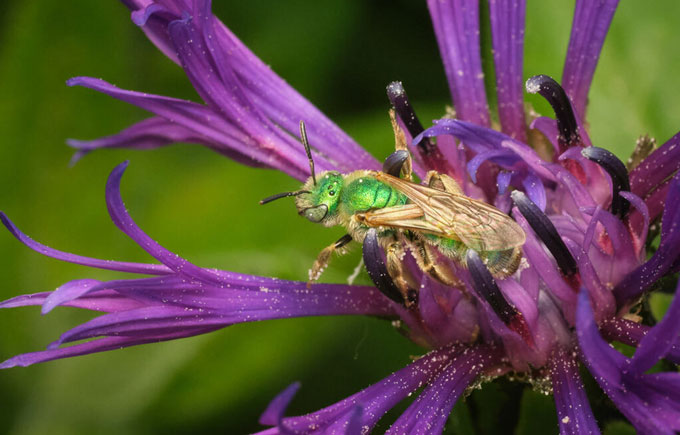 This sweat bee was photographed in Seattle, Wash. Its exoskeleton changes color with the humidity. Other iridescent insects may pull a similar color-change trick.Mike Davidson/iNaturalist
Humidity changes hue
This sweat bee was photographed in Seattle, Wash. Its exoskeleton changes color with the humidity. Other iridescent insects may pull a similar color-change trick.Mike Davidson/iNaturalist
Humidity changes hue
The team studied two dozen museum bee specimens. All were fine-striped sweat bees (Agapostemon subtilior). The bees were exposed to high and low humidity for 55 hours each. After each exposure, the team took photos.
The researchers also reviewed more than 1,000 photos of living sweat bees. These came from the citizen-science app iNaturalist. Here, too, they noted the humidity present when an image had been taken.
In dry conditions (less than 10 percent humidity), the bees were blue-green. But at 95 percent humidity, they turned a light, coppery green.
Humidity may cause layers in the bees’ exoskeletons to swell. That may change how those layers reflect light, creating an iridescence. That layering appears to scatter light at different wavelengths, creating colors. If the layers swelled, the space between them would increase. The extra space would reflect longer, redder light.
“Because we saw redder bees in more humid conditions, this fits with that [scientific explanation],” Ostwald says.
Future work with high-powered microscopes might confirm this. Lots of insects produce color with tiny structures rather than pigments, Ostwald says. So, the phenomenon might be widespread.
Color can be really changeable as something responds to the environment, she says — and “in ways we didn’t expect.” It’s important to study the color of the living organism in its natural environment to know its true hue.
app: Short for application, or a computer program designed for a specific task.
biology: The study of living things. The scientists who study them are known as biologists.
citizen science: Scientific research in which the public — people of all ages and abilities — participate. The data that these citizen “scientists” collect helps to advance research. Letting the public participate means that scientists can get data from many more people and places than would be available if they were working alone.
context: The setting or circumstances that help explain an event, some statement or some conclusion.
dynamic: An adjective that signifies something is active, changing or moving. (noun) The change or range of variability seen or measured within something.
ecologist: A scientist who works in a branch of biology that deals with the relations of organisms to one another and to their physical surroundings.
environment: The sum of all of the things that exist around some organism or the process and the condition those things create. Environment may refer to the weather and ecosystem in which some animal lives, or, perhaps, the temperature and humidity (or even the placement of things in the vicinity of an item of interest).
exoskeleton: A hard, protective outer body covering of many animals that lack a true skeleton, such as an insect, crustacean or mollusk. The exoskeletons of insects and crustaceans are largely made of chitin.
hue: A color or shade of some color.
humidity: A measure of the amount of water vapor in the atmosphere. (Air with a lot of water vapor in it is known as humid.)
insect: A type of arthropod that as an adult will have six segmented legs and three body parts: a head, thorax and abdomen. There are hundreds of thousands of insects, which include bees, beetles, flies and moths.
iridescent: Adjective that describes something that seems to change color with a shift in the angle at which it is viewed or at which lighting is applied.
microscope: An instrument used to view objects — such as bacteria or the single cells of plants or animals — that are too small to be visible to the unaided eye.
organism: Any living thing, from elephants and plants to bacteria and other types of single-celled life.
pigment: A material, like the natural colorings in skin, that alter the light reflected off of an object or transmitted through it. The overall color of a pigment typically depends on which wavelengths of visible light it absorbs and which ones it reflects. For example, a red pigment tends to reflect red wavelengths of light very well and typically absorbs other colors. Pigment also is the term for chemicals that manufacturers use to tint paint.
undergraduate: A student who is attending college but has not yet graduated.
wavelength: The distance between one peak and the next in a series of waves, or the distance between one trough and the next. It’s also one of the “yardsticks” used to measure radiation. Visible light — which, like all electromagnetic radiation, travels in waves — includes wavelengths between about 380 nanometers (violet) and about 740 nanometers (red). Radiation with wavelengths shorter than visible light includes gamma rays, X-rays and ultraviolet light. Longer-wavelength radiation includes infrared light, microwaves and radio waves.
weather: Conditions in the atmosphere at a localized place and a particular time. It is usually described in terms of particular features, such as air pressure, humidity, moisture, any precipitation (rain, snow or ice), temperature and wind speed. Weather constitutes the actual conditions that occur at any time and place. It’s different from climate, which is a description of the conditions that tend to occur in some general region during a particular month or season.
About Jake Buehler
Jake Buehler is a freelance science writer, covering natural history, wildlife conservation and Earth's splendid biodiversity, from salamanders to sequoias. He has a master's degree in zoology from the University of Hawaii at Manoa.
| # | Наименование новости | Тональность | Информативность | Дата публикации |
|---|---|---|---|---|
| 1 | Scientists stunned as bumble bees solve a classic intelligence test | 0 | 7.7 | 03-07-2026 |
| 2 | Scientists Say: Corn Sweat | 0 | 7.56 | 06-07-2026 |
| 3 | Songs prep unhatched finches’ brains for a hot world | 0 | 6.94 | 04-08-2026 |
| 4 | Scientists stunned as pink katydid transforms into green camouflage | 0 | 7.04 | 03-05-2026 |
| 5 | Analyze This: How many insects are in the air? | 0 | 7.59 | 29-04-2026 |
| 6 | В Тюменской области из-за жары гибнут пчёлы | -5 | 6 | 09-07-2026 |
| 7 | Scientists just discovered bees and hummingbirds are drinking alcohol | 0 | 9.37 | 25-03-2026 |
| 8 | Bumblebees collect up to 7 times more toxic metals than honeybees | 0 | 8.74 | 07-07-2026 |
| 9 | Un científico instaló 200 hoteles para 27.000 abejas y lo que encontró dentro después de 3 años cambia lo que sabíamos sobre estos insectos | 5 | 7 | 13-07-2026 |
| 10 | Pourquoi la France entière entend-elle soudain des cigales ? | 0 | 9.47 | 10-08-2026 |