Просмотр новости
Найдите то, что Вас интересует
 Спутники
 РН
РН SpaceX
 Роскосмос
 NASA
NASA
СпутникиРНSpaceXРоскосмосNASAThe strangler fig provides food and shelter for animals in the tropics. For at least 17 mammal species, it also serves as a toilet.
When a human has a sudden need to go number two, they might seek out a bathroom. When mammals in the forests of Costa Rica need to poop, they find a strangler fig. A survey of 169 trees found 11 that doubled as elevated toilets; all were figs. Cameras caught 17 different species using one of these treetop potties.
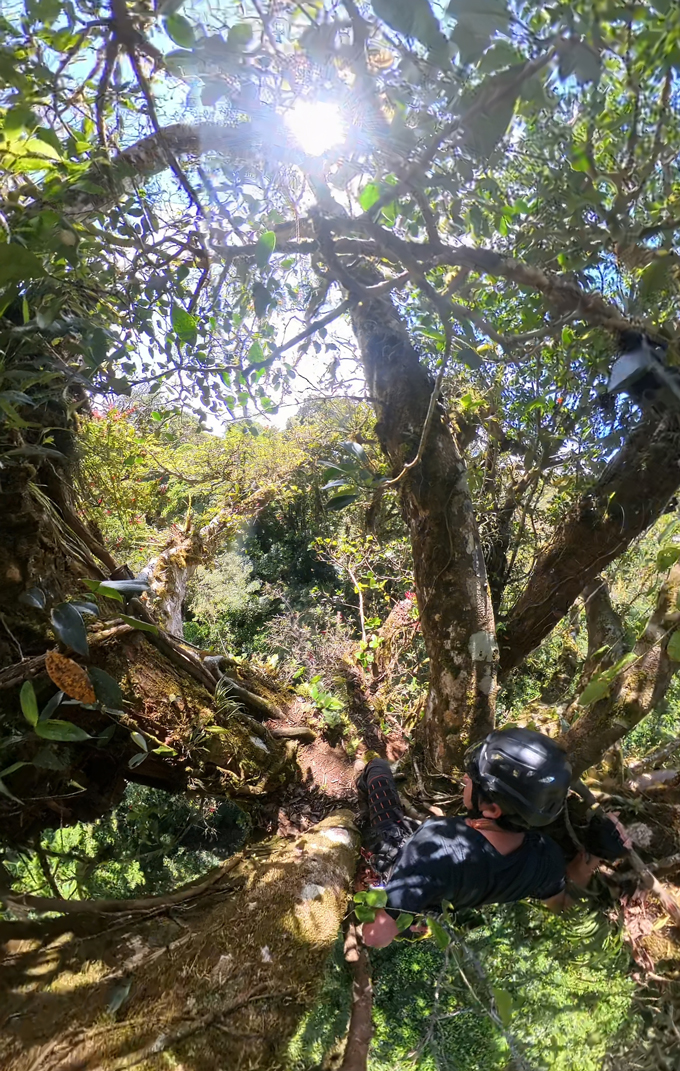 Jeremy Quirós-Navarro stands on the edge of an animal toilet that is tens of meters up in a strangler fig tree. The area where the branches join serves as a flat surface for animals to poop. Tropical canopy ecology project
Many mammals choose a favorite place to poo, says Mike Cove. He did not take part in the new research, but he does study mammals at the North Carolina Museum of Natural Sciences. That’s in Raleigh. There’ve been lots of reports of multiple tropical species sharing a pooping spot, Cove says. But all those toilets, also called latrines, were on the ground.
Jeremy Quirós-Navarro found his first treetop toilet by accident. At the time of this doo-doo discovery, he had been documenting plant life in the cloud forest of Costa Rica. These are forests that have a constant cover of mist and clouds. Quirós-Navarro works at the University of Connecticut, in Storrs, where he studies plant identification.
In a tree, right where a bunch of large branches came together, Quirós-Navarro found a pile of poo. As he kept climbing, he found more poop piles. “But only in a specific [type of] tree,” he says.
The lucky tree was a strangler fig (Ficus tuerckheimii). This plant is very important in tropical ecosystems. It provides plenty of food. It also has lots of holes that animals can use for shelter. Its wide, spreading branches along the forest ceiling also create walkways for many animals.
All these things make the strangler fig a hub for cloud forest mammals. That, in turn, makes this tree what scientists call a keystone species. Serving as a public restroom might be yet one more role that strangler figs play in forests.
Researchers shared their new findings March 16 in Ecology and Evolution.
The go-to for number twoQuirós-Navarro may have found the first fig tree toilet by accident. But after running into three more, “we started thinking that this is a pattern,” he recalls. So his team decided to look for more treetop latrines. They checked 29 different species — in all, 169 trees.
They turned up 11 latrines, all in strangler figs. In fact, 73 percent of the fig trees his team inspected had at least one pooping place. That’s almost three out of every four fig trees.
The scientists don’t know why figs are the preferred elevated forest potty. But Quirós-Navarro thinks the tree’s structure is important. “They have a specific and particular structure that forms, like, a hand at the crown,” he says. “All the branches grow from that part.”
The flat platform where all the branches join can be up to one meter (39 inches) wide and filled with soil and small plants. And poop.
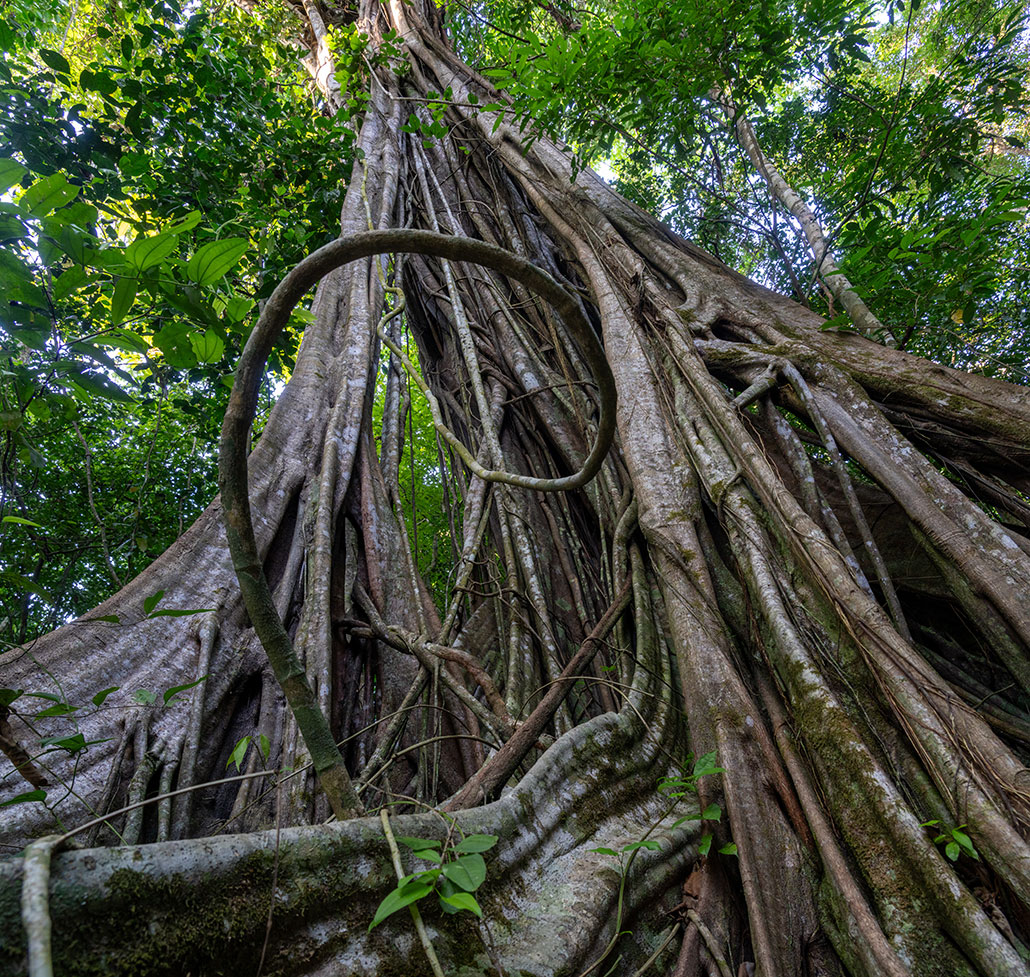 Looking up into a strangler fig tree. Many mammals that dwell in tropical forests spend much of their lives high above the ground in the forest canopy. When one feels the need to “do its business,” those in Costa Rica often choose this type of tree as their latrine of choice.Michael Metzger/iStock/Getty Images Plus
A bathroom grapevine
Looking up into a strangler fig tree. Many mammals that dwell in tropical forests spend much of their lives high above the ground in the forest canopy. When one feels the need to “do its business,” those in Costa Rica often choose this type of tree as their latrine of choice.Michael Metzger/iStock/Getty Images Plus
A bathroom grapevine
To figure out which critters visited treetop toilets, researchers added a camera trap to one of the latrines. Over two months, this potty was used by about three mammals a day. They came from 17 different species.
Mexican hairy dwarf porcupines were the most frequent visitors. But kinkajous, opossums, pocket mice, coatis and capuchin monkeys all stopped by. Even margays, secretive tree-dwelling cats, hit the toilet (though only to spray urine).
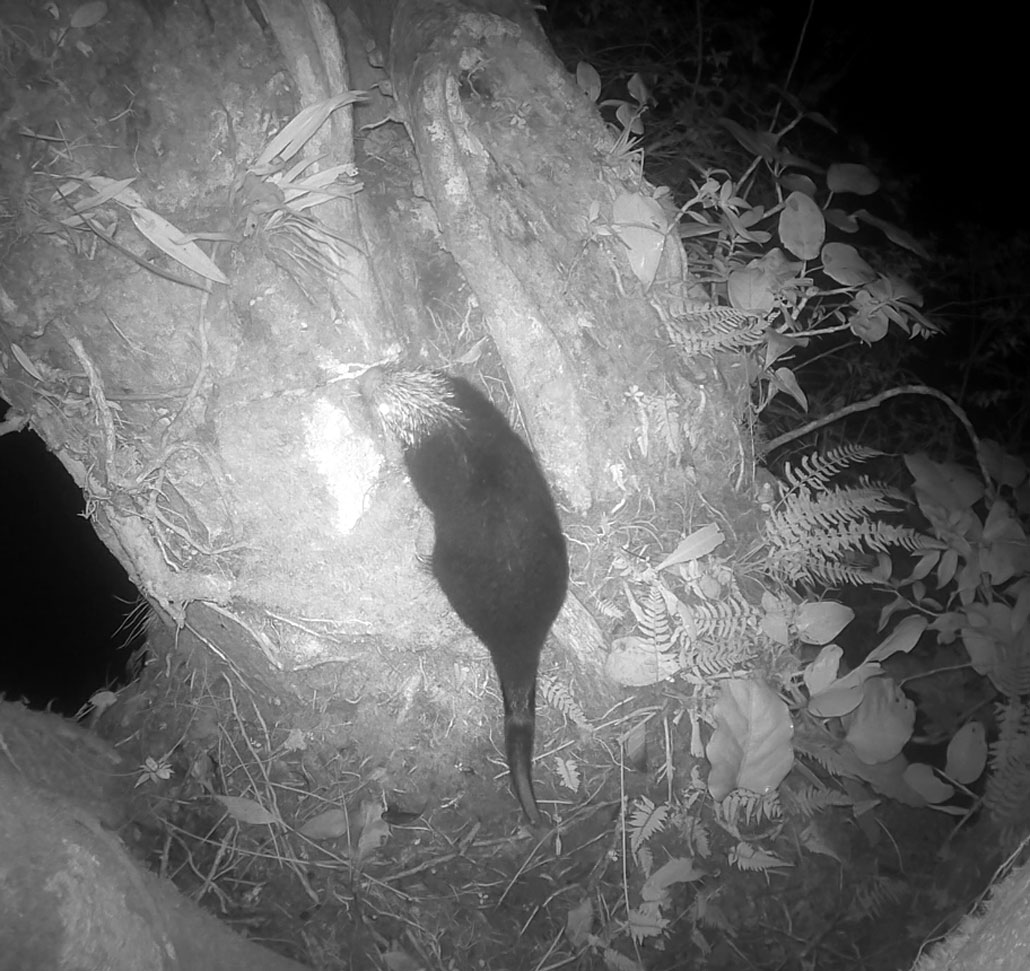 A porcupine pauses to poo in a tree latrine. Porcupines live in trees in Costa Rica and were frequent visitors to the treetop potties.Tropical canopy ecology project
The most surprising visitor was Hoffmann’s two-toed sloths. This was unexpected because these sloths were thought to come down to the ground to poop. Both visits caught on camera were made by a female with young. That might be why they used the tree latrine. “It’s more [of a] risk for them to go and poop in the ground,” Quirós-Navarro says.
It’s also possible the sloth didn’t realize the platform wasn’t the ground, Erik Hom points out. He studies symbiosis at the University of Mississippi in University and did not take part in the research. Once an animal is in a tree, “coming down is quite a way,” he says. So a flat, dirt-covered place in the branches might seem enough like the ground to go on.
It’s especially interesting that there are so many species using these poop spots, Cove says. “You have all of these animals coming together,” he says. They are “scent marking, defecating, urinating — and then, in some cases, rolling in it.”
Tree toilets might serve as the group chats of the forest canopy, Quirós-Navarro adds. All these mammals using the same toilet leave signals for each other through their poop and pee. The message could be “a predator was here,” “I’m looking for a mate” or even “this tree is mine.”
In the future, Quirós-Navarro hopes to find out why fig trees are the forest’s potty of choice. But serving as potties only adds to the strangler fig’s value in tropical forests. It’s a food source, a highway — and now, a la-tree-n.
Submit your question here, and we might answer it an upcoming issue of Science News Explores
camera trap: A still or video camera set to activate when motion is detected. The device is often used to monitor wildlife. It can also be used to record poachers.
canopy: (in botany) The top layer of a tree — or forest — where the tallest branches overlap.
capuchin: A forest-dwelling New World monkey that eats fruit, insects, leaves and sometimes small birds. Most have a coat of dark fur, except around the face, where it can be creamy or white. The almost hairless face is pink to gray in color. These monkeys used to be classified as belonging to a single genus: Cebus . In 2012, scientists broke off a group of robust capuchins and gave them a new genus name: Sapajus .
cloud forest: One of the more threatened tropical ecosystems, these are mist-shrouded rainforests that can develop high up along the sides of steep volcanic mountains. Because they have traditionally been hard to reach, they have tended to maintain a rich diversity of species.
coati: Any of several tropical ring-tailed species of mammals found in the Americas. Though related to the raccoon, their body and tail are longer. They also have a “masked” face and long flexible snout.
Costa Rica: A Central American nation with coastlines along both the Pacific Ocean and Caribbean Sea. This country of nearly 5 million people is sandwiched between Nicaragua to the north and Panama to its south. Almost one-fourth of its land consists of protected rainforests, which are home to such animals as spider monkeys and the quetzal birds.
ecology: A branch of biology that deals with the relations of organisms to one another and to their physical surroundings. A scientist who works in this field is called an ecologist.
ecosystem: A group of interacting living organisms — including microorganisms, plants and animals — and their physical environment within a particular climate. Examples include tropical reefs, rainforests, alpine meadows and polar tundra. The term can also be applied to elements that make up some artificial environment, such as a company, classroom or the internet.
evolution: (v. to evolve) A process by which species undergo changes over time, usually through genetic variation and natural selection. These changes usually result in a new type of organism better suited for its environment than the earlier type. The newer type is not necessarily more “advanced,” just better adapted to the particular conditions in which it developed. Or the term can refer to changes that occur as some natural progression within the non-living world (such as computer chips evolving to smaller devices which operate at an ever faster speed).
forest: An area of land covered mostly with trees and other woody plants.
keystone species: A species that plays a particularly large role on maintaining the ecosystem it inhabits. Such species tend to keep their communities diverse by helping to prevent an overabundance of certain other species or by helping ensure the availability of needed resources to other species in its ecosystem.
kinkajou: A golden-brown, night-dwelling mammal related to a raccoon. It’s found from Mexico down into South America. Living in trees, it uses its long prehensile tail as a sort of “fifth limb” to stabilize itself or even eat.
mammal: An animal distinguished by possessing hair or fur, the secretion of milk by females for the feeding of their young, and (typically) the bearing of live young. They also are warm-blooded (or endothermic).
organism: Any living thing, from elephants and plants to bacteria and other types of single-celled life.
predator: (adjective: predatory) A creature that preys on other animals for most or all of its food.
sloth: A slow moving, plant-eating mammal that lives in tropical rainforests in the Western Hemisphere. Most of these tree dwellers sleep all but four to nine hours a day.
species: A group of similar organisms capable of producing offspring that can survive and reproduce.
symbiosis: (Adj. symbiotic) A relationship between two species that live in close contact. A species that lives this way, offering substantial help to the other species, is sometimes called a symbiont.
tropics: The region near Earth’s equator. Temperatures here are generally warm to hot, year-round.
Bethany Brookshire was a longtime staff writer at Science News Explores and is the author of the book Pests: How Humans Create Animal Villains. She has a Ph.D. in physiology and pharmacology and likes to write about neuroscience, biology, climate and more. She thinks Porgs are an invasive species.
| # | Наименование новости | Тональность | Информативность | Дата публикации |
|---|---|---|---|---|
| 1 | How Atmospheric Nitrogen Gets Into Life | 0 | 9.18 | 03-02-2026 |
| 2 | Forests are changing fast and scientists are deeply concerned | 0 | 10.67 | 09-02-2026 |
| 3 | Here’s how ‘singing’ mice belt out their tiny tunes | 0 | 12.57 | 08-07-2026 |
| 4 | Хищники оказались ключом к устойчивости экосистем | 5 | 7 | 04-07-2026 |
| 5 | Hummingbirds speed up pineapple family's evolution | 5 | 7 | 06-07-2026 |
| 6 | Степной страж: как редкая птица змееяд помогает охранять леса от рептилий | 0 | 6.94 | 14-08-2026 |
| 7 | Порожки | 0 | 10 | 10-07-2026 |
| 8 | Струны для домры | 0 | 10 | 10-07-2026 |
| 9 | Самые залипательные животные 🐘слоны шикарные животные, так интересно за ними ... | 0 | 6.4 | 10-08-2026 |