Просмотр новости
Найдите то, что Вас интересует
 Спутники
 РН
РН SpaceX
 Роскосмос
 NASA
NASA
СпутникиРНSpaceXРоскосмосNASA

USD 36.80 BN
MARKET SIZE, 2033



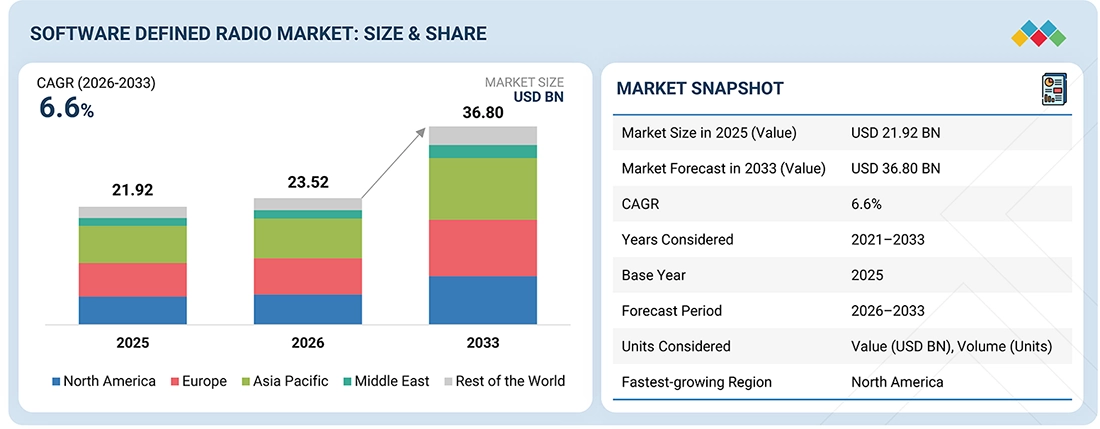
According to Marketsandmarkets, the Global Software Defined Radio Market Size was valued at USD 23.52 billion in 2026 and is projected to reach USD 36.80 billion by 2033, growing at a CAGR of 6.6% from 2026-2033. In terms of volume, the market is projected to grow from 3,424,776 units in 2026 to 4,476,811 units by 2033.
| REPORT METRIC | DETAILS |
|---|---|
| Market Size in 2025 | USD 21.92 Billion |
| Market Forecast in 2033 | USD 36.80 Billion |
| CAGR | 6.6% |
| Years Considered | 2021–2033 |
| Base Year | 2025 |
| Forecast Period | 2026-2033 |
| Units Considered | Value (USD Million/Billion), Volume (Units) |
| Report Coverage | Revenue forecast, company ranking, competitive landscape, growth factors, and trends |
| Top Companies |
|
| Growth Drivers |
|
| Segments Covered |
|
| Regions Covered | North America, Asia Pacific, Europe, Middle East, RoW |
By Region
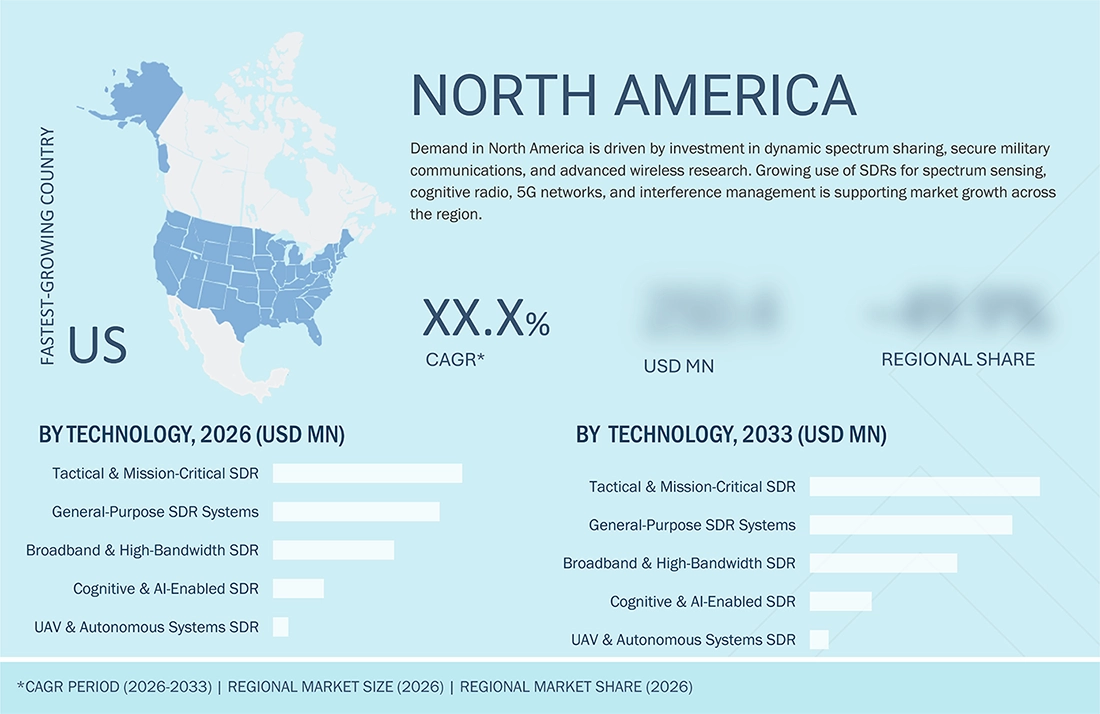
The North America SDR market is expected to register the highest CAGR of 7.0% between 2026 and 2033.
By Technology
UAV & autonomous systems are expected to register the highest CAGR of 9.2% between 2026 and 2033.
By Application
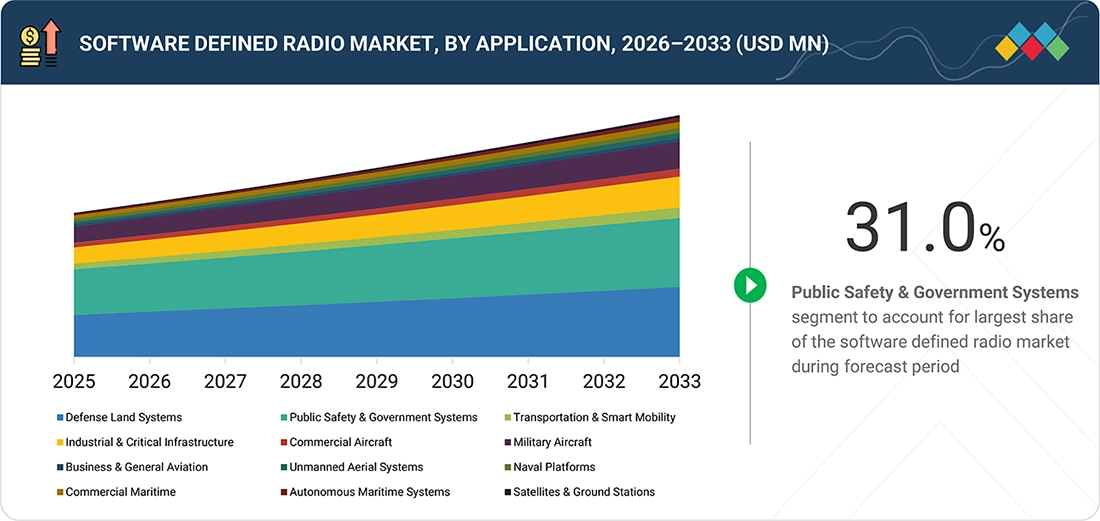
Public safety & government systems are estimated to be the most dominant segment in 2026.
Competitive Landscape
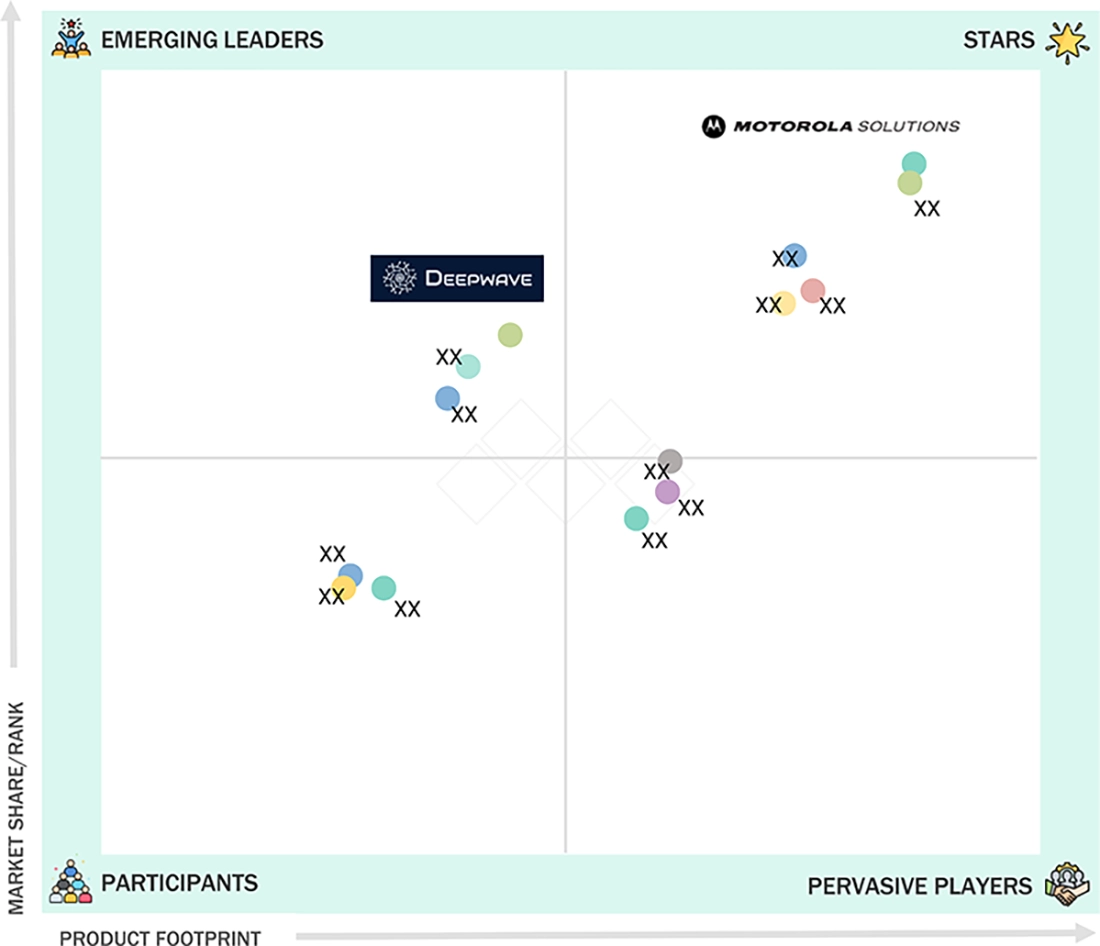
Motorola Solutions, Inc., L3Harris Technologies, Inc., and Thales were identified as some of the star players in the SDR market (global), given their strong market share and product footprint.
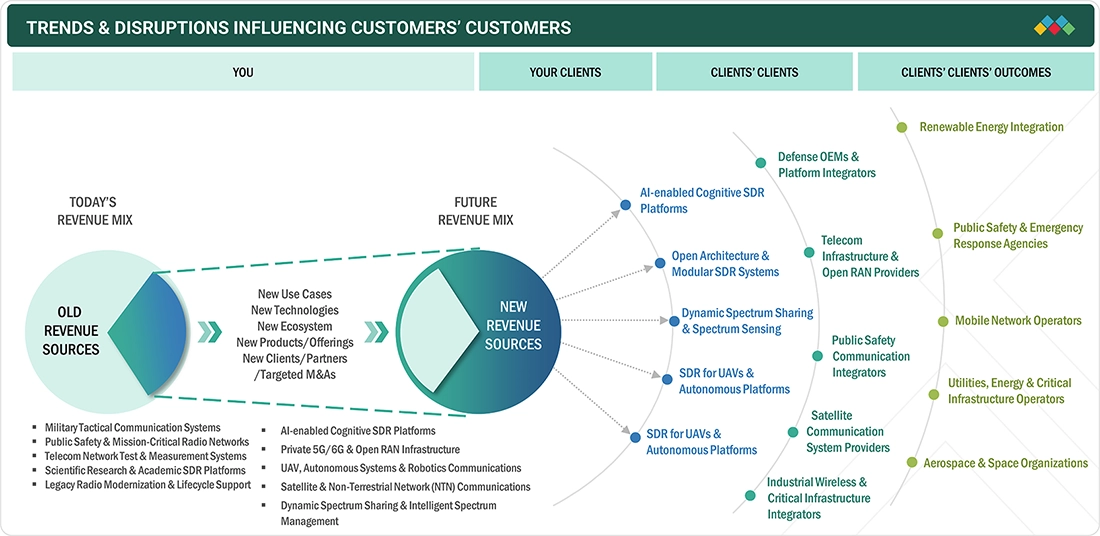
The SDR Industry is growing as communication networks become more complex. Many organizations still use different radio systems that cannot easily communicate with each other. SDRs help connect older and newer radios and allow voice, data, and images to be shared across different teams. This is increasing demand for SDRs in joint military operations, emergency response, and other missions where different users must communicate through one network.
Source: Secondary Research, Interviews with Experts, MarketsandMarkets Analysis
The impact on customers in the SDR market is driven by the need to reduce the number of separate communication devices. A single SDR can perform several communication tasks, which makes equipment easier to carry, use, and manage. Common controls, cables, and accessories can reduce training time and maintenance work. This helps military and public safety users deploy radios faster, simplify logistics, and lower operating costs.
Source: Secondary Research, Interviews with Experts, MarketsandMarkets Analysis



OPPORTUNITIES
Impact
Level

Source: Secondary Research, Interviews with Experts, MarketsandMarkets Analysis
Military forces are replacing old radios with modern software-defined radios. SDRs support secure voice, data, images, and video through one system. They can also use new waveforms added through software. This helps soldiers, vehicles, aircraft, and command centers communicate more effectively during joint operations.
SDR systems require advanced hardware, software, waveforms, encryption, and network tools. All these parts must be integrated and tested before the radio can be used. The software and waveforms also need regular support throughout their life. These requirements increase development time and cost, which can slow adoption by organizations with limited budgets.
AI can help SDRs to check the available spectrum and select a suitable frequency automatically. It can help radios detect interference as well as change their settings according to the surrounding signal conditions. This can improve communication quality in contested and crowded areas and also reduce the need for manual frequency management.
SDR functions depend heavily on software, which makes software security very important. Attackers may try to change radio software, steal waveforms, or send harmful updates. Radio providers must use secure software development, access control, encryption, and regular security checks. Weak protection can affect communication safety and mission operations.
| COMPANY | USE CASE DESCRIPTION | BENEFITS |
|---|---|---|
|
|
Motorola Solutions’ APX NEXT radios and ASTRO 25 platform support police, fire, and emergency-response communications. The radios combine P25 mission-critical voice with LTE-based applications, broadband connectivity, and remote fleet management. | Improves communication reliability and interoperability among public-safety agencies; broadband fallback helps maintain connectivity beyond P25 coverage, while remote programming and software updates reduce radio downtime and simplify fleet management. |
|
|
L3Harris supplies AN/PRC-158 and AN/PRC-163 software-defined radios to the US Army under the HMS program. These multichannel radios support resilient waveforms, multiple encryption levels, cross-banding, and connectivity between tactical ground and airborne networks. | Enables secure and resilient communications in contested electronic-warfare environments; software-defined waveforms and cross-banding improve interoperability across units and coalition forces, while allowing capabilities to be upgraded without replacing the complete radio hardware. |
|
|
Thales is supplying more than 6,000 SquadNet and SYNAPS software-defined radios to the Irish Defense Forces. The radios will support secure communications across military branches and carry coalition waveforms, including the ESSOR broadband waveform. | Establishes a common tactical communication network across personnel, vehicles, and command units; it improves information sharing with allied forces, supports broadband voice and data exchange, and enables future waveform upgrades as operational requirements evolve. |
Logos and trademarks shown above are the property of their respective owners. Their use here is for informational and illustrative purposes only.
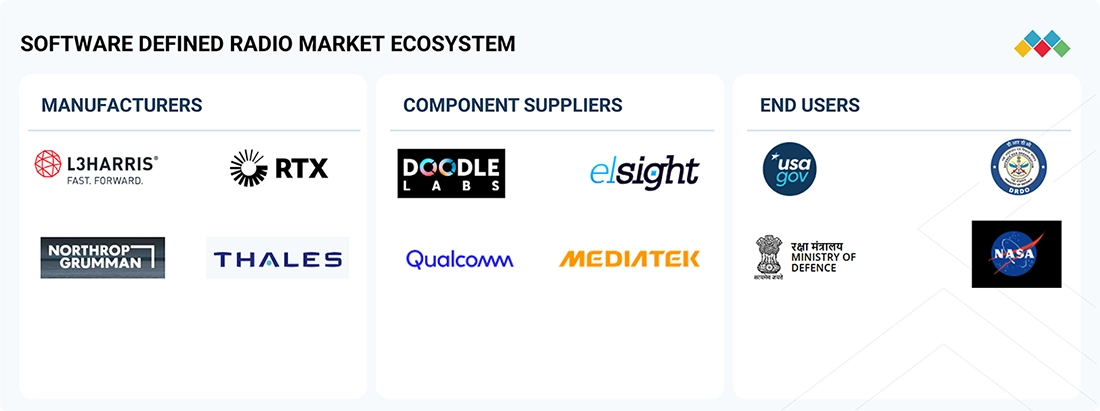
The SDR market includes radio manufacturers, component suppliers, waveform developers, software providers, and system integrators. Major companies such as L3Harris Technologies, Thales, RTX, General Dynamics, Motorola Solutions, BAE Systems, Rohde & Schwarz, Leonardo, and Elbit Systems provide SDR solutions for military, public safety, airborne, naval, and space communication. Smaller companies such as Nuand, Great Scott Gadgets, FlexRadio, SDRplay, AIRSPY, RFspace, Per Vices, Deepwave Digital, Epiq Solutions, and Fairwaves provide compact radios, receivers, transceivers, open SDR platforms, and signal-processing solutions for research, spectrum monitoring, amateur radio, telecommunications, defense, and testing applications.
Logos and trademarks shown above are the property of their respective owners. Their use here is for informational and illustrative purposes only.
Source: Secondary Research, Interviews with Experts, MarketsandMarkets Analysis
The tactical & mission-critical SDR segment holds the largest share of the market. These radios are widely used by defense forces for secure communication in difficult environments. They help soldiers and command teams share voice, data, and battlefield information during missions. Their strong use across handheld, manpack, and vehicle-based communication supports the segment’s large share.
The public safety & government systems segment holds the largest share of the market. Police, fire departments, emergency teams, and government agencies need reliable radios for daily work and emergency response. The large number of users and continuous need for interoperable communication support strong demand for SDR-based public-safety systems.
The HF/VHF/UHF segment holds the largest share of the market. These frequency bands are commonly used for long-range, field, and line-of-sight communication. They support military, government, public-safety, aviation, and maritime users across many operating conditions. Their wide use in existing communication networks boosts demand.
The North American SDR market is expected to grow at the fastest rate during the forecast period. Growth is supported by the modernization of military communication networks and the need for secure communication in difficult operating environments. The region is also investing in advanced spectrum management, electronic warfare testing, and AI-based radio technologies. Strong defense research capabilities and the presence of major SDR manufacturers are expected to support further market growth.
The SDR market matrix includes Motorola Solutions, Inc. (Star), supported by its strong position in public-safety communication and its wide range of P25 radios and communication systems. Its APX NEXT radios combine mission-critical P25 communication with LTE and digital applications. Deepwave Digital, Inc. (Emerging Leader) has good growth potential in AI-enabled SDR systems. Its AIR-T platform combines SDR hardware with GPU-based processing for real-time signal analysis and AI applications. Motorola Solutions has a wider customer base, while Deepwave Digital is building its position in intelligent RF and spectrum monitoring applications.
Source: Secondary Research, Interviews with Experts, MarketsandMarkets Analysis
List of Top Software Defined Radio (SDR) Market Companies
We have successfully delivered the following deep-dive customizations:
| CLIENT REQUEST | CUSTOMIZATION DELIVERED | VALUE ADDS |
|---|---|---|
| Leading Manufacturer | Additional segment breakdown for countries | Additional country-level market sizing tables for segments/sub-segments covered at the regional/global level to gain an understanding of market potential by each country |
| Emerging Leader | Additional company profiles | Competitive information on targeted players to gain granular insights on direct competition |
| Regional Market Leader | Additional country market estimates | Additional country-level deep dive for a more targeted understanding of the total addressable market |
 Exclusive indicates content/data unique to MarketsandMarkets and not available with any competitors.
4
MARKET OVERVIEW
Highlights the market structure, growth drivers, restraints, and near-term inflection points influencing performance.4.3
UNMET NEEDS AND WHITE SPACES
4.4
INTERCONNECTED MARKETS AND CROSS-SECTOR OPPORTUNITIES
4.5
STRATEGIC MOVES BY TIER 1/2/3 PLAYERS
5
INDUSTRY TRENDS
Covers the key developments, trend analysis, and actionable insights to support strategic planning and positioning.5.1
MACROECONOMIC OUTLOOK
5.1.1
TRENDS IN GLOBAL RADIO TECHNOLOGY INDUSTRY
5.1.2
TRENDS IN GLOBAL SOFTWARE-DEFINED RADIO INDUSTRY
5.4
INVESTMENTS & FUNDING SCENARIO
5.5.1
INDICATIVE PRICING ANALYSIS OF SOFTWARE-DEFINED RADIO, BY TECHNOLOGY
5.5.2
INDICATIVE PRICING ANALYSIS OF SOFTWARE-DEFINED RADIO, BY APPLICATION
5.8
KEY CONFERENCES AND EVENTS, 2026-2027
5.9
TRENDS/DISRUPTIONS IMPACTING CUSTOMER BUSINESS
5.11
IMPACT OF 2025 US TARIFFS ON SOFTWWARE DEFINED RADIO MARKET
5.11.3
PRICE IMPACT ANALYSIS
5.11.4
IMPACT ON COUNTRIES/REGIONS
5.11.5
IMPACT ON DIFFERENT APPLICATIONS
5.12
IMPACT OF ONGOING GEOPOLITICAL TENSIONS IN GLOBAL SOFTWARE DEFINED RADIO MARKET
5.13
ASSESSMENT OF COMMERCIAL OFF THE SHELF SOLUTIONS FOR MILITARY APPLICATIONS
6
TECHNOLOGICAL ADVANCEMENTS AND PATENTS ANALYSIS
6.1
KEY EMERGING TECHNOLOGIES
6.2
COMPLEMENTARY TECHNOLOGIES
6.3
ADJACENT TECHNOLOGIES
6.4
TECHNOLOGY/PRODUCT ROADMAP
7
SUSTAINABILITY AND REGULATORY LANDSCAPE
7.1
REGIONAL REGULATIONS AND COMPLIANCE
7.1.1
REGULATORY BODIES, GOVERNMENT AGENCIES, AND OTHER ORGANIZATIONS
7.2
SUSTAINABILITY INITIATIVES
7.2.1
CARBON IMPACT AND ECO-APPLICATIONS OF AIRCRAFT TIRES
7.3
SUSTAINABILITY IMPACT AND REGULATORY POLICY INITIATIVES
7.4
CERTIFICATIONS, LABELING, AND ECO-STANDARDS
8
CUSTOMER LANDSCAPE & BUYER BEHAVIOR
8.1
DECISION-MAKING PROCESS
8.2
BUYER STAKEHOLDERS AND BUYING EVALUATION CRITERIA
8.3
ADOPTION BARRIERS & INTERNAL CHALLENGES
8.4
UNMET NEEDS FROM VARIOUS END USES
9
SOFTWARE DEFINED RADIO MARKET, BY TECHNOLOGY (MARKET SIZE, VOLUME, & FORECAST TO 2033 - USD MILLION & UNITS)
9.2
GENERAL-PURPOSE SDR SYSTEMS
9.2.2
PORTABLE & MOBILE SDR SYSTEMS
9.2.3
EMBEDDED SDR SYSTEMS
9.3
TACTICAL & MISSION-CRITICAL SDR
9.3.1
TACTICAL COMMUNICATION SDR
9.3.2
MANET & MESH NETWORKING SDR
9.3.3
ANTI-JAM & SECURE SDR SYSTEMS
9.4
BROADBAND & HIGH-BANDWIDTH SDR
9.4.1
WIDEBAND SDR SYSTEMS
9.4.3
ISR & HIGH-SPEED DATA LINK SDR
9.5
UAV & AUTONOMOUS SYSTEM SDR
9.5.1
UNMANNED AERIAL VEHICLE (UAV)
9.5.2
UNMANNED GROUND SYSTEM (UGV)
9.5.3
UNMANNED MARITIME VEHICLE (UMV)
9.6
COGNITIVE & AI-ENABLED SDR
9.6.1
COGNITIVE RADIO SDR
9.6.3
DYNAMIC SPECTRUM ACCESS SDR
10
SOFTWARE DEFINED RADIO MARKET, BY APPLICATION (MARKET SIZE, VOLUME, & FORECAST TO 2033 - USD MILLION & UNITS)
10.2
TECHNOLOGY VS APPLICATION: USE CASE ASSESSMENT
10.3
DEFENSE LAND SYSTEMS
10.3.1
TACTICAL BATTLEFIELD COMMUNICATION
10.3.2
MILITARY VEHICLE COMMUNICATION
10.3.3
SOLDIER RADIOS & MANET SYSTEMS
10.4
PUBLIC SAFETY & GOVERNMENT SYSTEMS
10.4.1
POLICE COMMUNICATION
10.4.3
EMERGENCY SERVICES
10.5
TRANSPORTATION & SMART MOBILITY
10.5.1
RAILWAY COMMUNICATION
10.5.2
INTELLIGENT TRANSPORTATION SYSTEMS
10.5.3
CONNECTED & AUTONOMOUS MOBILITY INFRASTRUCTURE
10.6
INDUSTRIAL & CRITICAL INFRASTRUCTURE
10.6.1
MINING COMMUNICATION
10.6.2
OIL & GAS OPERATIONS
10.6.3
UTILITY GRID COMMUNICATION
10.9
BUSINESS & GENERAL AVIATION
10.10
UNMANNED AERIAL SYSTEMS
10.10.1
COMMERCIAL DRONES
10.10.1.1
DELIVERY DRONES
10.10.1.2
AGRICULTURE DRONES
10.10.1.3
MEDIA & PHOTOGRAPHY DRONES
10.10.2
ENTERPRISE & INDUSTRIAL DRONES
10.10.2.1
MINING & CONSTRUCTION
10.10.2.2
OIL & GAS INSPECTION
10.10.2.3
TELECOM INFRASTRUCTURE MONITORING
10.10.3.6
LOITERING MUNITIONS
10.10.4
GOVERNMENT & LAW ENFORCEMENT DRONES
10.10.4.1
BORDER SURVEILLANCE
10.10.4.2
LAW ENFORCEMENT
10.10.4.3
DISASTER MANAGEMENT
10.11.1
NAVAL TACTICAL COMMUNICATION
10.11.2
ISR COMMUNICATION SYSTEMS
10.12
COMMERCIAL MARITIME
10.12.1
COMMERCIAL SHIPPING
10.12.2
OFFSHORE PLATFORMS
10.12.3
PORT COMMUNICATION INFRASTRUCTURE
10.13
AUTONOMOUS MARITIME SYSTEMS
10.13.1
UNMANNED SURFACE VEHICLES
10.13.2
AUTONOMOUS UNDERWATER SYSTEMS
10.13.3
REMOTE MARITIME MONITORING
10.14
SATELLITES & GROUND STATIONS
11
SOFTWARE DEFINED RADIO MARKET, BY FREQUENCY BAND (MARKET SIZE & FORECAST TO 2033-USD MILLION)
11.5
MULTI-BAND & WIDEBAND SDR SYSTEMS
12
SOFTWARE DEFINED RADIO MARKET, BY REGION (MARKET SIZE & FORECAST TO 2033-USD MILLION)
12.4.6
REST OF ASIA PACIFIC
12.5.2
REST OF MIDDLE EAST
13.2
KEY PLAYER COMPETITIVE STRATEGIES/RIGHT TO WIN
13.3
PRODUCT BASE REVENUE ANALYSIS (TOP 5, 2021-2025)
13.4
MARKET SHARE ANALYSIS (TOP 5, 2025)
13.6
COMPANY EVALUATION MATRIX: KEY PLAYERS,
13.6.5
COMPANY FOOTPRINT, KEY PLAYERS,
13.6.5.1
COMPANY FOOTPRINT
13.6.5.2
REGION FOOTPRINT
13.6.5.3
TECHNOLOGY FOOTPRINT
13.6.5.4
APPLICATION FOOTPRINT
13.7
COMPANY EVALUATION MATRIX: STARTUPS/SMES,
13.7.1
PROGRESSIVE COMPANIES
13.7.2
RESPONSIVE COMPANIES
13.7.5
COMPETITIVE BENCHMARKING: STARTUPS/SMES,
13.7.5.1
LIST OF KEY STARTUPS/SMES
13.7.5.2
COMPETITIVE BENCHMARKING OF KEY STARTUPS/SMES
13.8
COMPETITIVE SCENARIO
13.8.3
OTHER DEVELOPMENTS
14.1
KEY PLAYERS (SDR OEM/PLATFORM INTEGRATORS)
14.1.1
L3HARRIS TECHNOLOGIES
14.1.11
ANDURIL INDUSTRIES
14.1.13
EMERSON ELECTRIC CO
14.2
KEY PLAYERS (COMMERCIAL & TELECOM SDR PROVIDERS)
14.2.1
HUAWEI TECHNOLOGIES
14.3
KEY PLAYERS (SDR ODMS/SYSTEM INTEGRATORS)
14.3.2
DTC (CODAN COMMUNICATIONS)
14.3.3
SILVUS TECHNOLOGIES
14.3.4
PERSISTENT SYSTEMS
14.3.5
RAJANT CORPORATION
14.4
KEY PLAYERS (SDR HARDWARE & MODULE PROVIDERS)
14.4.2
BEECHAT NETWORK SYSTEMS
14.4.3
SIMPULSE TECHNOLOGIES
14.5
KEY PLAYERS (SILICON & SEMICONDUCTOR PROVIDERS)
14.5.3
NXP SEMICONDUCTORS
14.5.4
STMICROELECTRONICS
14.6.7
PER VICES CORPORATION
14.6.8
DEEPWAVE DIGITAL, INC.
15.1.1.1
KEY DATA FROM SECONDARY SOURCES
15.1.2.1
KEY DATA FROM PRIMARY SOURCES
15.1.2.2
KEY PRIMARY PARTICIPANTS
15.1.2.3
BREAKDOWN OF PRIMARIES
15.1.2.4
KEY INDUSTRY INSIGHTS
15.2
MARKET SIZE ESTIMATION
15.2.1
BOTTOM-UP APPROACH
15.2.3
BASE NUMBER CALCULATION
15.3
MARKET FORECAST APPROACH
15.4
RESEARCH ASSUMPTIONS
15.5
RESEARCH LIMITATIONS AND RISK ASSESSMENT
16.2
KNOWLEDGESTORE: MARKETSANDMARKETS’ SUBSCRIPTION PORTAL
16.3
CUSTOMIZATION OPTIONS
The study used four main activities to estimate the current size of the software defined radio (SDR) market. First, detailed secondary research was conducted to collect information on SDR products, suppliers, applications, frequency bands, contracts, military communication programs, public-safety networks, and commercial wireless systems. The collected findings and assumptions were then checked through primary interviews with industry experts across the value chain. Demand-side analysis was used to estimate SDR spending by application and region. Finally, market breakdown and data triangulation were used to calculate the size of each segment and subsegment.
Secondary ResearchSecondary research included information from government procurement portals, defense ministries, spectrum and communication authorities, company annual reports, regulatory filings, investor presentations, product documents, press releases, technical papers, journals, and recognized industry databases. Sources such as SIPRI were used to review relevant military transfers and procurement activity, while ITU publications were used to understand radio frequency allocation and spectrum regulations. Company filings and official product information were used to study SDR portfolios, revenues, contracts, technologies, applications and geographical presence as well.
Primary ResearchPrimary research was conducted after completing the secondary research. Interviews were carried out with SDR manufacturers, component suppliers, software and waveform developers, system integrators, distributors, defense communication specialists, public-safety users, telecom experts, and other industry participants. The interviews covered major countries across North America, Europe, Asia Pacific, the Middle East, and the Rest of the World. Primary information was collected through questionnaires, emails, and telephone interviews and was used to check market assumptions, pricing, demand patterns, segment shares, and growth estimates.
Breakdown of Primary Interviews

To know about the assumptions considered for the study, download the pdf brochure
The top-down and bottom-up approaches were used to estimate and validate the size of the SDR market. The research methodology used to estimate the size of the market included the following details:

After determining the overall market size, the total market was divided into several segments and subsegments. The data triangulation and market breakdown procedures explained below were implemented, wherever applicable, to complete the overall market engineering process and arrive at the estimated market numbers for the market segments and subsegments. The data was triangulated by studying various factors and trends from the demand and supply sides. Additionally, the market size was validated using top-down and bottom-up approaches.
Software-defined radio (SDR) is a radio communication system where components that have been traditionally implemented by hardware, such as mixers, filters, amplifiers, modulators/demodulators, and detectors, are instead implemented by means of software to perform signal processing tasks. SDR can implement all these hardware functionalities using software so that the same hardware is used for multiple radio modes, resulting in an extremely flexible radio that can be quickly reconfigured to handle different signaling techniques.
MarketsandMarkets offers the following customizations for this market report:
Product matrix, which provides a detailed comparison of the product portfolio of each company in the SDR market

MarketsandMarkets has been crucial to our research findings and so far, they are the best source we've been able to locate. I'm sure nobody has the predictions nailed, but they seem to know it better than most.