Просмотр новости
Найдите то, что Вас интересует
 Спутники
 РН
РН SpaceX
 Роскосмос
 NASA
NASA
СпутникиРНSpaceXРоскосмосNASA
Kobakhidze said Georgia has no diplomatic relations with Russia but rejected describing Moscow as the country’s enemy.
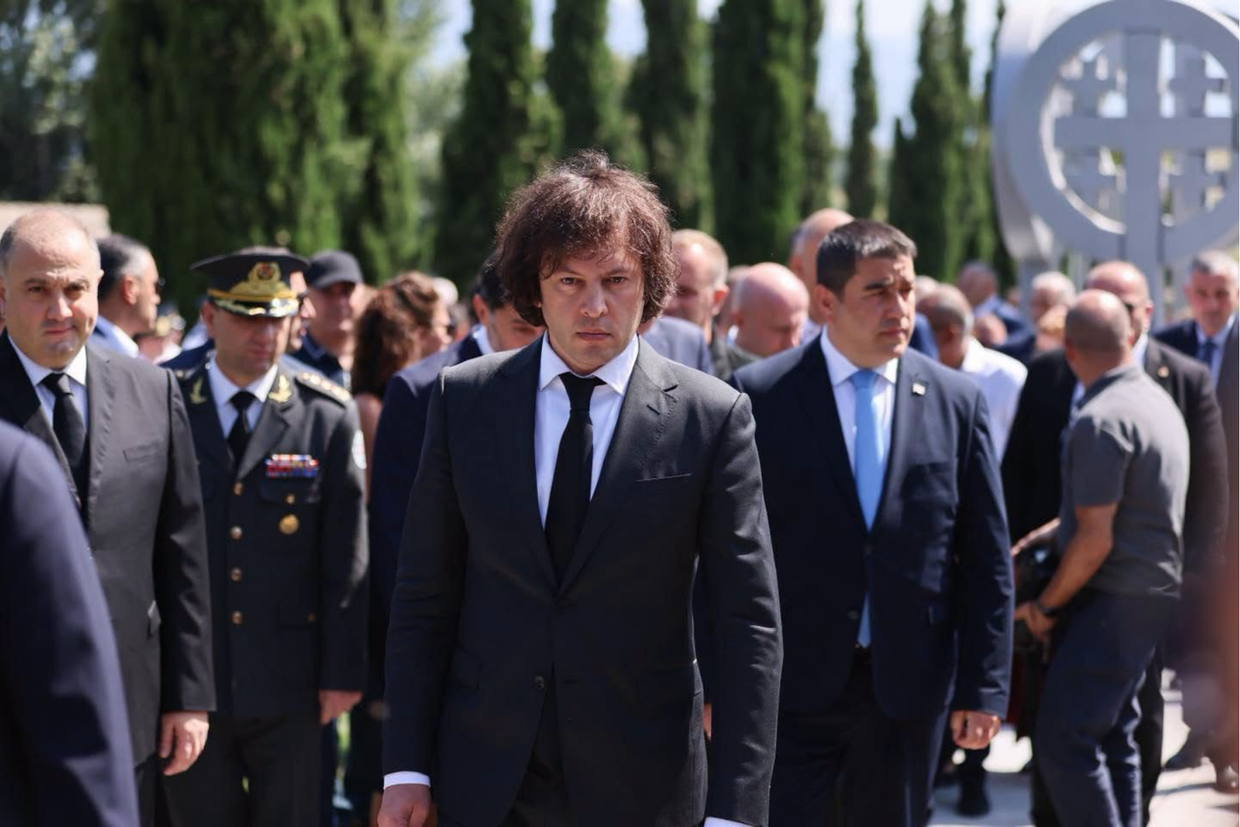
Georgian Prime Minister Irakli Kobakhidze has refused to describe Russia as Georgia’s enemy when directly asked by journalists, while again blaming the government of former President Mikheil Saakashvili for starting the August 2008 War.
On Tuesday, Kobakhidze was asked about the response from South Ossetia after his comments on the anniversary of the hostilities blaming the previous government for the war.
The journalist asked what responsibility Kobakhidze felt about statements from Tskhinvali (Tskhinval) that suggested by blaming Saakashvili, Georgia had effectively recognised him as responsible for being the aggressor, and should therefore accept itself responsibility for starting the war.
Kobakhidze rejected the premise, instead saying, ‘First of all, there is no Republic of South Ossetia, there is no Republic of Abkhazia, there are no such entities, and therefore we are not at all interested in what statements are made by representatives of the de facto formations of the occupied territories’.
He then repeated his claim that the previous government was responsible for starting the war, referring to a Council of Europe resolution on the conflict.
‘It was clearly written there that the conflict escalated into a large-scale military operation after your party bombed Tskhinvali without warning’, Kobakhidze said, referring to Saakashvili’s formerly ruling United National Movement (UNM) party.
Georgian Dream has repeatedly cited the Council of Europe’s controversial 2008 report when arguing that the previous government was responsible for provoking the war. The report said that Georgia’s shelling of Tskhinvali without warning played a role in the escalation into open and full-scale warfare.
Kobakhidze was then asked to say directly whom he considered Georgia’s enemy and who started the war.
‘The only state and the only party that occupied the territories of Georgia is naturally the Russian Federation, which is a fact’, he said.
‘The Russian Federation occupied 20% of the territories of Georgia, which was a crime against the Georgian state, our people. This is a blatant crime’.
When the journalist followed up by asking whether Russia was therefore the enemy, Kobakhidze called the question ‘shameful’.
He accused journalists of trying to obtain a headline by getting him to declare Russia an enemy, arguing that such a statement would have political consequences.
‘This is a specific political statement, which then has to be followed by steps, approximately the steps, or exactly the steps, that your party followed in 2008 and before 2008’, Kobakhidze said.
On Wednesday, the South Ossetian Foreign Ministry said that Georgia should take into account Russia’s position that its decisions recognising the independence of South Ossetia and Abkhazia were irreversible.
The ministry also said it saw ‘cautious trends’ towards Georgia recognising and accepting ‘full legal responsibility’ for what it called ‘the crimes committed in 2008’. It described Russia’s recognition of South Ossetia and Abkhazia as having followed an operation to ‘force the Georgian aggressor to peace’.
Tskhinvali also reiterated that it considered South Ossetia an independent state and called on Georgia to accept responsibility for the events of 2008.
The comments came amid signs of warming ties between Tbilisi and Moscow.
On Monday, Russian Deputy Foreign Minister Mikhail Galuzin said Moscow was ready to expand what he described as ‘pragmatic ties’ with Tbilisi.
In an interview with Russia’s state-run news agency TASS, Galuzin said Russia and Georgia were ‘natural partners’ because of their shared history, geography, and cultural ties.
‘It’s clear that the key to Georgia’s successful development lies not in confrontation, but in cooperation with our country’, Galuzin said.
At the same time, Galuzin acknowledged that there are currently no bilateral political contacts between Moscow and Tbilisi. He blamed Georgia for what he described as an unwillingness to engage in dialogue.
Galuzin also said that Western pressure on Georgia to avoid cooperation with Russia had failed.
‘Taking into account the close interweaving of historical destinies and geography, Russia and Georgia are natural partners for each other’, Galuzin said, adding that Russia and Georgia were seeking to build ‘mutually respectful relations’ despite their political differences.
Asked about the Russian official’s comments, Kobakhidze said Georgia had no diplomatic relations with Russia and would not restore them while Moscow continued to recognise Abkhazia and South Ossetia.
‘We do not have diplomatic relations for obvious reasons. Until the so-called recognition is an accomplished fact, diplomatic relations from the Russian Federation will certainly not be restored’, Kobakhidze said.
He added that Georgia’s goal in its relations with Russia was a peaceful resolution of the conflict.
‘Our goal in relation to the Russian Federation is a peaceful resolution of the conflict. This is our political statement and we hope that all this will be possible as a result of political changes’, he said.
Tskhinvali also responded to Kobakhidze’s comments, saying the South Ossetian Foreign Ministry also referred to Russia’s recognition of South Ossetia and Abkhazia, saying Georgia should take into account Moscow’s position that those decisions were irreversible.
For ease of reading, we choose not to use qualifiers such as ‘de facto’, ‘unrecognised’, or ‘partially recognised’ when discussing institutions or political positions within Abkhazia and South Ossetia. This does not imply a position on their status.
| # | Наименование новости | Тональность | Информативность | Дата публикации |
|---|---|---|---|---|
| 1 | Вам жить… Грузия не намерена восстанавливать дипотношения с Россией | 0 | 11.96 | 11-08-2026 |
| 2 | Премьер-министр Грузии объяснил отказ называть Россию врагом | 0 | 24.29 | 11-08-2026 |
| 3 | Премьер Грузии призвал общество не допустить вражды с Россией | 0 | 14.75 | 12-08-2026 |
| 4 | Georgia rules out restoring diplomatic ties with Russia — prime minister | 0 | 7.9 | 11-08-2026 |
| 5 | Wednesday, 12 August 2026 | 0 | 9.38 | 12-08-2026 |
| 6 | Премьер Грузии исключил восстановление дипотношений с Россией | 0 | 9.7 | 11-08-2026 |
| 7 | Кобахидзе: грузинская оппозиция стала русофобской по указке извне | 0 | 7.66 | 04-08-2026 |
| 8 | Премьер Грузии объяснил невозможность восстановления дипотношений с Россией | 0 | 10.37 | 11-08-2026 |
| 9 | Кобахидзе обещает сохранить прагматизм в отношениях с Россией | 0 | 5 | 27-06-2026 |
| 10 | რუსეთთან ურთიერთობის საკითხებში კობახიძის მრჩევლის პოზიცია „ამ ეტაპზე ვაკანტურია“ | 0 | 5.34 | 18-08-2026 |
