Просмотр новости
Найдите то, что Вас интересует
 Спутники
 РН
РН SpaceX
 Роскосмос
 NASA
NASA
СпутникиРНSpaceXРоскосмосNASAIt’s not because ice heats up and then partially melts. Rather, ice changes at the molecular level — a process scientists have finally modeled.
Slippery ice is something most of us have encountered, whether it’s been under our boots, car tires or skates. But why ice is so slick has puzzled scientists for centuries. Now researchers in Germany offer a new explanation. They show ice can melt slightly with no heat added. It’s due to molecular-level changes that disrupt the crystal structure of ice.
For hundreds of years, people have tried to understand why ice is slippery. In the 1850s, Michael Faraday performed a now-famous experiment. This chemist and physicist showed that if you placed two ice cubes atop one another, eventually they’d lock together. Each had been coated in a thin layer of water, he explained. And that water froze when the cubes touched.
This didn’t show, however, why ice was covered in that thin layer of water.
A few years later, an engineer named James Thomson offered an explanation. Pressure, like heat, can melt ice. Using math, he showed that the pressure from a boot, say, or skate blade could melt a small amount of the ice. That could form the thin layer of water.
But there was a problem with this explanation.
The pressure from a boot wouldn’t melt enough water for the ice to turn slippery. You’d need to concentrate all of someone’s weight on a very small area to do that. How small? About the size of a poppy seed.
Almost a century later, in 1939, a pair of physical chemists came up with another idea. Pressure and heat together could melt ice to create a slippery layer of water, they suggested. This heat could develop from the friction of a boot or other object traveling over the ice.
But even this explanation fell short. Why? Ice remains slippery even at sub-freezing temps. And so the slick mystery persisted.
In 2024, researchers at Peking University in Beijing, China, explained why some of the water layer forms. Tiny defects in the surface of ice, they found, can create a thin layer of water on top of it. In fact, notes Martin Müser, that team showed that “even at an extremely cold temperature, there is some initial water on the surface.” However, Müser argues, that water layer is not thick enough to make ice truly slippery.
Müser’s team at Saarland University in Saarbrücken, Germany, now offers a different, but related, explanation. To figure it out, these materials scientists modeled what happens to ice at the molecular level.
Here’s a visual explanation — based on chemistry — of what can happen when ice freezes and how scientists recently linked deformations in the crystalline structure of this solid to its inherent slipperiness. You can jump ahead to details on the role of these deformations (disordered molecules) by forwarding to the passage running from 8:40 to 10:20 minutes into this video. When ice gets ‘frustrated’
Ice is a crystal. This means its molecules are arranged in a neat pattern. With his team, Müser created a computer model of ice. Then they watched how properties of its molecules would change when the model had a sheet of ice touch another surface (such as a boot, tire or skate).
Water is a dipole molecule. That means one side has a slight negative electric charge; the other side is positively charged. That charge separation makes the molecules in ice line up in a regular structure — like little magnets.
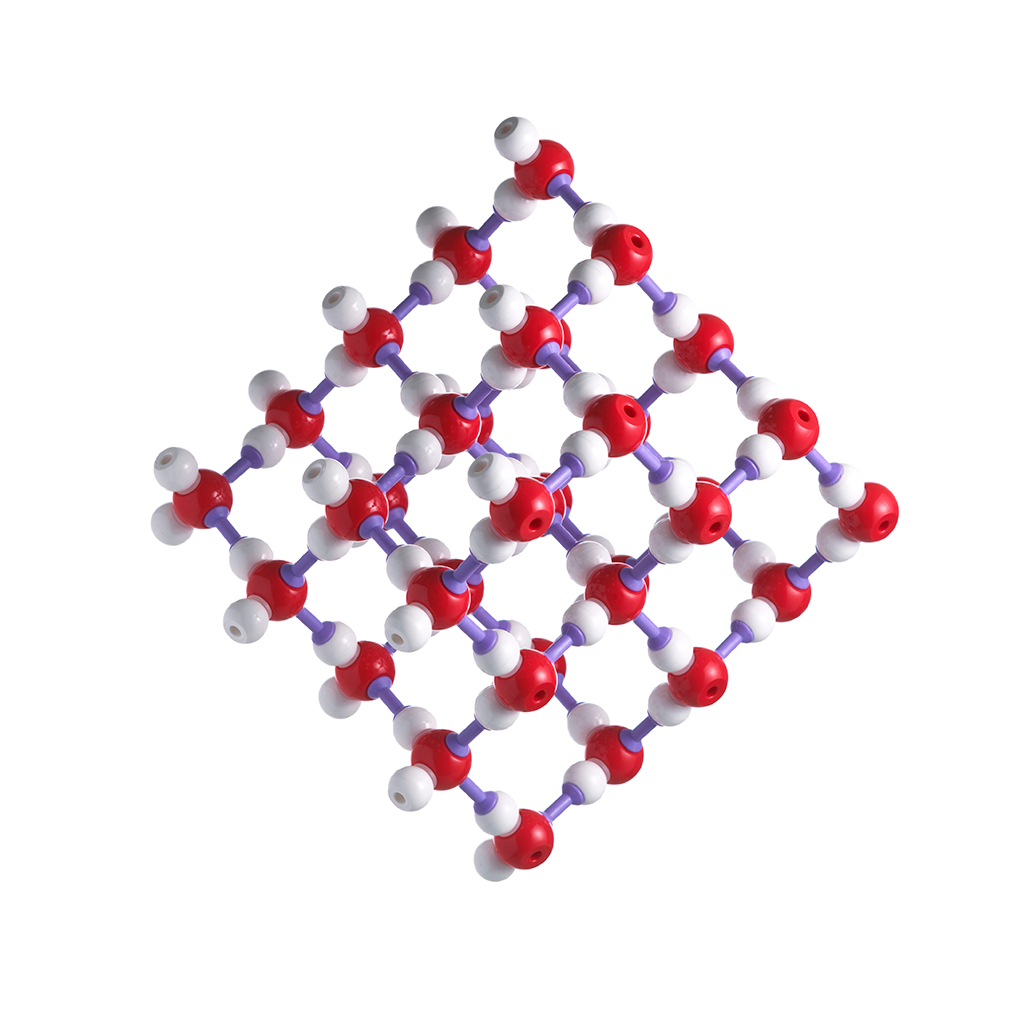 The crystal structure of ice is made up of a lattice of highly ordered water molecules, each with two hydrogen atoms (white) bonded to an oxygen atom (red). Science Photo Library/Getty Images Plus
Yet it doesn’t take much to disrupt that ordered structure. Imagine a boot touching the ice. Dipoles within the boot itself will attract dipoles in the top layers of the ice. It’s like two magnets attracting one another.
As the boot moves, the dipoles in the ice move, too. Now the perfect crystal structure of ice begins to fall apart as more and more of its molecules step out of line.
This process is called frustration, says Müser. The ice “kind of melts without really heating.”
The molecular changes shown by the new simulations would be virtually impossible to physically observe, the researchers note.
Müser likens crystalline ice to “an ordered bed of shell pasta.” Imagine, he says, what would happen if “now you rub over it with a slightly sticky hand.” Some shells will get pulled out of order. The dipoles in the boot or tire provide a similar stickiness to pull ice molecules out of order.
The affected molecules no longer behave like a crystal. Instead, they become that thin layer of water atop the ice.
A melt — with no heat neededThis is not the traditional way ice melts. It usually melts due to pressure or heat. But in this case, solid ice changes into liquid water as defects mess up its crystal structure.
“This means ice can be slippery even at low temperatures,” says Lars Pastewka. He’s a microsystems engineer at the University of Freiburg in Germany. Indeed, the Saarland computer model shows that “frustrated” ice will remain slippery at 10 kelvins. That’s –442º Fahrenheit, or close to absolute zero.
“Molecular simulations like these have the power to show what every atom is doing,” says Robert Carpick. That “is why [this new model’s] results should be taken seriously.” A mechanical engineer, Carpick works at the University of Pennsylvania in Philadelphia.
Pastewka’s group has shown similar crystal defects in silicon and diamond. This can turn their surfaces slippery, too. Diamond has one critical difference, though. With water ice, “the harder you push, the easier it gets to turn it into a liquid-like goo,” Pastewka says. In diamond, you get the opposite effect — which actually protects the surface.
In theory, you could skate on diamond for the same reason you can on water ice. But you wouldn’t leave as many marks on the surface of a diamond rink.
So what’s the solution to keep you from slipping on ice in winter? “I would say, put on cleats,” says Müser. “That’s really the only way.”
Submit your question here, and we might answer it an upcoming issue of Science News Explores
atom: The basic unit of a chemical element. Atoms are made up of a dense nucleus that contains positively charged protons and uncharged neutrons. The nucleus is orbited by a cloud of negatively charged electrons.
behavior: The way something, often a person or other organism, acts towards others, or conducts itself.
computer model: A program that runs on a computer that creates a model, or simulation, of a real-world feature, phenomenon or event.
develop: To emerge or to make come into being, either naturally or through human intervention, such as by manufacturing.
diamond: One of the hardest known substances and rarest gems on Earth. Diamonds form deep within the planet when carbon is compressed under incredibly strong pressure.
dipole: (in chemistry) A type of molecule in which a collection of positive electric charges are separated from a similar concentration of negative charges. (in physics) Two equal and oppositely charged electric or magnetic poles that are separated by some distance.
disrupt: (n. disruption) To break apart something; interrupt the normal operation of something; or to throw the normal organization (or order) of something into disorder.
engineer: A person who uses science and math to solve problems. As a verb, to engineer means to design a device, material or process that will solve some problem or unmet need.
friction: The resistance that one surface or object encounters when moving over or through another material (such as a fluid or a gas). Friction generally causes a heating, which can damage a surface of some material as it rubs against another.
kelvin: A temperature scale that has units the size of those on the Celsius scale. The difference, 0 kelvin is absolute zero. So 0 kelvin is equal to -273.15 Celsius. That means 0 Celsius is equal to 273.15 kelvins. NOTE: Unlike with the Celsius and Fahrenheit scales, there is no use of the term “degrees” for numbers on the kelvin scale.
liquid: A material that flows freely but keeps a constant volume, like water or oil.
magnet: A material that usually contains iron and whose atoms are arranged so they attract certain metals.
materials scientist: A researcher who studies how the atomic and molecular structure of a material is related to its overall properties. Materials scientists can design new materials or analyze existing ones. Their analyses of a material’s overall properties (such as density, strength and melting point) can help engineers and other researchers select materials that are best suited to a new application.
mechanical: Having to do with the devices that move, including tools, engines and other machines (even, potentially, living machines); or something caused by the physical movement of another thing.
mechanical engineer: Someone trained in a research field that uses physics to study motion and the properties of materials to design, build and/or test devices.
model: A simulation of a real-world event (usually using a computer) that has been developed to predict one or more likely outcomes. Or an individual that is meant to display how something would work in or look on others.
molecule: A group of atoms that represents the smallest possible amount of a chemical compound. Molecules can be made of single types of atoms or of different types. For example, the oxygen in air is made of two bound oxygen atoms (O2). Water is made of two hydrogen atoms and one oxygen atom (H2O).
phenomenon: Something that is surprising or unusual.
physicist: A scientist who studies the nature and properties of matter and energy.
pressure: Force applied uniformly over a surface, measured as force per unit of area.
silicon: A nonmetal, semiconducting element used in making electronic circuits. Pure silicon exists in a shiny, dark-gray crystalline form and as a shapeless powder.
simulation: (v. simulate) An analysis, often made using a computer, of some conditions, functions or appearance of a physical system. A computer program would do this by using mathematical operations that can describe the system and how it might change over time or in response to different anticipated situations.
theory: (in science) A description of some aspect of the natural world based on extensive observations, tests and reason. A theory can also be a way of organizing a broad body of knowledge that applies in a broad range of circumstances to explain what will happen. Unlike the common definition of theory, a theory in science is not just a hunch. Ideas or conclusions that are based on a theory — and not yet on firm data or observations — are referred to as theoretical. Scientists who use mathematics and/or existing data to project what might happen in new situations are known as theorists.
| # | Наименование новости | Тональность | Информативность | Дата публикации |
|---|---|---|---|---|
| 1 | Melting sea ice combines with Arctic sea to make clouds | 0 | 10.89 | 05-08-2026 |
| 2 | Scientists finally reveal why mint feels cold | 0 | 8 | 08-03-2026 |
| 3 | Antarctic Collapse 9,000 Years Ago Hints at White Continent's Future | 0 | 9.2 | 29-12-2025 |
| 4 | Scientists solve mystery of Antarctica's giant sea ice hole | 0 | 7 | 02-05-2024 |
| 5 | Christmas in July: Engineers capture gigapixel 3D video of snowflakes | 0 | 14.75 | 27-07-2026 |
| 6 | Scientists just uncovered a 3 million-year climate mystery in Antarctic ice | 0 | 10.18 | 24-04-2026 |
| 7 | Scientists find molecular-level evidence for two structures in liquid water | 0 | 8 | 25-06-2026 |
| 8 | Изменение климата привело к вскрытию самого толстого льда в Арктике | 0 | 0 | 22-08-2018 |
| 9 | Scientists observe water's behavior in a single molecular layer | 0 | 7 | 06-07-2026 |
| 10 | Ученые назвали вероятную причину обрушения ледяной глыбы с водопада на Камчатке | 0 | 0 | 07-01-2021 |