Просмотр новости
Найдите то, что Вас интересует
 Спутники
 РН
 SpaceX
 Роскосмос
 NASA
СпутникиРНSpaceXРоскосмосNASAThough they can look like rocks or plants, corals are animals. Most are made up of colonies of individuals called polyps.
Take a plunge into Australia’s Great Barrier Reef, and you’ll come face to face with a what looks like a gorgeous rocky garden. This dazzling array of corals is the largest living structure on Earth. Some, like staghorn coral, look like leafless bushes sprouting from the ocean floor. Others, such as honeycomb coral, resemble rocks dotted with tiny holes. Then there’s brain coral, which, you guessed it, look like brains. And that’s just a small sample of the brilliant diversity to be found in a reef.
Despite their appearance, corals are animals. These invertebrates are close relatives of jellyfish and sea anemones. Most corals live in colonies of thousands of tiny individuals called polyps growing together. Each polyp sports a cylindrical body topped with a ring of tentacles surrounding its mouth.
“You can think of them as upside-down jellyfish,” says Peter Cowman. At Queensland Museum Tropics in Townsville, Australia, this marine biologist studies the evolutionary history of corals.
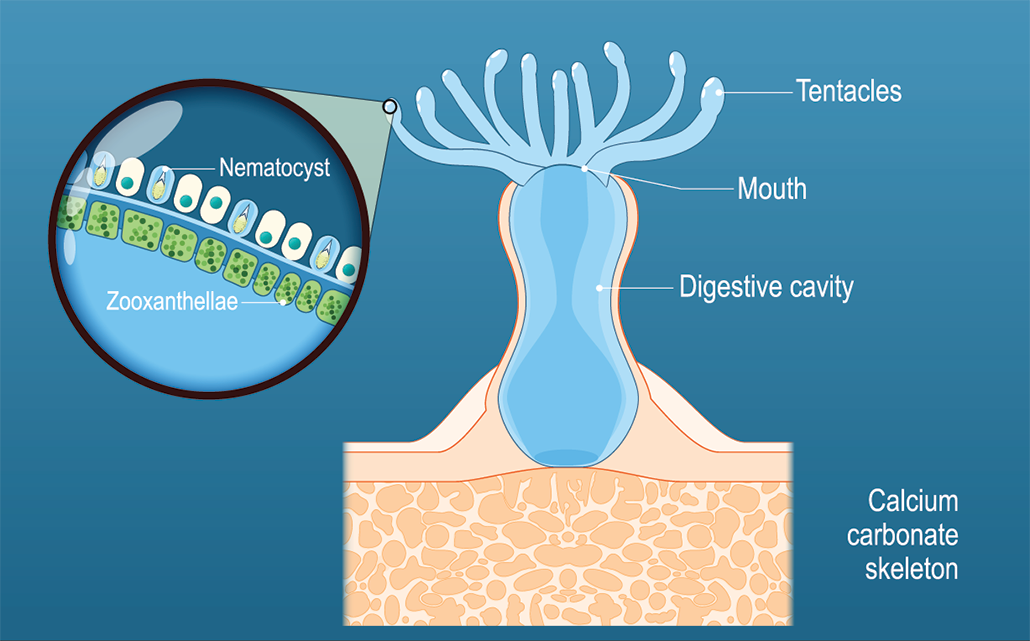 A coral looks somewhat like an upside-down jellyfish, one that is attached to a skeleton made of calcium carbonate. In the coral’s tentacles are stinging nematocysts that help it catch prey and zooxanthellae that make energy from sunlight.ttsz/iStock/Getty Images Plus
Like their jellyfish cousins, coral polyps use tentacles to feed and defend themselves. These appendages are packed with specialized stinging cells called nematocysts. Each contains a coiled, barbed thread. When touched, the cell “fires” this thread to inject venom into its target. Most corals hunt at night, snagging tiny zooplankton, floating eggs and small fish.
Many corals have a more laid-back way of feeding, too. Inside their tissues, they house algae called zooxanthellae (Zoh-uh-ZAN-thuh-lay). (This is an example of symbiosis, where two creatures benefit by associating together.) These single-celled organisms are photosynthetic. They use light and carbon dioxide to make sugars and proteins. Most of these nutrients are offered to the coral. “In return, the coral gives them a safe apartment to live in,” says Cowman. “They’re the solar-powered roommates.”
Corals that rely on light-powered algae live in shallow, warm waters. It’s here where you find coral reefs. These structures are made by a type of coral called hard or stony corals. “They are the engineers of the reef system,” says Cowman.
Stony corals produce hard skeletons of aragonite, a mineral made of calcium carbonate. Over hundreds to thousands of years, generations of polyps can build up massive reef systems.
Soft corals, like their name implies, don’t make these stony skeletons. Instead, they have bendy structures that move with ocean currents. They can often be found living among reefs, though. “The soft corals are like the decorators,” says Cowman. “They look like underwater swaying trees and fans.”
Some corals — both soft and hard — can live in deep water, up to 6,000 meters (20,000 feet) below the water surface. Stony corals found at these depths are often smaller than their shallow-water counterparts. Most tend to live as single polyps. Some species do create reefs, but they’re less of a team effort. Called “mounds,” these deep reefs grow over the skeletons of old or dead corals on the ocean floor.
Reefs at riskThe first true corals appeared about 500 million years ago. But many of today’s reef-building corals can be traced back to the end of the Cretaceous Period some 66 million years ago. That’s when an asteroid impact wiped out about 80 percent of all animals (including the nonbird dinosaurs).
“The mass extinction had an effect in the oceans as well,” says Cowman. Existing reef-builders died out. Their extinction allowed stony corals to take their place. Today, corals are found in all of the world’s oceans.
But many are at risk from human activities. These dangers include pollution and destructive or heavy fishing. One of the biggest threats is climate change. High water temperatures and too much sunlight can stress corals, leading to a phenomenon called coral bleaching.
 When coral is stressed, such as when water temperatures are high, it can lose its algae — and its color. If the stress goes away, the algae may return. If not, the coral remain pale and vulnerable.NOAA
At higher temperatures, the algae produce toxic compounds. “When the water gets too hot, the coral gets stressed and they evict their zooxanthellae,” says Cowman. These microbes are also responsible for a coral’s bright colors. In their absence, the coral’s tissues turn transparent. All that remains visible is the coral’s white skeleton.
Bleaching doesn’t kill the coral immediately. If conditions improve, the coral may recover and even take the algae back in. But if coral go too long without their algal partners, they may get sick or die. “If they can’t get the zooxanthellae back in again, they [will] actually starve to death,” says Cowman.
This bleaching affects coral worldwide. Since 2023, the world’s corals have been experiencing the largest bleaching event on record.
 Coral reefs, such as this one off Florida, face many risks, including climate change, pollution and overfishing. DurdenImages/iStock/Getty Images Plus
Rainforests of the sea
Many scientists and conservationists are concerned about corals’ future. Coral reefs are among Earth’s most diverse ecosystems. Though they cover less than one percent of the seafloor, coral reefs support at least one-fourth of all marine species. “On land, you think of rainforests as having all that diversity,” says Cowman. “The rainforests of the sea are the coral reefs.”
Corals are important for people, too. Humans rely on many reef-dwelling species for food. Reefs can also buffer coasts against damage from strong waves or storms, says Cowman. Chemical compounds from reef animals have been found to help fight pain and treat cancer. And reefs support tourism around the globe. The food, products, jobs and coastal protection provided by corals are estimated to be worth $2.7 trillion per year.
Says Cowman, “as humans, we rely on reefs a lot in our daily lives, even if we don’t think of it.”
algae: A group of single-celled and multicellular organisms, once considered plants (they aren’t). As aquatic organisms, they grow in water. Like green plants, they depend on sunlight to make their food.
anemone: (in zoology) Known as sea anemones, these soft, gelatinous invertebrates have a tubular body and one or more circles of venomous tentacles surrounding their mouths. These carnivorous animals tend to live glued to rocks on the seafloor, where they feed on plankton and tiny fish. Resembling a flower, an anemone can range in size from less than 2.5 centimeters (an inch) to some 1.5 meters (5 feet) across.
appendage: A finger, leg, ear, antenna or other feature that sticks out from some creature and has some apparent specific function.
array: A broad and organized group of objects. Sometimes they are instruments placed in a systematic fashion to collect information in a coordinated way. Other times, an array can refer to things that are laid out or displayed in a way that can make a broad range of related things, such as colors, visible at once. The term can even apply to a range of options or choices.
asteroid: A rocky object in orbit around the sun. Most asteroids orbit in a region that falls between the orbits of Mars and Jupiter. Astronomers refer to this region as the asteroid belt.
biologist: A scientist involved in the study of living things.
calcium: A chemical element and alkali metal common in minerals of the Earth’s crust and in sea salt. It is also found in bone mineral and teeth, and can play a role in the movement of certain substances into and out of cells.
calcium carbonate: The main chemical compound in limestone, a rock made from the tiny shells of ancient marine organisms. Its formula is CaCO3 (meaning it contains one calcium atom, one carbon atom and three oxygen atoms). It’s also the active ingredient in some antacid medicines (ones used to neutralize stomach acids).
cancer: Any of more than 100 different diseases, each characterized by the rapid, uncontrolled growth of abnormal cells. The development and growth of cancers, also known as malignancies, can lead to tumors, pain and death.
carbon: A chemical element that is the physical basis of all life on Earth. Carbon exists freely as graphite and diamond. It is an important part of coal, limestone and petroleum, and is capable of self-bonding, chemically, to form an enormous number of chemically, biologically and commercially important molecules. (in climate studies) The term carbon sometimes will be used almost interchangeably with carbon dioxide to connote the potential impacts that some action, product, policy or process may have on long-term atmospheric warming.
carbon dioxide: (or CO2) A colorless, odorless gas produced by all animals when the oxygen they inhale reacts with the carbon-rich foods that they’ve eaten. Carbon dioxide also is released when organic matter burns (including fossil fuels like oil or gas). Carbon dioxide acts as a greenhouse gas, trapping heat in Earth’s atmosphere. Plants convert carbon dioxide into oxygen during photosynthesis, the process they use to make their own food.
cell: (in biology) The smallest structural and functional unit of an organism. Typically too small to see with the unaided eye, it consists of a watery fluid surrounded by a membrane or wall. Depending on their size, animals are made of anywhere from thousands to trillions of cells. Most organisms, such as yeasts, molds, bacteria and some algae, are composed of only one cell.
chemical: A substance formed from two or more atoms that unite (bond) in a fixed proportion and structure. For example, water is a chemical made when two hydrogen atoms bond to one oxygen atom. Its chemical formula is H2O. Chemical also can be an adjective to describe properties of materials that are the result of various reactions between different compounds.
climate: The weather conditions that typically exist in one area, in general, or over a long period.
climate change: Long-term, significant change in the climate of Earth. It can happen naturally or in response to human activities, including the burning of fossil fuels and clearing of forests.
compound: (often used as a synonym for chemical) A compound is a substance formed when two or more chemical elements unite (bond) in fixed proportions. For example, water is a compound made of two hydrogen atoms bonded to one oxygen atom. Its chemical symbol is H2O.
coral: Marine animals that often produce a hard and stony exoskeleton and tend to live on reefs (the exoskeletons of dead ancestor corals).
coral bleaching: Corals depend on certain algae to help nurture them. When the corals’ water gets too hot or infected with disease-causing agents, those algae may flee, leaving the corals a stark white. This is a bleaching event. If the algae don’t soon return, the corals can die.
Cretaceous: A geologic time period that included the end of the Age of Dinosaurs. Spanning 145 million to 66 million years ago, it was a time when the whole planet had a relatively mild climate, with forests growing near both the North and South Poles. It marked the emergence of flowering plants and massive volcanic eruptions, which triggered big shifts in ocean ecosystems. And some regions cooled, leading dinosaurs there to adapt by evolving a coat of insulating feathers. Finally, it all came to an end 66 million years ago when a giant meteorite crashed into Earth, changing the global climate overnight. This wiped out all the dinosaurs (except those that would survive as birds), along with half of all plant and animal species.
current: A fluid — such as of water or air — that moves in a recognizable direction.
diversity: A broad spectrum of similar items, ideas or people. In a social context, it may refer to a diversity of experiences and cultural backgrounds. (in biology) A range of different life forms or a range of traits within the population of some species.
ecosystem: A group of interacting living organisms — including microorganisms, plants and animals — and their physical environment within a particular climate. Examples include tropical reefs, rainforests, alpine meadows and polar tundra. The term can also be applied to elements that make up some artificial environment, such as a company, classroom or the internet.
engineer: A person who uses science and math to solve problems. As a verb, to engineer means to design a device, material or process that will solve some problem or unmet need.
evolutionary: An adjective that refers to changes that occur within a species over time as it adapts to its environment. Such evolutionary changes usually reflect genetic variation and natural selection, which leave a new type of organism better suited for its environment than its ancestors. The newer type is not necessarily more “advanced,” just better adapted to the conditions in which it developed.
extinction: (adj. extinct) The permanent loss of a species, family or larger group of organisms.
generation: A group of individuals (in any species) born at about the same time or that are regarded as a single group. Your parents belong to one generation of your family, for example, and your grandparents to another. Similarly, you and everyone within a few years of your age across the planet are referred to as belonging to a particular generation of humans. The term also is sometimes extended to year classes of other animals or to types of inanimate objects (such as electronics or automobiles).
Great Barrier Reef: Some 2,300 kilometers (1,430 miles) long, this natural coral habitat is the largest living structure on Earth. In coastal waters off of northeastern Australia, It’s big enough to see from space. It’s home to some 3,000 coral reefs, 600 islands, and hundreds of types of 600 types corals, more jellyfish, mollusks, worms and fish. It’s also patrolled by more than 30 species of whales and dolphins.
invertebrate: An animal lacking a backbone. About 90 percent of animal species are invertebrates.
marine: Having to do with the ocean world or environment.
marine biologist: A scientist who studies creatures that live in ocean water, from bacteria and shellfish to kelp and whales.
mineral: Crystal-forming substances that make up rock, such as quartz, apatite or various carbonates. Most rocks contain several different minerals mish-mashed together. A mineral usually is solid and stable at room temperatures and has a specific formula, or recipe (with atoms occurring in certain proportions) and a specific crystalline structure (meaning that its atoms are organized in regular three-dimensional patterns). (in physiology) The same chemicals that are needed by the body to make and feed tissues to maintain health.
nematocyst: Stinging cells in the tentacles of jellyfish, hydra and related animals. The toxins released by these cells help immobilize prey and ward off attackers.
nutrient: A vitamin, mineral, fat, carbohydrate or protein that a plant, animal or other organism requires as part of its food in order to survive.
organism: Any living thing, from elephants and plants to bacteria and other types of single-celled life.
oxygen: A gas that makes up about 21 percent of Earth's atmosphere. All animals and many microorganisms need oxygen to fuel their growth (and metabolism).
phenomenon: Something that is surprising or unusual.
protein: A compound made from one or more long chains of amino acids. Proteins are an essential part of all living organisms. They form the basis of living cells, muscle and tissues; they also do the work inside of cells. Antibodies, hemoglobin and enzymes are all examples of proteins. Medicines frequently work by latching onto proteins.
Queensland: One of the states that makes up the northeast corner of the country of Australia.
rainforest: Dense forest rich in biodiversity found in tropical areas with consistent heavy rainfall.
reef: A ridge of rock, coral or sand. It rises up from the seafloor and may come to just above or just under the water’s surface.
risk: The chance or mathematical likelihood that some bad thing might happen. For instance, exposure to radiation poses a risk of cancer. Or the hazard — or peril — itself. (For instance: Among cancer risks that the people faced were radiation and drinking water tainted with arsenic.)
sea: An ocean (or region that is part of an ocean). Unlike lakes and streams, seawater — or ocean water — is salty.
species: A group of similar organisms capable of producing offspring that can survive and reproduce.
stress: (in biology) A factor — such as unusual temperatures, movements, moisture or pollution — that affects the health of a species or ecosystem.
symbiosis: (Adj. symbiotic) A relationship between two species that live in close contact. A species that lives this way, offering substantial help to the other species, is sometimes called a symbiont.
system: A network of parts that together work to achieve some function. For instance, the blood, vessels and heart are primary components of the human body's circulatory system. Similarly, trains, platforms, tracks, roadway signals and overpasses are among the potential components of a nation's railway system. System can even be applied to the processes or ideas that are part of some method or ordered set of procedures for getting a task done.
tissue: Made of cells, it is any of the distinct types of materials that make up animals, plants or fungi. Cells within a tissue work as a unit to perform a particular function in living organisms. Different organs of the human body, for instance, often are made from many different types of tissues.
toxic: Poisonous or able to harm or kill cells, tissues or whole organisms. The measure of risk posed by such a poison is its toxicity.
transparent: Allowing light to pass through so that objects behind can be distinctly seen. Or information that lets others understand the otherwise hidden people, processes and impacts behind some product, action or proposal.
venom: A poisonous secretion of an animal, such as a snake, spider or scorpion, usually transmitted by a bite or sting. A single venom may contain a mix of toxins.
zooplankton: Small organisms that drift in the sea. Zooplankton are tiny animals that eat other plankton. They also serve as an important food source for other marine creatures.
zooxanthellae: Certain photosynthetic algae that live in most reef-building corals. These algae provide both food and color to the corals. The corals protect the algae. Meanwhile, the algae feed their host, provide oxygen and help the corals get rid of their wastes. This mutual support by unrelated species is known as mutualism.
Aaron Tremper is the assistant editor for Science News Explores. He has a B.A. in English (with minors in creative writing and film production) from SUNY New Paltz and an M.A. in Journalism from the Craig Newmark Graduate School of Journalism’s Science and Health Reporting program. A former intern at Audubon magazine and Atlanta’s NPR station, WABE 90.1 FM, he has reported a wide range of science stories for radio, print, and digital media. His favorite reporting adventure? Tagging along with researchers studying bottlenose dolphins off of New York City and Long Island, NY.
| # | Наименование новости | Тональность | Информативность | Дата публикации |
|---|---|---|---|---|
| 1 | Better together? Coral fusion could throw bleached reefs a lifeline | 0 | 7.21 | 15-10-2026 |
| 2 | Корнеты | 0 | 10 | 10-07-2026 |
| 3 | 👋Привет, юные океанографы и любители подводного мира🦈! Сегодня в рубрике ... | 0 | 8.71 | 29-07-2026 |
| 4 | movement: Analyse Animal Body Movements | 0 | 10 | 26-02-2026 |
| 5 | История корутин: появление, развитие, спад и возрождение | 0 | 7.07 | 27-07-2026 |
| 6 | Los corales pueden estar adaptándose al cambio climático | 2 | 7 | 02-10-2025 |
| 7 | Adaptogens: What They Are and Why They Matter | 0 | 7.66 | 12-02-2021 |
| 8 | Корнеты, аксессуары | 0 | 10 | 10-07-2026 |
| 9 | Coral reefs could feed millions if we let them rebuild | 0 | 8.8 | 04-01-2026 |
| 10 | Это варан или динозавр? Лучшие фотографии океана-2025 | 0 | 8.62 | 19-10-2025 |