Просмотр новости
Найдите то, что Вас интересует
 Спутники
 РН
РН SpaceX
 Роскосмос
 NASA
NASA
СпутникиРНSpaceXРоскосмосNASA
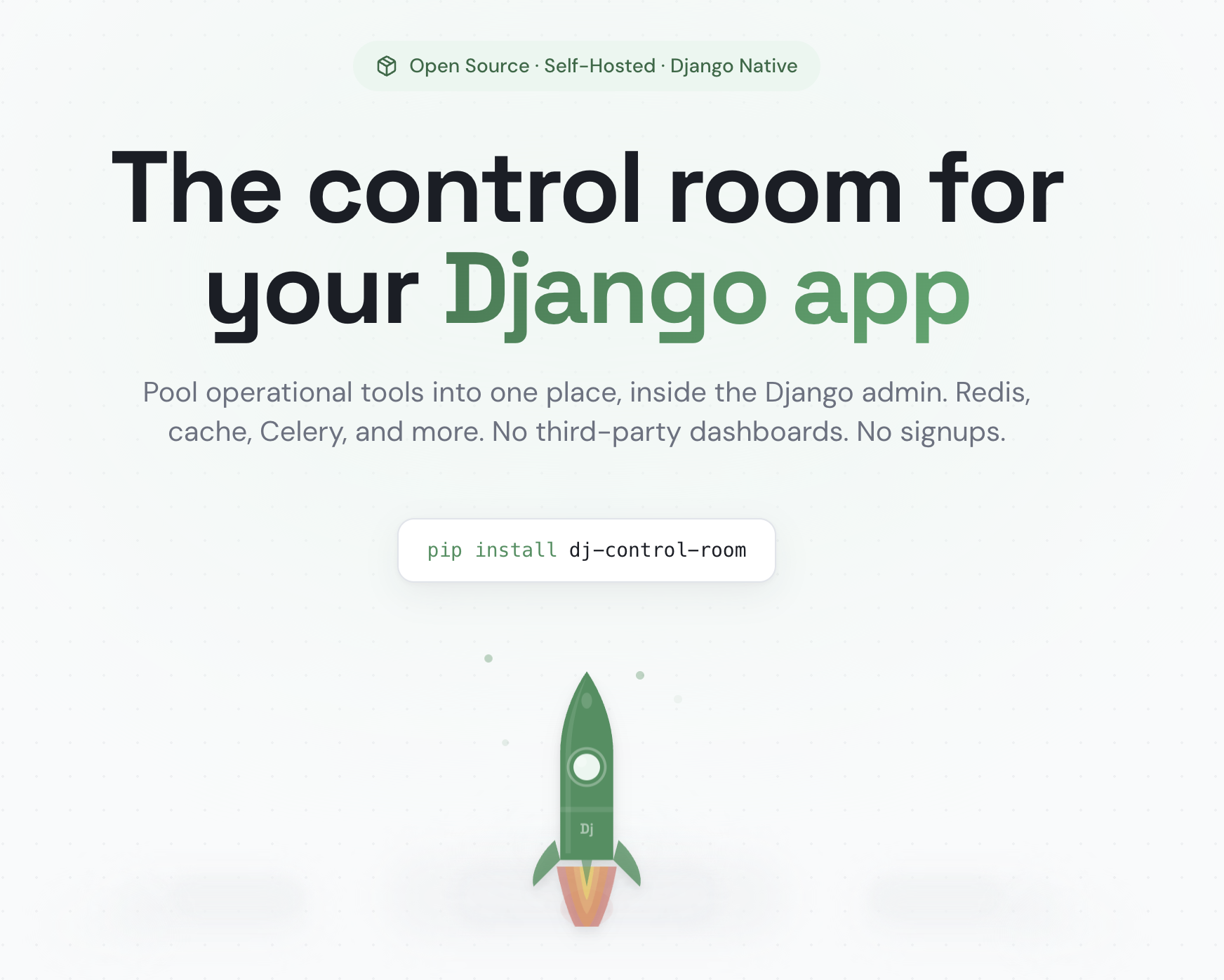
A framework for building Django admin tools and a growing suite of operational tools for your project.
Django Control Room is a plugin framework for building Django admin tools (called "panels"), it's also a suite of official panels for managing all sorts of services like Redis, Celery, Caches and inspecting Django internals like URLs and Signals. Every panel - official or third-party - is a small, independent Python package built on the same public plugin API/SDK available in dj-control-room-base.
Install dj-control-room and it discovers every compatible panel via Python entry points, renders it in a centralized dashboard, and gives it a shared design system, permissions model, and admin sidebar integration - all for free.
The Official Panels below are reference implementations of that same framework - a starting point, not the whole story. See Creating Custom Panels to build your own.
Features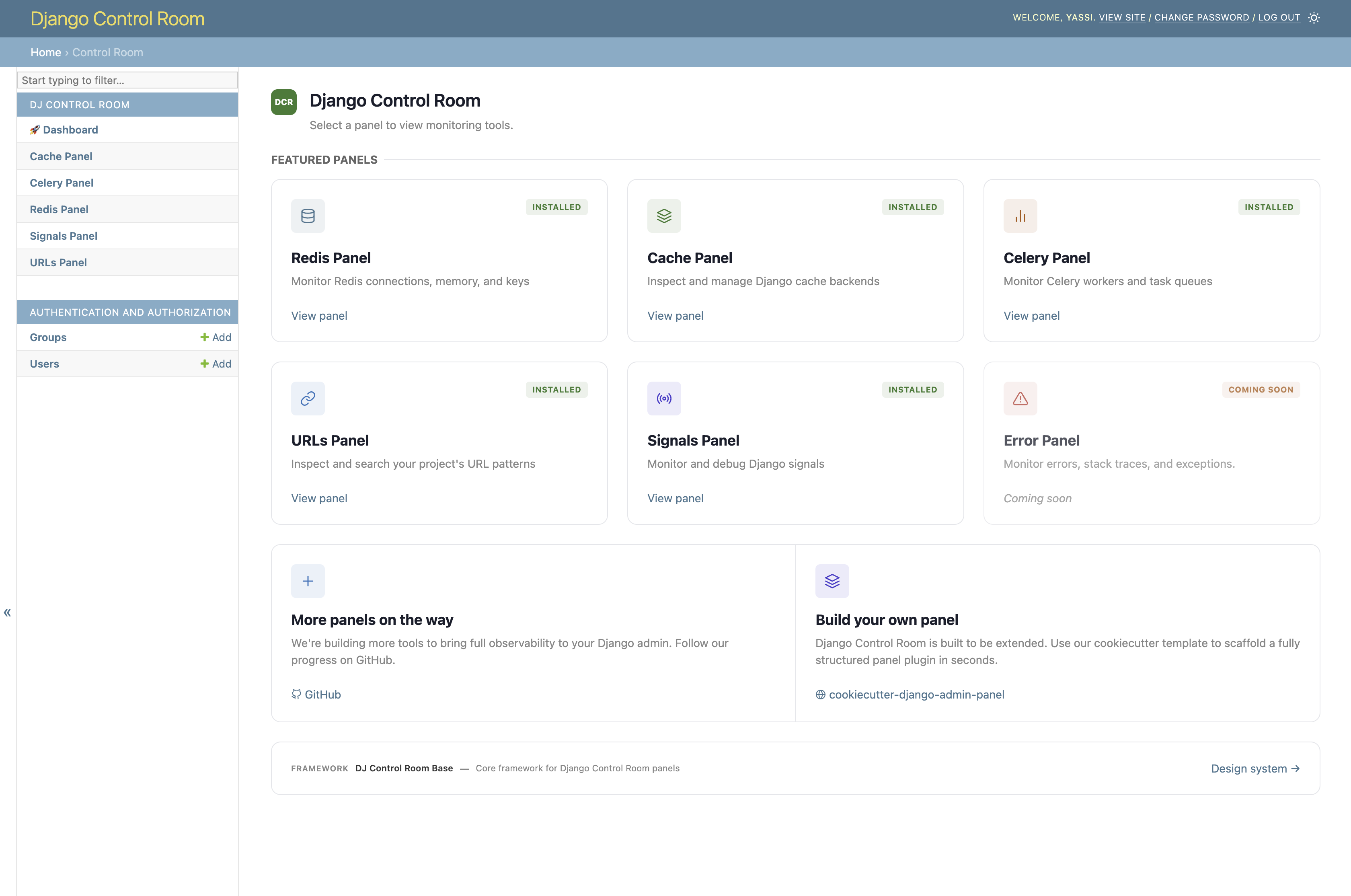
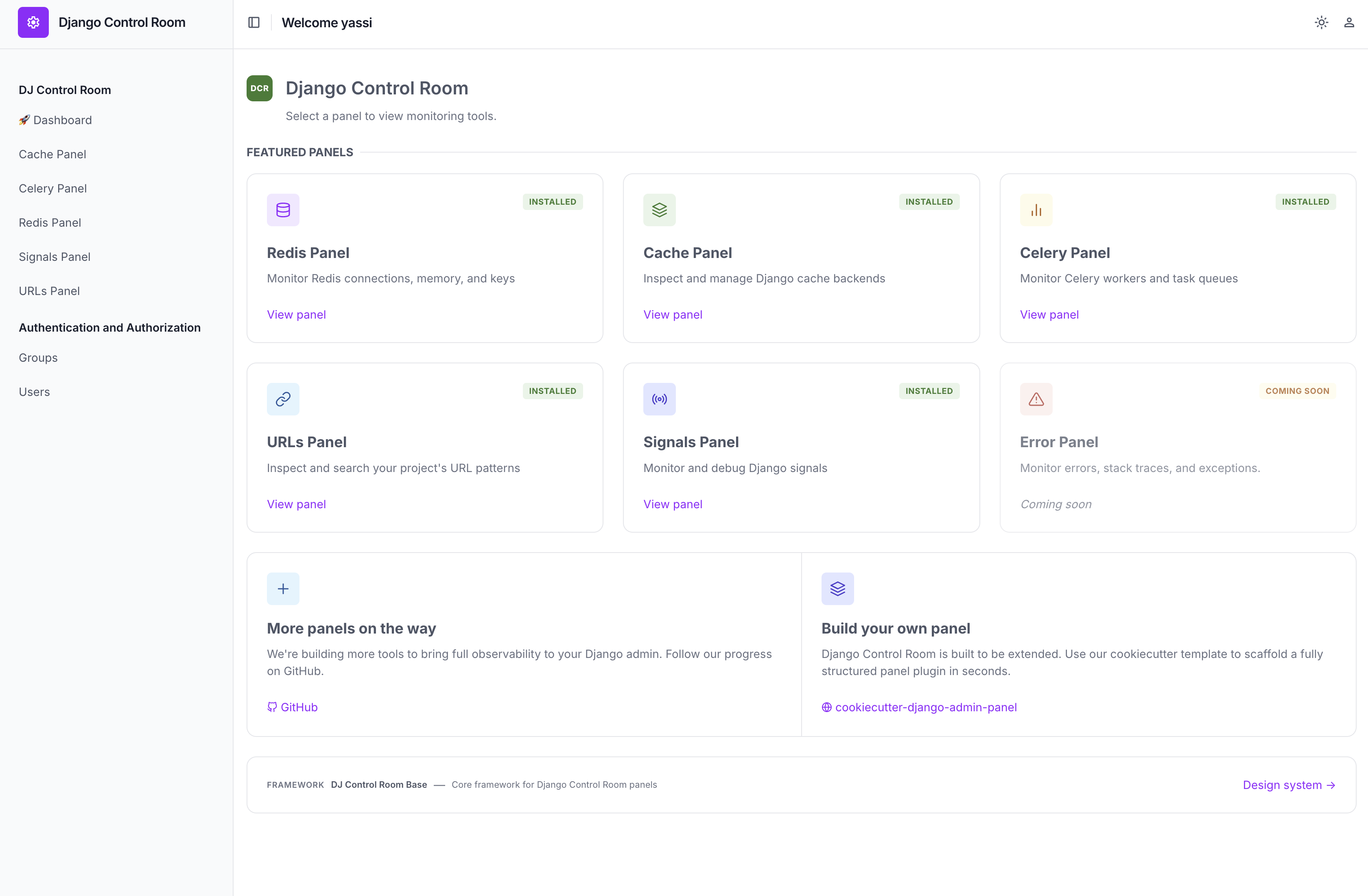
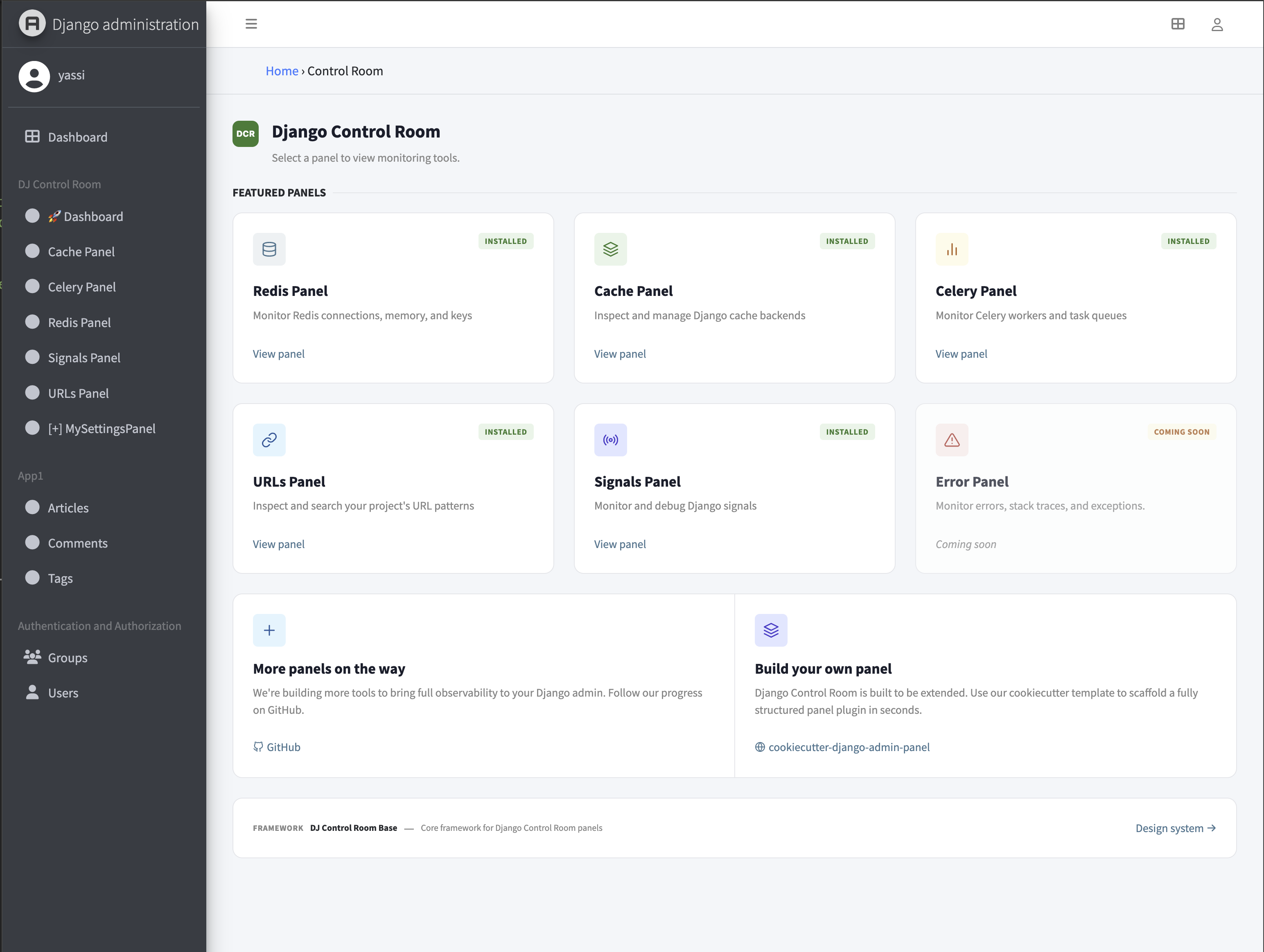
Opt-in stylesheets that remap the dashboard to match popular admin skins. Enable via EXTRA_CSS - nothing is applied automatically. See Theme adapters for the full list.
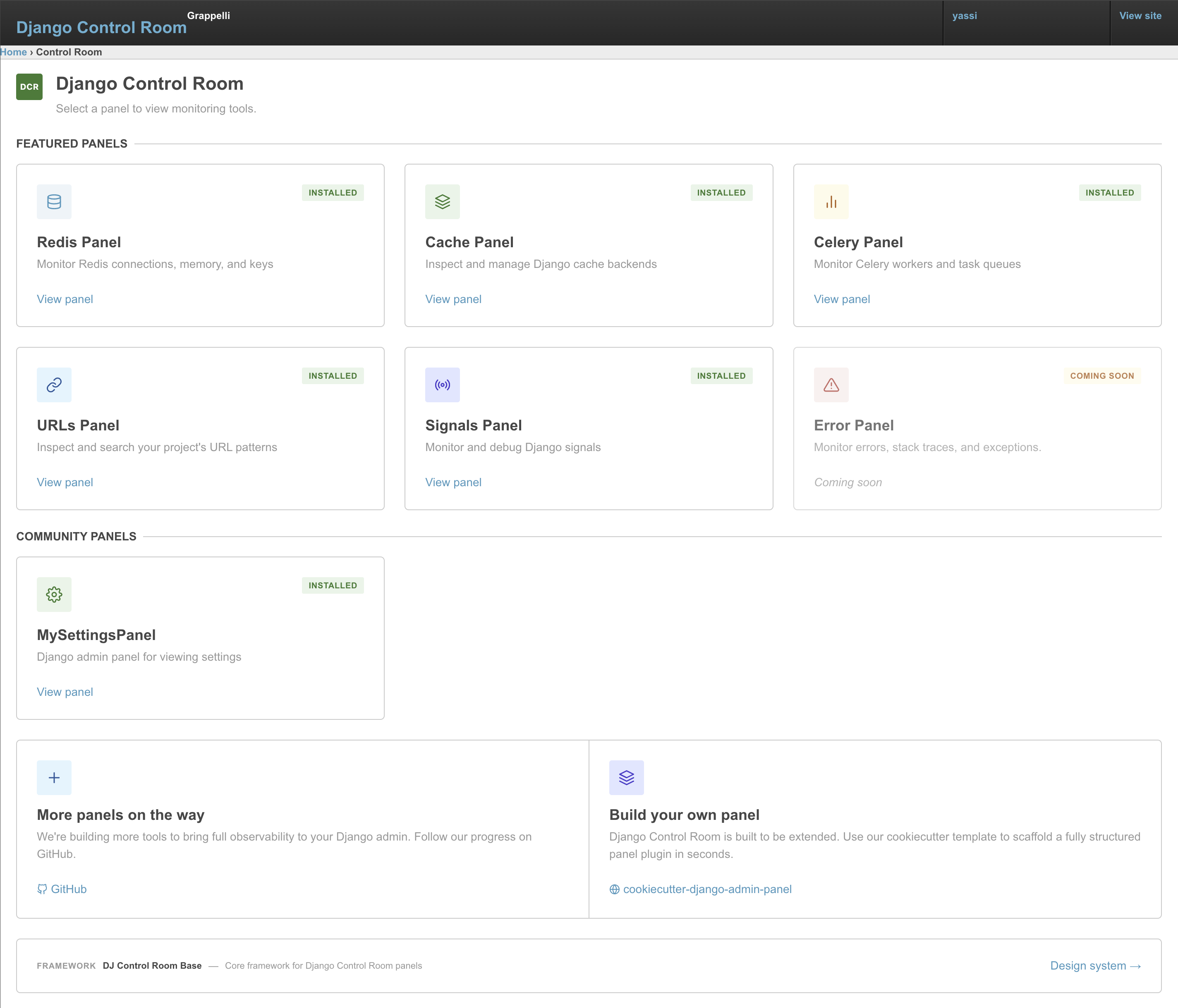
# Core only
pip install dj-control-room

# With specific official panels
pip install dj-control-room[redis,cache,urls]

# Or with all official panels
pip install dj-control-room[all]
Add dj_control_room_base (core library), your panels, then dj_control_room (so they all appear under one admin section), include the URLs, and migrate:
INSTALLED_APPS = [
    # ...
    "dj_control_room_base",
    "dj_redis_panel",
    "dj_cache_panel",
    "dj_urls_panel",
    "dj_control_room",
]
urlpatterns = [
    path("admin/dj-redis-panel/", include("dj_redis_panel.urls")),
    path("admin/dj-cache-panel/", include("dj_cache_panel.urls")),
    path("admin/dj-urls-panel/", include("dj_urls_panel.urls")),
    path("admin/dj-control-room/", include("dj_control_room.urls")),
    path("admin/", admin.site.urls),
]
Then visit http://localhost:8000/admin/dj-control-room/.
For the full walkthrough and settings reference (admin sidebar behavior, theme adapters, MCP/AI agent integration), see the Installation and Configuration docs.
Admin Sidebar IntegrationAll installed panels appear in the Django admin sidebar under "Django Control Room":
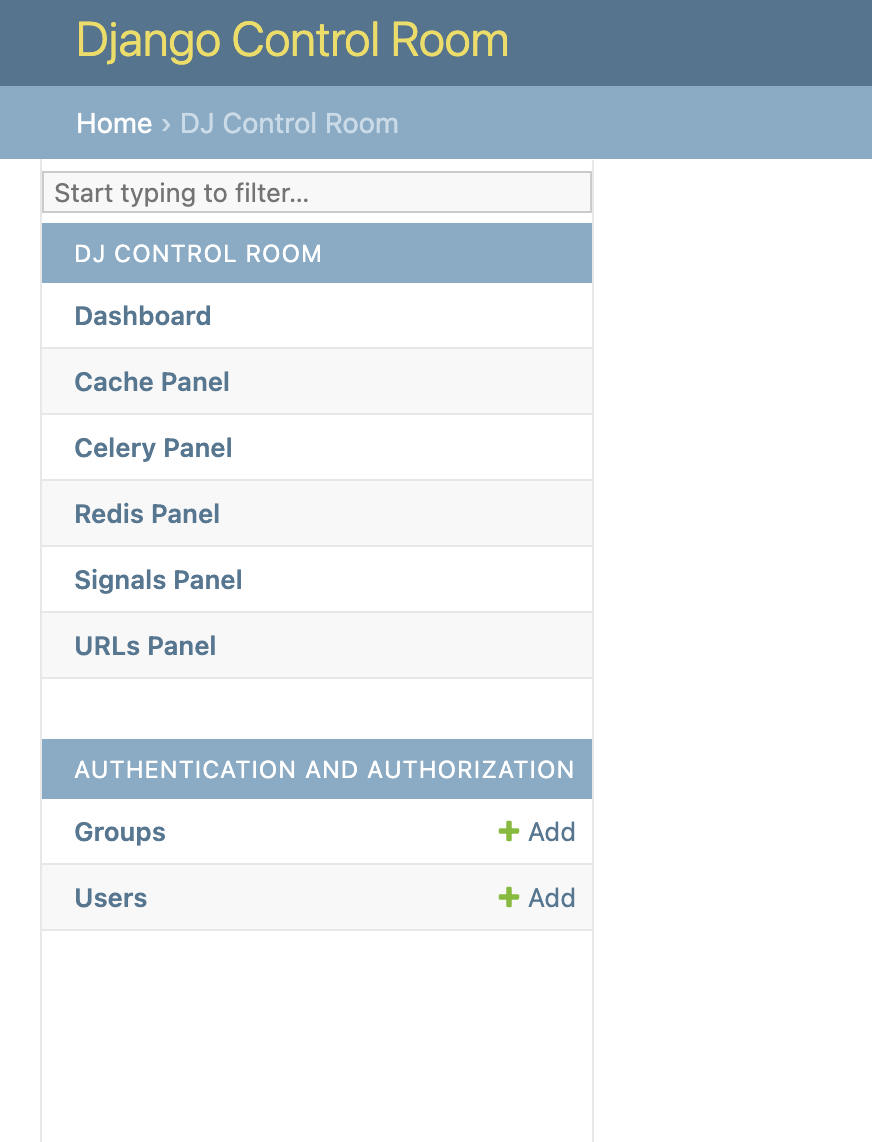
# settings.py
DJ_CONTROL_ROOM_SETTINGS = {
    # Global: Show panels in both Control Room and their own sections
    "REGISTER_PANELS_IN_ADMIN": False,  # Default: False
    # Per-panel: Override for specific panels
    "PANEL_ADMIN_REGISTRATION": {
        "dj_redis_panel": True,  # Redis in both places
        "dj_cache_panel": False,  # Cache only in Control Room
    },
    # CSS: load built-in styles and/or inject your own
    "LOAD_DEFAULT_CSS": True,
    # Static paths are relative to app's static/ dir (e.g. 'myapp/css/overrides.css'
    # for a file at myapp/static/myapp/css/overrides.css). Full URLs also accepted.
    "EXTRA_CSS": [],
}
These are reference panels built using the same plugin framework described above - a great way to see it in action, and a starting point if you want to build your own.
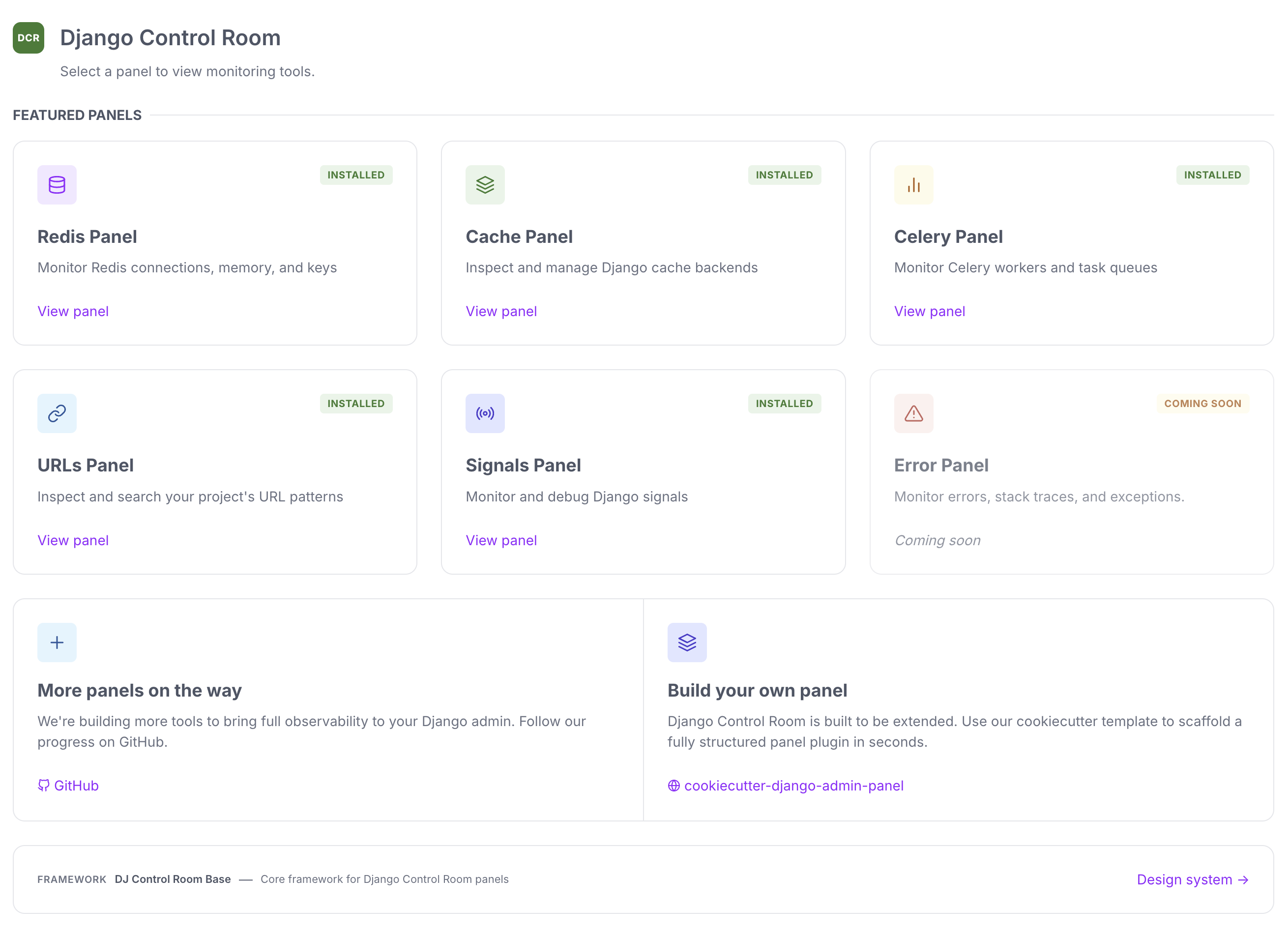
| Panel | Description | Install |
|---|---|---|
| Redis Panel | Monitor connections, inspect keys, view memory usage | pip install dj-redis-panel |
| Cache Panel | Inspect cache entries, view hit/miss ratios | pip install dj-cache-panel |
| URLs Panel | Browse URL patterns, test resolvers | pip install dj-urls-panel |
| Celery Panel | Monitor workers, track task queues | pip install dj-celery-panel |
| Signals Panel | Inspect Django signals and recievers | pip install dj-signals-panel |
| Panel | Description | Status |
|---|---|---|
| Error Panel | Monitor errors, exceptions, and tracebacks | In Development |
The fastest way to create a new panel is using our official cookiecutter template:
pip install cookiecutter
cookiecutter https://github.com/django-control-room/cookiecutter-dj-control-room-plugin
This generates a complete panel structure with Django admin integration, tests, documentation, and Docker setup.
Manual Panel CreationPrefer full control over the generated structure? You can build a panel by hand instead of using the cookiecutter template. See our Creating Panels Doc for the complete guide, or use our Build your own panel guide, which still uses the cookiecutter template to get started quickly.
SecurityDjango Control Room includes built-in security features:
Visit the official site at djangocontrolroom.com for guides, tutorials, and examples.
Full documentation: https://django-control-room.github.io/dj-control-room/
RequirementsWe welcome contributions! Please see our Contributing Guide for details.
LicenseThis project is licensed under the MIT License - see the LICENSE file for details.
CreditsCreated by Yasser Toruno
Official Site • Star us on GitHub • Report Bug • Request Feature
| # | Наименование новости | Тональность | Информативность | Дата публикации |
|---|---|---|---|---|
| 1 | django-devbar - Lightweight performance devbar for Django. | 0 | 24.29 | 12-01-2026 |
| 2 | dj-celery-panel: Celery Task Inspector for Django Admin | 0 | 24.29 | 05-02-2026 |
| 3 | django-tasks-db - An ORM-based backend for Django Tasks | 0 | 35 | 21-02-2026 |
| 4 | django-query-doctor: Diagnose Slow Django Queries | 0 | 30 | 02-08-2026 |
| 5 | django-arch-check: Static Checker for Common Django Issues | 0 | 24.29 | 01-06-2026 |
| 6 | dj-signals-panel: View Django Signals in the Admin | 0 | 24.29 | 20-04-2026 |
| 7 | django-live-translations - In-browser translation editing for Django superusers | 0 | 35 | 29-03-2026 |
| 8 | dj-urls-panel | 0 | 14.93 | 22-02-2026 |
| 9 | django-freeze: Convert Django Sites to Static Ones | 0 | 24.29 | 23-04-2026 |
| 10 | django-crawl - An in-process site crawler using Django’s test client | 0 | 28.18 | 28-07-2026 |