Просмотр новости
Найдите то, что Вас интересует
 Спутники
 РН
РН SpaceX
 Роскосмос
 NASA
NASA
СпутникиРНSpaceXРоскосмосNASADespite major advances in cancer immunotherapy, clinical decision-making still relies heavily on static biomarkers derived from single time-point measurements, such as PD-L1 expression or baseline inflammatory indices. While informative, these markers fail to capture the dynamic and time-dependent nature of host–tumor immune interactions. Accumulating evidence from circadian biology shows that immune cell trafficking, cytokine release, antigen presentation, and checkpoint pathway activity are under robust endogenous rhythmic control. Ignoring this temporal dimension may therefore lead to biological misclassification, inconsistent trial results, and suboptimal therapeutic strategies. Here, we argue that the limitations of static biomarkers reflect a conceptual gap: the absence of a system-level, time-aware framework capable of integrating longitudinal immune dynamics. We introduce Circadian Immune Coherence (CIC) as a systems-level property describing the temporal organization, rhythmic stability, and phase alignment of immune trajectories over time. Rather than focusing on isolated values, CIC captures the structured temporal behavior of the immune system. Preliminary application of this framework to longitudinal real-world clinical data (manuscript under review) supports its feasibility and suggests the presence of distinct immune coherence phenotypes associated with treatment outcomes. Time-series and spectral approaches can operationalize CIC by revealing latent rhythmic patterns in immune data that remain invisible to static analyses. Incorporating time-aware stratification and adaptive scheduling into biomarker development and clinical trial design may help reconcile conflicting results and improve therapeutic precision. Recognizing time as an intrinsic biological variable is therefore essential for advancing biomarker science in immunotherapy.
The advent of immune checkpoint inhibitors (ICIs) has transformed oncology, enabling durable responses across multiple tumor types.1 In parallel, efforts have focused on biomarkers predicting response, resistance, and toxicity. However, most strategies remain anchored in a static paradigm, relying on single time-point measurements such as PD-L1 expression or baseline neutrophil-to-lymphocyte ratio (NLR).1–3 While clinically convenient, this approach treats the immune system as a snapshot rather than a dynamic process.
Immune surveillance and anti-tumor responses are temporally structured. Immune cell trafficking, cytokine secretion, antigen presentation, and checkpoint activity fluctuate under circadian control,4–6 coordinated by molecular clock networks in immune and peripheral tissues.4,5 Thus, a single measurement reflects only a transient phase of a continuous biological oscillation.
Despite this, time is largely absent from immunotherapy biomarker frameworks. Measurements are often assumed to be representative, despite well-documented spatial and temporal variability of markers such as PD-L1.2,3 This mismatch—describing a dynamic system with static descriptors—may contribute to inconsistent predictive performance and divergent outcomes among patients with similar baseline profiles.
Emerging clinical data reinforce this limitation. Retrospective studies suggest that the timing of ICI administration influences outcomes,7–10 indicating that efficacy depends not only on molecular targets but also on host temporal biology. Similarly, longitudinal analyses show that immune trajectories may outperform baseline values,11–13 yet most approaches ignore rhythmic structure, leaving higher-order temporal organization unmeasured.
These limitations call for a shift from point-based assessment to time-aware, system-level characterization. Rather than asking whether a biomarker is “high” or “low,” a more relevant question is whether immune dynamics are temporally organized and stable.
We therefore introduce Circadian Immune Coherence (CIC) as a systems-level descriptor of immune organization over time. CIC reflects the degree of rhythmic structure, phase alignment, and temporal stability of immune parameters across observations. Rather than replacing existing biomarkers, it reframes them within a temporal architecture. Time-series methods, including spectral and Fourier-based approaches, provide the tools to quantify such coherence and reveal latent temporal patterns in immune data.14
By integrating circadian biology,4–6 clinical timing studies,7–9 and longitudinal biomarker research,11,12 we argue that static biomarkers fall short because they omit time as a core biological variable. Incorporating temporal organization into biomarker science may improve patient stratification and enable time-aware therapeutic strategies.
Circadian rhythms are a fundamental organizing principle of immune physiology, coordinating leukocyte trafficking, cytokine secretion, antigen presentation, and checkpoint pathway activity across the 24-hour cycle.4–6,15 These processes are regulated by molecular clock networks synchronized by systemic cues, generating predictable patterns of immune responsiveness. However, immunotherapy research often treats these dynamics as background variability rather than meaningful structure.
To address this gap, we propose Circadian Immune Coherence (CIC) as a system-level descriptor of immune organization over time. Circadian Immune Coherence (CIC) describes the extent to which the immune system maintains a temporally organized, rhythmically stable, and phase-aligned state over time, reflecting its capacity to respond in a coordinated and time-appropriate manner within the host’s biological time. CIC is defined not by absolute biomarker values, but by the temporal relationships within longitudinal immune dynamics.
CIC can be understood through three core aspects: rhythmic integrity (presence of periodicity), phase alignment (coordination between components), and temporal stability (persistence over time). Together, these define whether the immune system operates as a coordinated temporal network or a desynchronized system.
This framework differs from conventional dynamic biomarkers that focus on trends or early changes.11,12,16 While such approaches capture temporal evolution, they do not assess underlying temporal structure. CIC instead treats time as an intrinsic biological variable.
Biologically, coherence reflects general physiological principles where synchronization supports efficient function.17 Loss of temporal organization—even with preserved mean values—may indicate reduced adaptability. In immuno-oncology, patients with similar baseline biomarkers may therefore differ in their ability to sustain effective immune responses.
Clinical observations support this concept. Associations between immunotherapy outcomes and treatment timing,7–9,17 along with the prognostic value of immune trajectories,11,16,18 suggest that temporal behavior carries relevant biological information. CIC provides a system-level framework to integrate these findings.
Operationally, CIC does not require new biomarkers but reframes existing parameters—such as leukocyte subsets, inflammatory indices, or cytokines—within a temporal context. Rather than thresholds, it emphasizes pattern recognition across time.
Time-series approaches, including spectral and Fourier-based methods, enable quantification of CIC by identifying periodicity, phase consistency, and synchronization in longitudinal data.14,17,19
Within this model, high CIC may reflect a resilient immune system, whereas low coherence may indicate dysregulation and variable therapeutic response. CIC is conceptualized as a continuous property, allowing graded stratification and monitoring.
To further clarify the conceptual and visual representation of CIC, the key components and states are defined as follows:
High Circadian Immune Coherence (CIC) is defined as a state of stable, phase-aligned oscillatory immune dynamics, characterized by consistent temporal coordination between pro- and anti-inflammatory components, whereas low CIC reflects disrupted and desynchronized immune oscillations, marked by phase instability, irregular amplitude, and loss of temporal coordination. The pro-inflammatory component represents oscillatory immune activity associated with activation of innate immune responses, including neutrophil predominance and elevated inflammatory signaling, while the anti-inflammatory component reflects immune regulation and resolution, including lymphocyte-mediated responses and suppression of excessive inflammation. These components correspond to established hematological patterns, with pro-inflammatory states associated with increased neutrophils and elevated NLR, and anti-inflammatory states linked to lymphocyte predominance and lower NLR values. Immune activity is represented as a normalized, dimensionless measure (−1.5 to 1.5), reflecting the relative magnitude and direction of immune oscillations over time, where positive values indicate predominance of activation and negative values reflect regulatory or suppressed states (Figure 1).
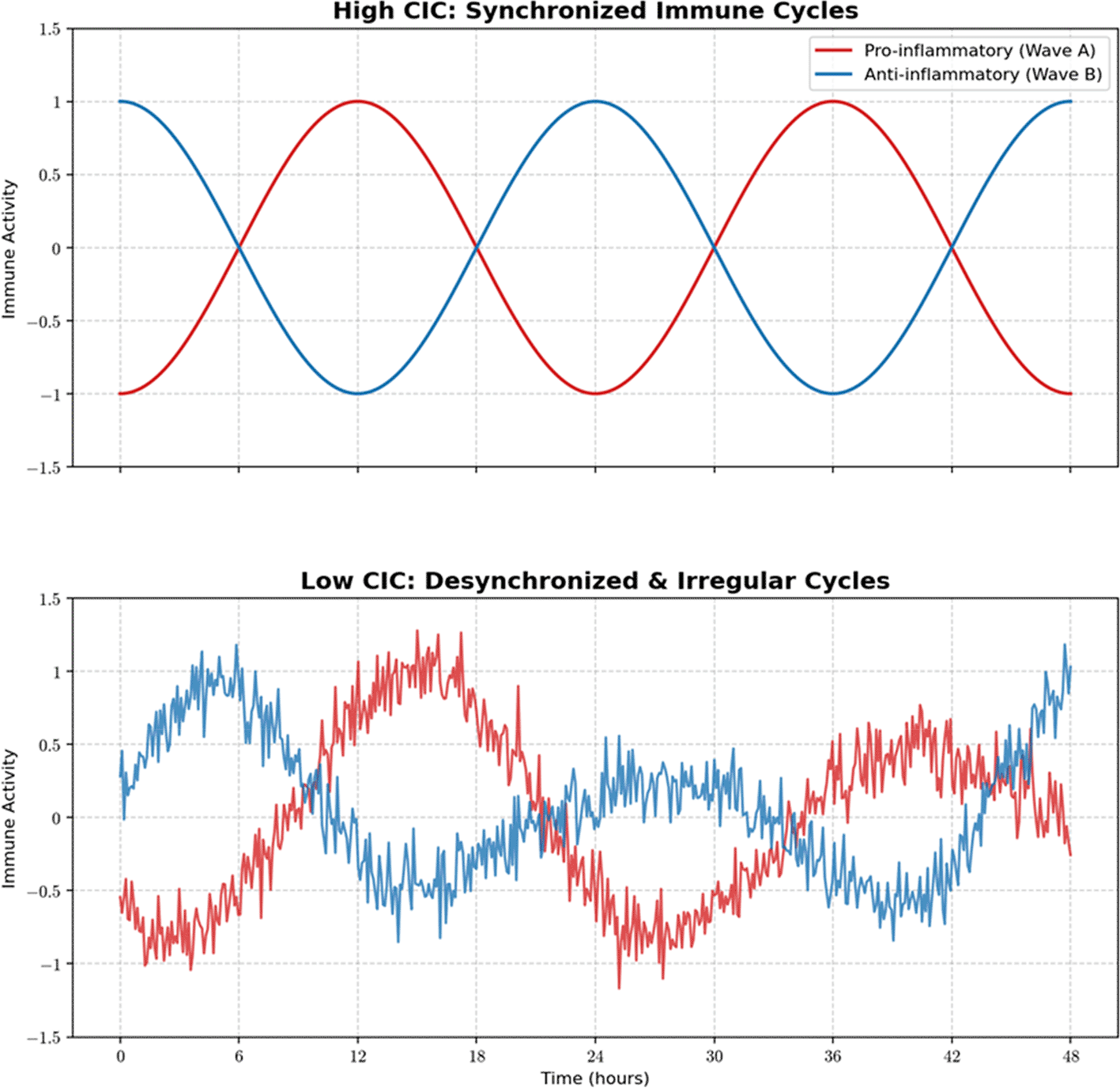
The upper panel represents a high-coherence state, characterized by stable, phase-opposed oscillations between pro-inflammatory and anti-inflammatory components. The lower panel illustrates a low-coherence state, with irregular, desynchronized patterns and loss of temporal coordination. Immune activity is represented as a normalized, dimensionless scale (−1.5 to 1.5), reflecting the relative magnitude and direction of immune oscillations over time.
This representation provides a conceptual bridge between theoretical immune dynamics and clinically accessible biomarkers such as NLR.
By formalizing circadian immune coherence as a measurable system-level attribute, this framework links circadian biology, longitudinal biomarkers, and clinical trial design, supporting time-aware approaches to immunotherapy.
Quantifying circadian immune coherence requires moving beyond conventional analytical approaches such as baseline comparisons, on-treatment deltas, or linear trends.11,12,16 These methods reduce temporal variation to noise around a mean signal and fail to capture temporal organization—the defining feature of coherence.
Time-series analysis provides a different framework, treating sequential immune measurements as a continuous signal generated by a dynamic system. Within this perspective, the focus shifts from magnitude (“high” vs. “low”) to structure (“organized” vs. “disordered”). Spectral and Fourier-based methods are particularly suited for this purpose, as they decompose complex signals into their underlying rhythmic components.14,17,19
Fourier decomposition transforms data from the time domain into the frequency domain, enabling identification of dominant rhythms within immune signals. This allows detection of circadian or ultradian periodicity even in noisy or irregularly sampled clinical data, making it applicable to real-world datasets.
Within the CIC framework, Fourier-based analysis evaluates three key features of temporal organization: periodicity (presence of biologically plausible rhythms), spectral concentration (dominance of specific frequency bands), and phase stability (consistency of peak timing across cycles).
Importantly, these methods can be applied to routine clinical parameters—such as complete blood counts, inflammatory indices, or cytokine levels—without requiring high-frequency sampling. Their strength lies in extracting latent temporal structure from longitudinal data that is otherwise treated as noise.14
Additional time-series techniques extend this framework. Short-time Fourier transforms allow tracking of dynamic changes in rhythmic properties over the course of treatment. Autocorrelation analysis quantifies temporal persistence, reflecting system stability. Coherence metrics assess synchronization between immune parameters, enabling system-level evaluation of coordinated behavior.17
Integration with machine learning further enhances this approach.20 Models trained on spectral features—such as dominant frequency, phase stability, and spectral entropy—can identify temporal phenotypes not captured by conventional biomarkers. In this context, AI functions as a pattern-recognition tool within a biologically grounded framework.
This approach redefines variability: patterns interpreted as noise in the time domain may represent loss of rhythmic structure in the frequency domain. Conversely, stable oscillatory patterns—even with low amplitude—reflect organized system behavior.
Importantly, circadian immune coherence should not be equated with mere oscillatory complexity. Coherence implies structured and stable temporal coordination, including consistent frequencies and phase relationships, rather than maximal variability.
From a systems perspective, CIC represents an emergent property of immune organization arising from coordinated interactions across multiple biological processes. Fourier-based methods do not impose structure but quantify the degree to which such organization exists.
Clinically, loss of coherence may occur without major changes in absolute biomarker values, reflecting disruption of temporal coordination. Conversely, preserved coherence may indicate resilient immune function despite modest fluctuations.
This distinction highlights a limitation of static biomarkers: patients with similar baseline values may exhibit fundamentally different temporal architectures. One may demonstrate stable circadian organization, while another shows fragmented or chaotic patterns, potentially explaining divergent treatment outcomes.
Chrono-Fourier approaches therefore act not as replacements but as an additional analytical layer that situates biomarkers within the dimension of time. By operationalizing CIC as a measurable property, they enable longitudinal monitoring, temporal phenotyping, and the development of time-aware therapeutic strategies.
Adopting circadian immune coherence (CIC) as a core framework requires rethinking both biomarker development and clinical trial design. If immune function is inherently temporal, reliance on single time-point measurements introduces systematic bias. This is not a failure of biology, but of methodology—we measure states instead of systems, and incorporating time becomes a necessary correction rather than an added complexity.
Current biomarker strategies rely on binary thresholds that classify patients into static categories, imposing fixed interpretations on inherently dynamic processes. CIC proposes an alternative based on temporal phenotypes, where the defining characteristic is not baseline magnitude but longitudinal behavior, including rhythmic stability, phase alignment, and systemic coherence. This perspective captures system-level properties such as resilience and adaptability and reframes existing biomarkers within their temporal context. For example, identical baseline values, such as NLR, may correspond to fundamentally different immune organizations, with one displaying stable circadian structure and another exhibiting disordered dynamics, leading to divergent clinical outcomes.
Variability across immunotherapy trials may partly reflect unmeasured temporal effects. Differences in treatment timing or biomarker sampling introduce uncontrolled biological variability that appears as noise or inconsistency. Incorporating temporal variables, including time-of-day or CIC, may help reconcile these discrepancies and reveal that some negative findings represent biologically active interventions delivered during suboptimal temporal phases. In this context, time emerges as a critical effect modifier rather than a nuisance variable.
Conventional clinical trial design assumes time to be uniform and interchangeable, with treatment schedules and assessments determined largely by logistical considerations. The CIC framework challenges this assumption and supports chronobiologically informed designs in which timing is explicitly integrated into study structure. This includes temporal stratification of patients, incorporation of baseline immune coherence into risk modeling, and the development of adaptive approaches where treatment timing is aligned with individual biological rhythms. Such strategies shift the central question from whether a therapy works to when and for whom it is most effective.
The integration of artificial intelligence further strengthens this paradigm. Machine learning models trained on temporal features derived from longitudinal data, such as spectral characteristics and phase stability, can identify clinically relevant patterns that remain undetected by conventional approaches. Within this framework, CIC provides biologically grounded feature space, ensuring that computational models operate within meaningful temporal dimensions rather than purely correlative high-dimensional data.
Importantly, this approach is pragmatically feasible, as it relies on reinterpretation of routinely collected longitudinal data rather than the introduction of new assays. Its implementation will require prospective validation of CIC-derived metrics, development of standardized analytical pipelines, and engagement with regulatory frameworks to accommodate dynamic, time-aware biomarkers.
In summary, circadian immune coherence extends beyond a methodological refinement, offering a conceptual shift toward time-aware translational oncology. It supports a transition from static measurements to dynamic system-level understanding, where clinical decisions are informed not only by what is measured, but also by when it is measured.
Persistent inconsistencies in immunotherapy trials—variable efficacy, biomarker performance, and toxicity—may partly arise from an unaccounted variable: time. Differences in treatment timing, sampling, and immune assessment introduce biologically meaningful variability that is often treated as noise, reducing statistical power and obscuring reproducible signals. Incorporating temporal dimensions, from simple covariates such as time-of-day to system-level metrics like circadian immune coherence (CIC), allows a more accurate interpretation of results. In this context, some negative findings may represent “chrono-false negatives,” where biologically active therapies are delivered during suboptimal temporal phases. Re-analysis of existing datasets with temporal stratification may therefore uncover clinically relevant signals currently masked by temporal variability.7–9,20
Conventional randomized trials assume temporal neutrality, treating clock time as interchangeable. This assumption is biologically untenable. A time-aware design begins with standardization and recording of treatment timing, enabling stratification by circadian windows and incorporation of baseline CIC into analysis. More advanced approaches extend this into adaptive chronotherapy, where treatment timing is dynamically aligned with patient-specific biological rhythms derived from longitudinal monitoring. Such designs shift the focus from whether a therapy works to when and for whom it is most effective, positioning time as a modifiable therapeutic dimension.7–9,17
The integration of artificial intelligence further enables this paradigm. Machine learning models trained on temporal features—such as periodicity, phase stability, and spectral structure—can identify clinically relevant patterns that remain undetected in static analyses.20 Within this framework, CIC provides a biologically grounded feature space, guiding models toward meaningful temporal organization rather than spurious correlations in high-dimensional data. This creates a synergy in which biological theory constrains feature selection, and computational methods extract scalable insights from longitudinal datasets.
Importantly, this approach is pragmatically feasible. It relies primarily on reinterpretation of routinely collected longitudinal data, such as laboratory values and clinical records, rather than the introduction of new assays. This facilitates translation by emphasizing analytical refinement over procedural complexity. Demonstrating improved predictive performance through time-aware re-analysis of existing datasets may support regulatory acceptance, while clinical implementation can begin with retrospective use in complex or atypical cases and evolve toward prospective decision support.
Recognizing circadian immune coherence ultimately calls for a shift toward temporally informed scientific practice. It requires re-evaluation of existing evidence through a temporal lens, redesign of clinical trials to account for biological time, and adoption of analytical methods capable of capturing system dynamics. This transition moves immuno-oncology beyond static measurements toward a process-oriented understanding of host–tumor interactions, where clinical decisions are guided not only by what is measured, but by how biological systems are organized in time.
The framework of circadian immune coherence (CIC), while biologically grounded, remains at the interface between conceptual innovation and empirical validation. Although initially proposed as a hypothesis, its application to longitudinal clinical datasets suggests operational feasibility and supports further systematic investigation. A balanced appraisal of its limitations is essential for responsible development.
Current evidence for time-dependent effects in immunotherapy is largely retrospective and associative. Observed links between treatment timing, immune dynamics, and outcomes arise from heterogeneous datasets influenced by multiple confounders, including treatment selection, comorbidities, and concomitant therapies.7–9 While consistency across studies supports biological plausibility, causality remains unproven. Accordingly, CIC should be regarded not as a clinical tool, but as a framework for prospective validation.
A key limitation lies in data structure. Ideal circadian analysis requires high-frequency sampling, which is rarely feasible in clinical practice. Real-world data are sparse and irregular, and although time-series methods can tolerate such limitations, excessive sparsity may obscure meaningful rhythmic patterns. Addressing this gap will require both prospective studies with improved temporal resolution and analytical approaches capable of extracting latent structure from imperfect data.
Importantly, CIC reflects a composite property of host temporal biology shaped by multiple factors, including molecular clock function, disease burden, treatment effects, medications, and behavioral influences. Future work must therefore move beyond detection toward understanding its determinants, using integrative models that account for these interacting components.
In this context, CIC is best viewed not as a static metric, but as a dynamic readout of the evolving host–temporal state during immunotherapy.
Future validation of circadian immune coherence (CIC) requires coordinated efforts across prospective, analytical, and methodological domains. Prospective time-stratified trials will be essential to establish causality, while systematic re-analysis of existing datasets can rapidly assess the added prognostic value of CIC and identify temporally sensitive patient subgroups. In parallel, standardization of analytical frameworks and integration with multimodal data and AI will enable robust, scalable identification of clinically relevant temporal phenotypes.
Immunotherapy harnesses a fundamentally dynamic biological system, yet its evaluation remains largely static. Reliance on single time-point biomarkers captures only fragments of immune behavior and fails to reflect its temporal organization.
We propose circadian immune coherence (CIC) not as a standalone biomarker, but as a conceptual framework that shifts focus from static measurements to temporal structure—emphasizing rhythmic stability, phase alignment, and system-level organization. This reframing is both biologically grounded and operationally feasible through time-series and Fourier-based analysis of routinely collected longitudinal data.
Although CIC remains a hypothesis requiring prospective validation, it provides a foundation for reinterpreting existing evidence and designing time-aware clinical studies. Incorporating time as a core variable is a necessary step toward a more accurate and dynamic model of immunotherapy.
Recognizing immune function as a temporally organized process is therefore not an extension of current practice, but its evolution toward truly time-aware precision oncology.
No data are associated with this article.
No generative AI was used in the creation of scientific content.