Просмотр новости
Найдите то, что Вас интересует
 Спутники
 РН
РН SpaceX
 Роскосмос
 NASA
NASA
СпутникиРНSpaceXРоскосмосNASASpaceX have filed for a 100,000 satellite Gen3 NGSO system. The satellites will be 2000-2500 kg, area 300 to 400 sq m. Orbits 320-480 km at various inclinations. The FCC application says the Gen3 constellation will deliver extremely low-latency, multi-gigabit symmetrical throughput. And the sheer number of satellites will ensure multiple satellites are always visible ... Read more
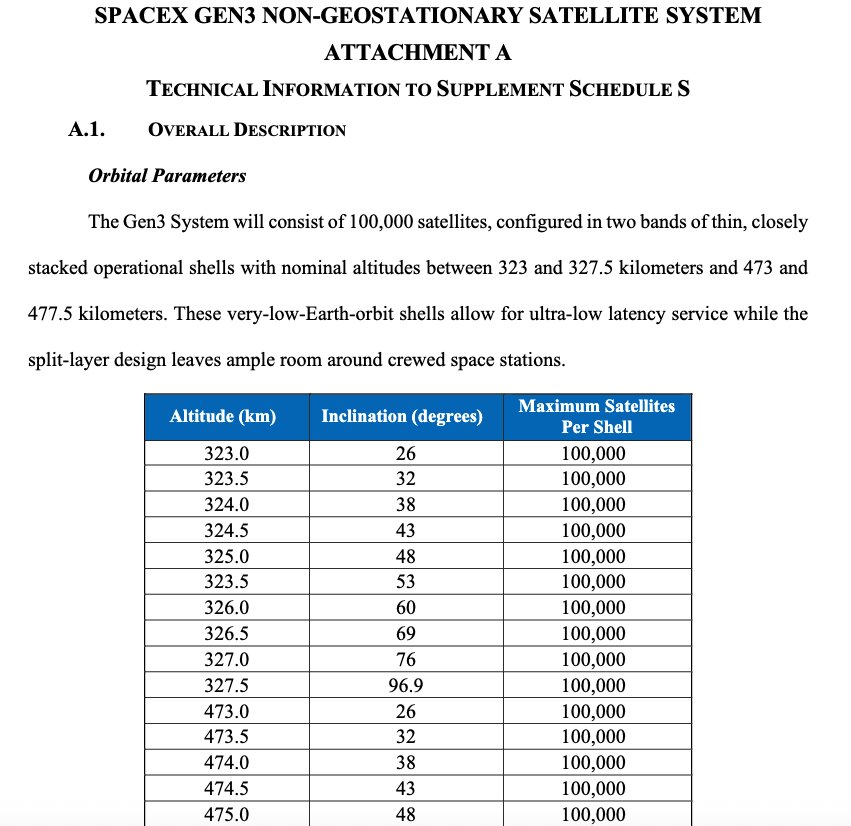
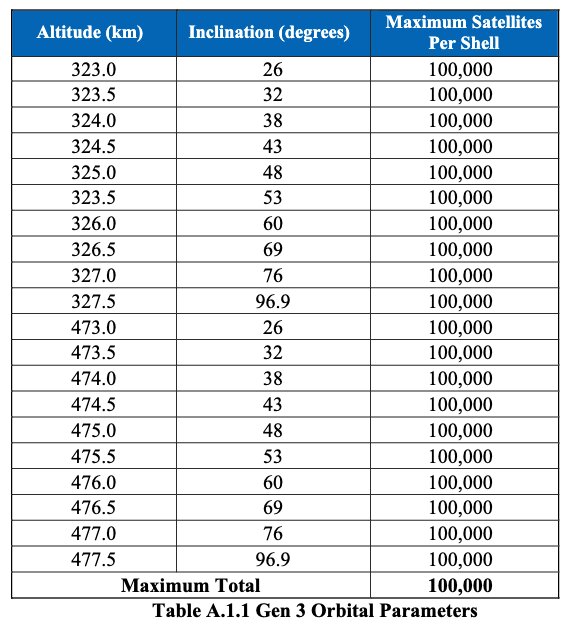
SpaceX have filed for a 100,000 satellite Gen3 NGSO system. The satellites will be 2000-2500 kg, area 300 to 400 sq m. Orbits 320-480 km at various inclinations.
The FCC application says the Gen3 constellation will deliver extremely low-latency, multi-gigabit symmetrical throughput. And the sheer number of satellites will ensure multiple satellites are always visible from any point on Earth.
SpaceX have filed for a 100,00 satellite "Gen3 NGSO" system. Presumably Starlink Gen3, but they don't call it that. The sats are 2000-2500 kg, area 300 to 400 sq m. Orbits 320-480 km at various inclinations. Have added to my page at https://t.co/uFI9aoSNnM
— Jonathan McDowell (@planet4589) July 9, 2026
The FCC filing positions Starlink as AI-connectivity infrastructure rather than simply a satellite broadband network.
The Gen3 system will use spectrum in Ku-, Ka-, V- and E-bands that the FCC granted for SpaceX’s Gen2 system. But SpaceX will also request to operate in greenfield W- and D-band frequencies between 92 and 275 GHz.
This builds upon the over 10,000 V1.5 and V2 mini starlink satellites currently operating in orbit.
 Screenshot
 Screenshot
The Gen3 system will use advanced phased array beam-forming and digital processing technologies onboard each satellite payload to make highly efficient use of spectrum resources and share spectrum flexibly with other space-based and terrestrial licensed users. User terminals will employ highly directive, electronically steered antenna beams that track the system’s satellites.
Gateway earth stations will generate high-gain steered beams to communicate with multiple satellites within the constellation from a single gateway site. SpaceX will implement advanced optical inter-satellite links on the Gen3 system to provide seamless network management and continuity of service while minimizing the spectrum footprint of the system overall and facilitating spectrum sharing with other space-based and terrestrial systems. Broadband service will be
available for residential, commercial, institutional, governmental, and other users worldwide.
Consistent with Commission policy, SpaceX has prioritized spectrum in the Ku-, Ka-, V-, E-, W-, and D-bands to deliver gigabit-speed, low-latency broadband and more symmetrical speeds for end users worldwide.
Core/workhorse bands (already largely authorized for Gen2 and carried forward/augmented):
Ku-band (e.g., ~10.7–13.4 GHz class downlink ranges, associated uplinks) — primary user links historically.
Ka-band (e.g., ~17.3–21.2 GHz and higher gateway/user ranges) — higher capacity.
V-band (~37.5–42.5 GHz and related) — significant capacity expansion.
E-band (previously authorized ~71–76 GHz space-to-Earth / 81–86 GHz Earth-to-space for Gen2 gateways/feeder links).
The new W- and D-band spectrum (92–275 GHz) in the July 2026 Gen3 constellation filing primarily unlocks the next leap: reliable multi-gigabit symmetrical service to far more customers simultaneously, plus the massive uplink and backhaul needed for AI devices.
From V3’s 1 Tbps/sat to Multi-Gigabit per Customer
V3 / early Gen3 1 Tbps downlink and 160–200 Gbps uplink per satellite is already enormous. A single Starship flight of ~60 V3 sats can add ~60 Tbps of network capacity. With dense VLEO shells, advanced digital beamforming, and optical ISLs, this supports multi-gigabit peaks and gigabit sustained for many users under good conditions (especially with upgraded terminals). Rain fade, beam sharing, and backhaul constraints still limit how many customers get true multi-gigabit simultaneously and how symmetrical the service can be. Uplink remains the harder direction for high rates.
W- and D-band role will be greenfield millimeter-wave / sub-THz bands provide huge contiguous bandwidth (tens to hundreds of GHz potentially) mainly for gateway feeder links / backhaul. This removes the bottleneck so that the satellite’s full user-link capacity (still primarily on improved Ku/Ka/V/E) can be delivered to many users at once without the feeder links saturating. It also enables higher-order modulation, more beams, and better symmetry because uplink capacity can scale more freely. The filing explicitly ties the new bands + optical ISLs to “multi-gigabit symmetrical throughput” and the “massive uplink capacity” required for AI (high-definition spatial/auditory data, industrial automation, edge devices).
V3 (aka gen 2) already delivers the per-satellite horsepower for multi-gigabit peaks. W/D + denser constellation + better sharing = multi-gigabit to many more customers at once, with far better symmetry and AI readiness.
Rollout Path
SpaceX almost always iterates incrementally and starts with the bands it already has authority for:
Immediate / V3 early flights (2026–2027, Starship-enabled)
Heavy reliance on improved core/workhorse bands that are already largely authorized for Gen2 and carried forward:
Ku (~10.7–13.4 GHz class downlinks + associated uplinks) — still primary user links for volume.
Ka (higher capacity user/gateway).
V (~37.5–42.5 GHz and related) — significant expansion of user and feeder capacity.
E (71–76 GHz down / 81–86 GHz up) — already partially authorized for Gen2 gateways; expanded use for high-capacity feeder links.
These get bigger phased arrays, better digital beamforming, higher-order modems, more efficient power amplifiers, and denser frequency reuse. Optical ISLs handle most inter-satellite traffic. This alone gets many users into multi-gigabit peaks and sustained gigabit+ service. New user terminals (larger/more advanced phased arrays) are required for full performance.
Mid-term Gen3 / early V4 will see progressive introduction of W- and D-band on gateways and then satellites as hardware matures and spectrum access is granted (waivers, non-conforming operations, coordination). Starts on high-capacity gateways (easier power/thermal) then migrates to space. This is what unlocks true multi-gigabit symmetrical at scale and the AI uplink tsunami.
Full multi-gigabit symmetrical + AI scale will come from the the full 100k-satellite Gen3 constellation density, mature W/D hardware, refined sharing frameworks, and widespread upgraded terminals. Optical mesh further reduces RF spectrum pressure.
SpaceX will likely ramp to 300-400 Starship launches per year for the communication satellites to achieve a 3 year deployment and then replacement and maintenance of the constellation. More launches will be for the AI satellites.
V3 is already ~2,000 kg class. Adding high-band arrays, more solar, better thermal, and higher-capacity digital payloads will push mass, power, and complexity higher — but Starship capacity absorbs this.
Expect larger solar arrays, more efficient argon (or next-gen) thrusters, advanced heat rejection, and denser electronics.
Other modifications expected for V4 / mature Gen3 will be
* Even larger/higher-performance phased arrays (multi-band shared-aperture or stacked).
* More sophisticated hybrid digital/analog beamforming + onboard AI for dynamic spectrum and interference management.
* Higher-capacity optical ISLs (already multi-hundred-Gbps to Tbps class trajectory).
* Improved propulsion and station-keeping for denser VLEO shells.
* Better space-to-ground optical options as secondary high-capacity links.
* User terminals: multi-band phased arrays supporting higher frequencies, higher EIRP/G/T, and better power efficiency (will drive terminal cost/size up initially).
* Gateway evolution into dense W/D-capable gateways with optical fiber backhaul.
* Software will have more aggressive dynamic beam and power control, spectrum sharing algorithms, and AI traffic prediction.
Millimeter-Wave / Sub-THz (W/D) Technology Needs for Phased Arrays & Systems
Moving from E-band (~70–90 GHz) into W (roughly 75–110 GHz) and especially D (110–170+ GHz up to 275 GHz) is a big step.
Key requirements:
Phased-array elements size scales with wavelength (λ/2 spacing). At 100+ GHz, elements become tiny (mm-scale or smaller). Arrays can pack enormous numbers of elements into the same physical aperture → higher gain, narrower beams, better spatial reuse. But manufacturing tolerances become brutal (micron-level accuracy), and mutual coupling, surface waves, and fabrication defects are harder.
Active electronics (MMICs / beamformers): Need high-performance III-V semiconductors (InP, GaAs, GaN) or advanced SiGe/CMOS-SOI. Power amplifiers (PAs) suffer rapidly declining efficiency and saturated output power as frequency rises (PAE and Psat scale poorly with frequency). Low-noise amplifiers (LNAs) also degrade. Hybrid beamforming (analog sub-arrays + digital) becomes almost mandatory to keep power and complexity manageable.
Power & thermal: Space platforms have strict power budgets. High-frequency PAs are inefficient → more heat and more solar array / battery demand. Cooling (radiators, heat pipes, advanced materials) becomes critical. On the ground, terminal power consumption and heat also rise.
Materials & packaging: Low-loss dielectrics, advanced substrates, hermetic packaging, and interconnects (waveguides, gapwave, or advanced PCB/LTCC) that work at THz. Conventional PCB materials become lossy; new materials or metal waveguide hybrids are needed. Antenna-in-package or wafer-level integration becomes attractive.
Beamforming & digital processing: Massive digital beamforming is power-hungry at high bandwidths. Hybrid architectures, low-resolution ADCs/DACs, and advanced algorithms (including AI-assisted) help. Onboard processing must handle enormous instantaneous bandwidths.
Atmospheric effects will have much higher free-space path loss and especially rain/atmospheric attenuation (water vapor, oxygen lines). Short VLEO paths help a lot, but adaptive coding/modulation, site diversity, optical offload, and very high EIRP are still required. Clear-sky performance can be excellent; rain performance needs robust margins.
Other systems needed High-frequency filters, oscillators with low phase noise, precise frequency generation/distribution, and radiation-hardened high-speed digital logic. Optical ISLs become even more important to keep most traffic off the RF spectrum.

Brian Wang is a Futurist Thought Leader and a popular Science blogger with 1 million readers per month. His blog Nextbigfuture.com is ranked #1 Science News Blog. It covers many disruptive technology and trends including Space, Robotics, Artificial Intelligence, Medicine, Anti-aging Biotechnology, and Nanotechnology.
Known for identifying cutting edge technologies, he is currently a Co-Founder of a startup and fundraiser for high potential early-stage companies. He is the Head of Research for Allocations for deep technology investments and an Angel Investor at Space Angels.
A frequent speaker at corporations, he has been a TEDx speaker, a Singularity University speaker and guest at numerous interviews for radio and podcasts. He is open to public speaking and advising engagements.
| # | Наименование новости | Тональность | Информативность | Дата публикации |
|---|---|---|---|---|
| 1 | SpaceX подала заявку в FCC на до 100 000 спутников ... | 0 | 7 | 18-07-2026 |
| 2 | SpaceX подала заявку на размещение в космосе 100 000 спутников ... | 0 | 7 | 11-07-2026 |
| 3 | SpaceX хочет увеличить группировку Starlink до 100 тысяч спутников нового поколения | 0 | 12.13 | 21-09-2026 |
| 4 | SpaceX applies to launch 100,000 Gen3 Starlink satellites | 0 | 19.93 | 09-07-2026 |
| 5 | SpaceX подала заявку на размещение в космосе 100 000 спутников ... | 0 | 7 | 12-07-2026 |
| 6 | SpaceX Has the Best Radiative Cooling Solution and It is Working | 0 | 7.89 | 24-02-2026 |
| 7 | More Pentagon Satellite Contracts for SpaceX and New Cursor Model Tomorrow | 0 | 9.76 | 07-07-2026 |
| 8 | Илон Маск выведет на орбиту рекордное число новых спутников Starlink ... | 0 | 7 | 13-07-2026 |
| 9 | Илон Маск выведет на орбиту рекордное число новых спутников Starlink ... | 0 | 7 | 13-07-2026 |
| 10 | Илон Маск выведет на орбиту рекордное число новых спутников Starlink ... | 0 | 7 | 13-07-2026 |