Просмотр новости
Найдите то, что Вас интересует
 Спутники
 РН
РН SpaceX
 Роскосмос
 NASA
NASA
СпутникиРНSpaceXРоскосмосNASABefore she retires later this year, Laura Kissel, polar archivist for the Byrd Polar and Climate Research Center Archival Program (or Polar Archives) at The Ohio State University, wanted to arrange one final exhibition.
Before she retires later this year, Laura Kissel, polar archivist for the Byrd Polar and Climate Research Center Archival Program (or Polar Archives) at The Ohio State University, wanted to arrange one final exhibition.
“Exhibitions are hard work,” she said. “I started to think about all the collection materials that I wanted to show and as I made this list, I thought, ‘What is my theme?’ It took me months of brainstorming. And all of a sudden, I realized everything that I wanted to show had some kind of artistic quality.”
“Polar Expressions: Finding Beauty in the Coldest Regions on Earth,” Kissel’s final exhibition, opened in February and will be on display in Thompson Library’s gallery space through Aug. 2.
Founded in 1960, the Institute of Polar Studies, now called the Byrd Polar and Climate Research Center (or Byrd Center), is focused on maintaining research excellence and supporting public engagement in polar and climate studies at Ohio State. The Polar Archives is a collaborative program between the Ohio State University Libraries and the Byrd Center, as well as one of eight special collections at the university’s library system.
The materials in the Polar Archives date back as far as the 1890s and document the history of polar exploration. There are hundreds of collections held by the Polar Archives, but the cornerstone collections are the Papers of Admiral Richard E. Byrd, Sir George Hubert Wilkins and The Frederick A. Cook Society
Scholars from around the world come to Columbus to study the Polar Archives, Kissel said.
“Archives by their nature have unique materials,” she said. “If you want to research Richard Byrd, can you do it without coming here? Yes, you can. But if you’re trying to explore something new, if you want to look at original materials, that’s where we come into play.”
The collections of the Polar Archives are home to typical items like diaries, letters and newspaper clippings, as well as photographs, drawings and posters. Explorers like Byrd were immensely popular, Kissel said, so the collections also hold cartoons and poetry from the public.
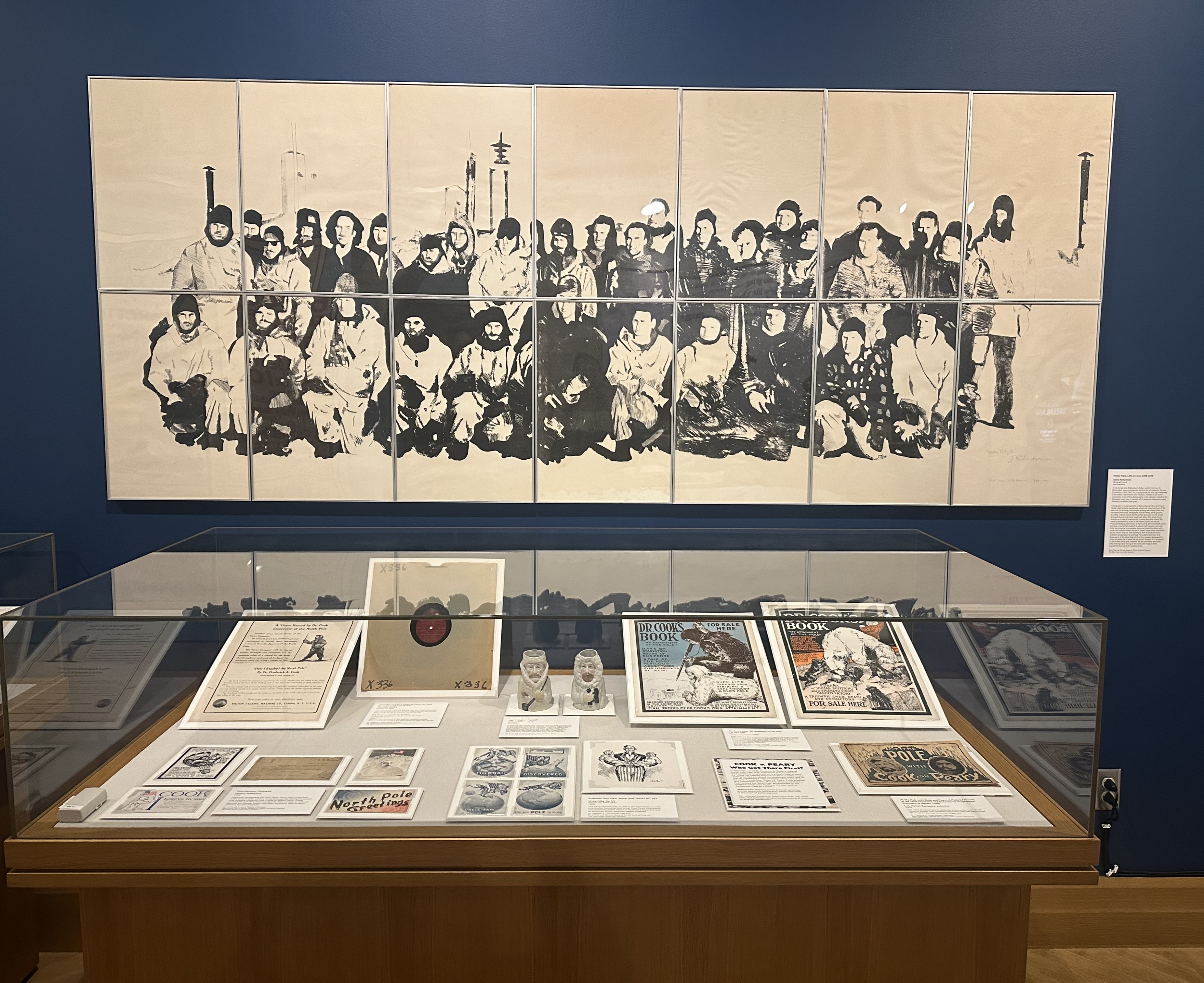
“He would have been like John Glenn, in terms of his heroic status” Kissel said. “An explorer who had ticker tape parades and all that.”
Drawings from Walt Disney’s office and Rudy Wendelin, who created Smokey Bear for the U.S. Forest Service, demonstrate just how captivating Byrd’s adventures were.
There are also more unusual items, like a painted portrait of Byrd’s dog Igloo, who was famous in his own right.
“We have a painting of Igloo that someone sent to Byrd,” Kissel said. “Byrd went to both poles and took Igloo with him. Igloo was very popular.”
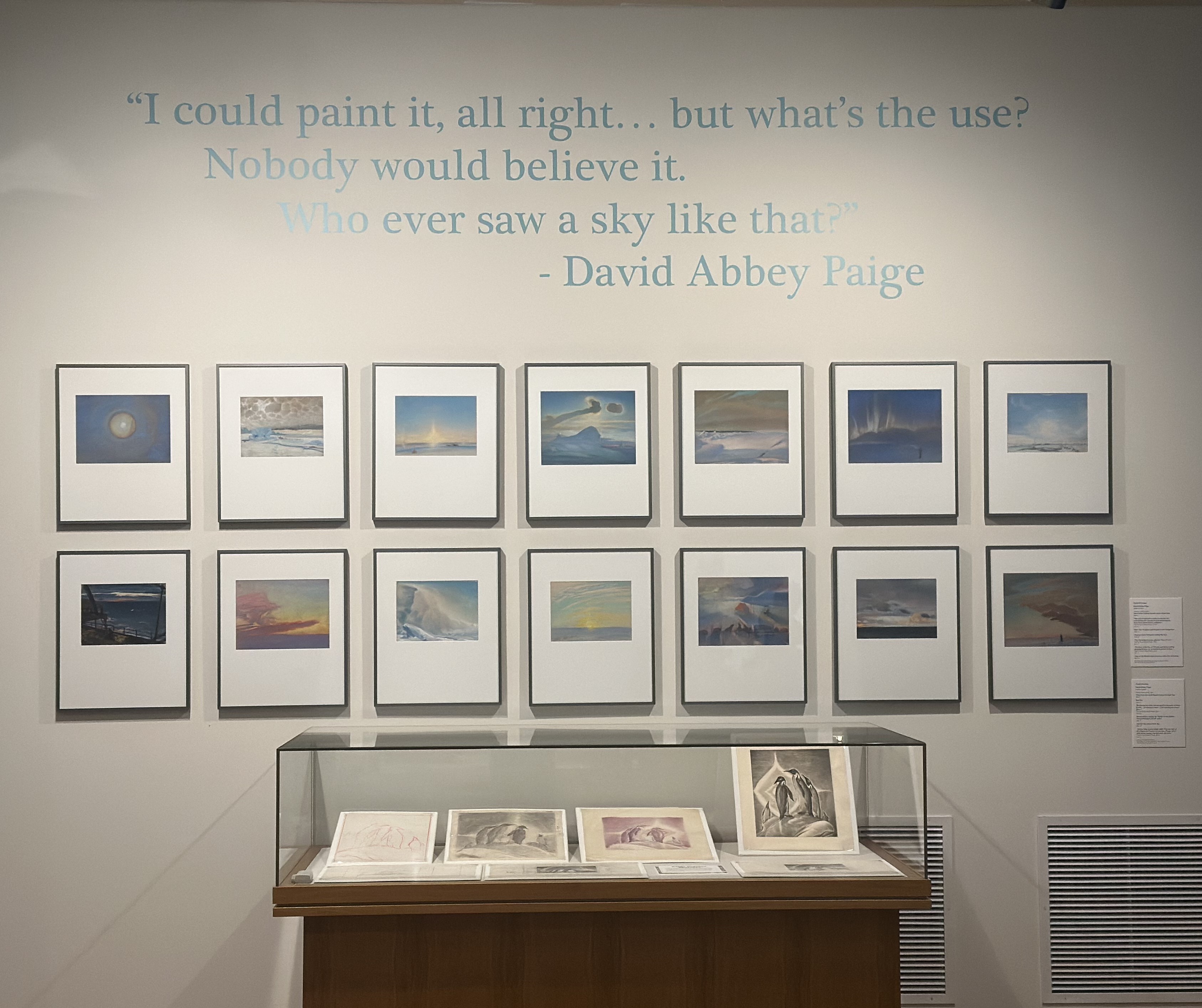
Other items on display include a vibrant series of pastel drawings by David Abbey Paige, who served as Byrd’s expedition artist. The Polar Archives has 60 of Paige’s original 100 colorful drawings. Kissel wanted to include them in the show because of the surprising range of colors Paige used.
“I assumed that Antarctica is just some big, wide, open white,” she said. “But there is contrast and color. I think Paige does a fabulous job of capturing that.”
One of the larger pieces is a hand-painted advertisement for a lecture by Wilkins about his explorations. The vivid poster is actually six 30-inch-by-40-inch sheets mounted together, announcing “6,000 feet of THRILLS. Above, Below and in the ICE” to entice potential audience members.
“Polar explorers were not wealthy people,” Kissel said. “In order to make money, they lectured. They lectured before they went on an expedition, then they lectured after to pay the bills.”
The exhibition does not ignore the people who were already living in the Arctic when explorers arrived. Just inside the gallery door is a case displaying stone and ivory figurines carved by Cree and Inuit artists. There are bears, whales, seals, both necklaces and freestanding objects.
“These have been shown at the Byrd Center but never elsewhere,” Kissel said. “This is their first time for wide viewing, and I love how we are able to display them.”
Exploration has always raised questions that are challenging to answer. One – Who got there first? – is reflected in the show.
Cook claimed to have been the first man to reach the North Pole. Robert Peary, a fellow explorer, disputed the claim and made it for himself. Ironically, both claims are viewed as uncertain today.
“Imagine trying to prove in the 1900s that you were somewhere first,” Kissel said. “We have smartphones and tagging and GPS now. Proof then was a different kind of thing. You might have a diary; you might have a photograph or two, but you’re certainly not going to have the documentation we have today.
“And how close is close enough? Do you have to get to a specific spot, or can you be a mile away? There are a lot of questions around these expeditions that will never be answered. How do you prove it?”
Questions like these are why archival work is so important, Kissel said. It can be hard to know what to save. You never know what’s going to be interesting to the public and scholars in the future.
“All of the work that the scientists at the Byrd Center are doing now is important and interesting today. And it’s gratifying to know that the documentation of that work will end up in our archival collections, accessible to scholars and researchers far into the future.”
| # | Наименование новости | Тональность | Информативность | Дата публикации |
|---|---|---|---|---|
| 1 | Art students flourish through Ohio State externship program | 0 | 12.12 | 05-05-2026 |
| 2 | Ohio State Artist Laureate eager to celebrate American semiquincentennial | 0 | 9.28 | 14-05-2026 |
| 3 | Ohio State launches Arts and Humanities AI Institute to support research and teaching | 0 | 6.67 | 25-03-2026 |
| 4 | Ohio State, 80 Columbus nonprofits among those urging stop to federal grant changes | 0 | 7 | 17-07-2026 |
| 5 | В Уфе открылся музей полярников имени уроженца города Валериана Альбанова | 0 | 0 | 26-05-2021 |
| 6 | "Полярником может быть тот, кто любит сюрпризы". История океанолога, похожего на викинга | 0 | 0 | 10-08-2021 |
| 7 | Ohio time capsule: Gov. DeWine helps preserve history at State Fair | 0 | 13.18 | 05-08-2026 |
| 8 | Огненная старуха, обереги и северный единорог. О сокровищнице народов Крайнего Севера | 0 | 0 | 18-02-2022 |
| 9 | Learn and Enjoy History | 0 | 3.49 | 22-07-2026 |