Просмотр новости
Найдите то, что Вас интересует
 Спутники
 РН
РН SpaceX
 Роскосмос
 NASA
NASA
СпутникиРНSpaceXРоскосмосNASAMay’s new-vehicle market was defined by a clear three-part story: Inventory stayed essentially steady, sales accelerated, and days’ supply tightened as a result. vAuto Live Market View showed 2.89 million units in inventory in May, up modestly from April and…
The post May New-Vehicle Inventory Holds Near 2026 Norms, But a Stronger Sales Pace Tightened Days’ Supply Across Most Brands appeared first on Cox Automotive Inc..
May’s new-vehicle market was defined by a clear three-part story: Inventory stayed essentially steady, sales accelerated, and days’ supply tightened as a result. vAuto Live Market View showed 2.89 million units in inventory in May, up modestly from April and broadly in line with the 2026 average, while the faster sales pace pulled supply lower across most brands.
Even with consumer confidence subdued and inflation concerns back in focus, the daily retail selling rate rose 6.5% from April and 9.6% year over year. Listing prices also climbed to a 2026 high of $49,307, indicating that demand is still holding up even as vehicle prices migrate higher.
Total Inventory
as of May 2026
Average Listing Price
Compared with the tariff-driven volatility of 2025, the 2026 market has been notably more orderly. Retail sales momentum has improved since January, and May marked the strongest daily sales pace of the year. At the same time, inventory has remained within a relatively narrow range, allowing days’ supply to fall from the weather-distorted February peak of 96 to 76 in May.
May inventory reached 2.89 million units, up from 2.86 million in April, 5.6% above January, and 13% higher than a year earlier. Even so, the broader pattern remains one of steady supply rather than renewed accumulation. That year-over-year increase also reflects a tougher comparison base: Spring 2025 inventory was depleted by a sales pace that ran above 17 million SAAR in March and April, draining dealer lots.
May Days’ Supply of Inventory by Brand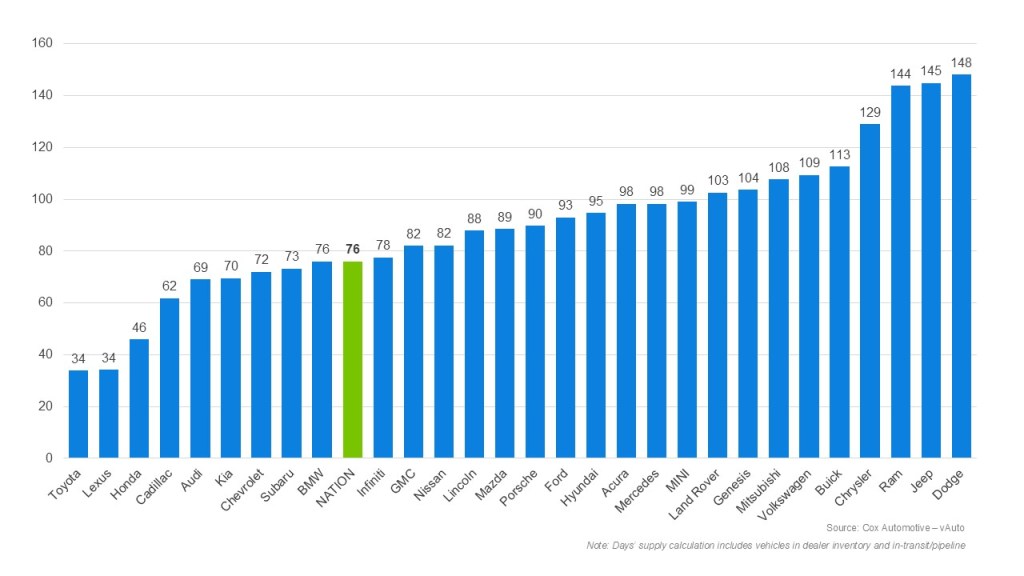
At the brand level, Nissan remains the clearest example of the broader thesis: Days’ supply fell to 82 in May, down from both April and a year earlier, largely because sales accelerated. The opposite pattern remains most visible at Stellantis, where Chrysler, Dodge, and Jeep continued to post materially higher supply levels year over year as inventory growth outpaced demand. Together, those cases explain the market well: Tighter supply where sales are working, looser supply where sale volume is not clearing inventory fast enough.
Pricing Holds, Pressure PersistsPrices continue to show discipline, but that should not be mistaken for improved affordability. The average listing price rose to a 2026 high of $49,307 in May, up 1.2% year over year. Roughly 56% of available inventory was priced below $50,000, and 25% sat in the $30,000-to-$40,000 range, showing there is still volume in the core of the market even as the average remains elevated.
Kelley Blue Book data reinforces that point. Average transaction prices fell 0.5% month over month to $49,220 and were up just 1.2% from a year earlier, the smallest annual gain of 2026 and well below the typical May increase. MSRP growth was also subdued at 1.6% year over year. In other words, pricing has not broken higher—but financing costs and household budget pressure still mean many consumers do not experience this market as meaningfully easier.
Incentives rose to 7.1% of ATP in May, continuing a gradual climb, but not to a level that suggests widespread distress. Instead, the market is still showing selective support: Incentives are helping sustain demand while pricing strength remains concentrated in high-volume segments such as midsize SUVs, compact SUVs, and full-size pickups.
Balanced, Not EasyThe market looks balanced, but it is not broadly comfortable. Demand is still holding up better than many expected, supported in part by a solid labor market and wealth effects at the higher end, yet elevated financing costs and household budget pressure continue to cap how far that strength can carry. For automakers, the key takeaway is that inventory discipline is working. Supply is tighter not because the market has become easy, but because sales are moving well enough to prevent inventories from building meaningfully.
View Historical New Vehicle Inventory reports.
| # | Наименование новости | Тональность | Информативность | Дата публикации |
|---|---|---|---|---|
| 1 | June New-Vehicle Inventory Holds Steady as Sales Pace Cools | 0 | 13.67 | 16-07-2026 |
| 2 | Used Vehicle Sales Pace Slows in May as Prices Climb Higher | 0 | 8.75 | 12-06-2026 |
| 3 | Price Drop and Income Growth Improve New-Vehicle Affordability in May | 0 | 12.95 | 16-06-2026 |
| 4 | Cox Automotive Forecast: New-Vehicle Sales Pace Holds Strong Through First Half of 2026 Despite Continued Economic and Policy Uncertainty | 0 | 13.47 | 24-06-2026 |
| 5 | Kelley Blue Book Report: New-Vehicle Price Increases Moderate in May, Incentive Spending Grows | 0 | 8.66 | 09-06-2026 |
| 6 | Auto Credit Availability Climbs in May as Approval Rates Improve, Yield Spreads Narrow | 0 | 15.71 | 10-06-2026 |
| 7 | EV Market Monitor – May 2026 | 0 | 13.07 | 16-06-2026 |
| 8 | Ep. 10: May Sales, Hybrid Momentum, and Strained Affordability | 0 | 9.9 | 09-06-2026 |
| 9 | Used-Vehicle Supply Rises as Summer Sales Pace Slows | 0 | 9.51 | 17-07-2026 |
| 10 | Cox Automotive Forecast: New-Vehicle Sales Pace Strengthens in July as Buyers Shrug Off Economic Headwinds | 0 | 9.34 | 27-07-2026 |