Просмотр новости
Найдите то, что Вас интересует
 Спутники
 РН
РН SpaceX
 Роскосмос
 NASA
NASA
СпутникиРНSpaceXРоскосмосNASA'Peter Simensky: Pyrite Radio' at the Maine College of Art & Design explores the impact of the late artist.
 A view of "Peter Simensky: Pyrite Radio." (Photo by Joel Tsui, courtesy of the ICA at MECA&D)
I have a confession to make. I don’t like everything I review. In my own personal tastes, I have a respect for aesthetics and craftsmanship and, dare I say it, beauty. But that does not preclude my enjoyment of all kinds of art or the conceptual underpinnings of many artists’ work. There is such a thing as invention for invention’s sake, which has little staying power. But when new forms of expression — beautiful or not — intersect with truly creative and intellectual intent, the mix is potent. There are few things in this life that are more fascinating to me than an artist’s mind. So, when I look at something, I try to decipher it from the artist’s perspective. What were they trying to accomplish? Did it work? If so, why? If not, why not?
Which is to say that if you are the sort of person who likes to parse things into neat categories like sculpture or painting, if you expect to go to an art exhibition solely to reinforce your own ideas of what art is and should be, you will not likely find “Peter Simensky: Pyrite Radio” at the Institute for Contemporary Art at the Maine College of Art & Design (ICA through Sept. 13) to your liking.
Simensky’s contraptions are messy and jerry-rigged. Wires are exposed everywhere and appear to be tangled jumbles rather than the subjects of premeditation and ordered thinking. They incorporate all sorts of unconventional materials: frog and duck umbrellas, common spring clamps, wind chimes, strings of wooden beads, pieces of mesh, emergency space blankets, spools of copper wire, rocks and, of course, pyrite. They seem not to have any rhyme or reason, and certainly no sense of aesthetics that would conform to anything remotely related to the conventional sense of that word.
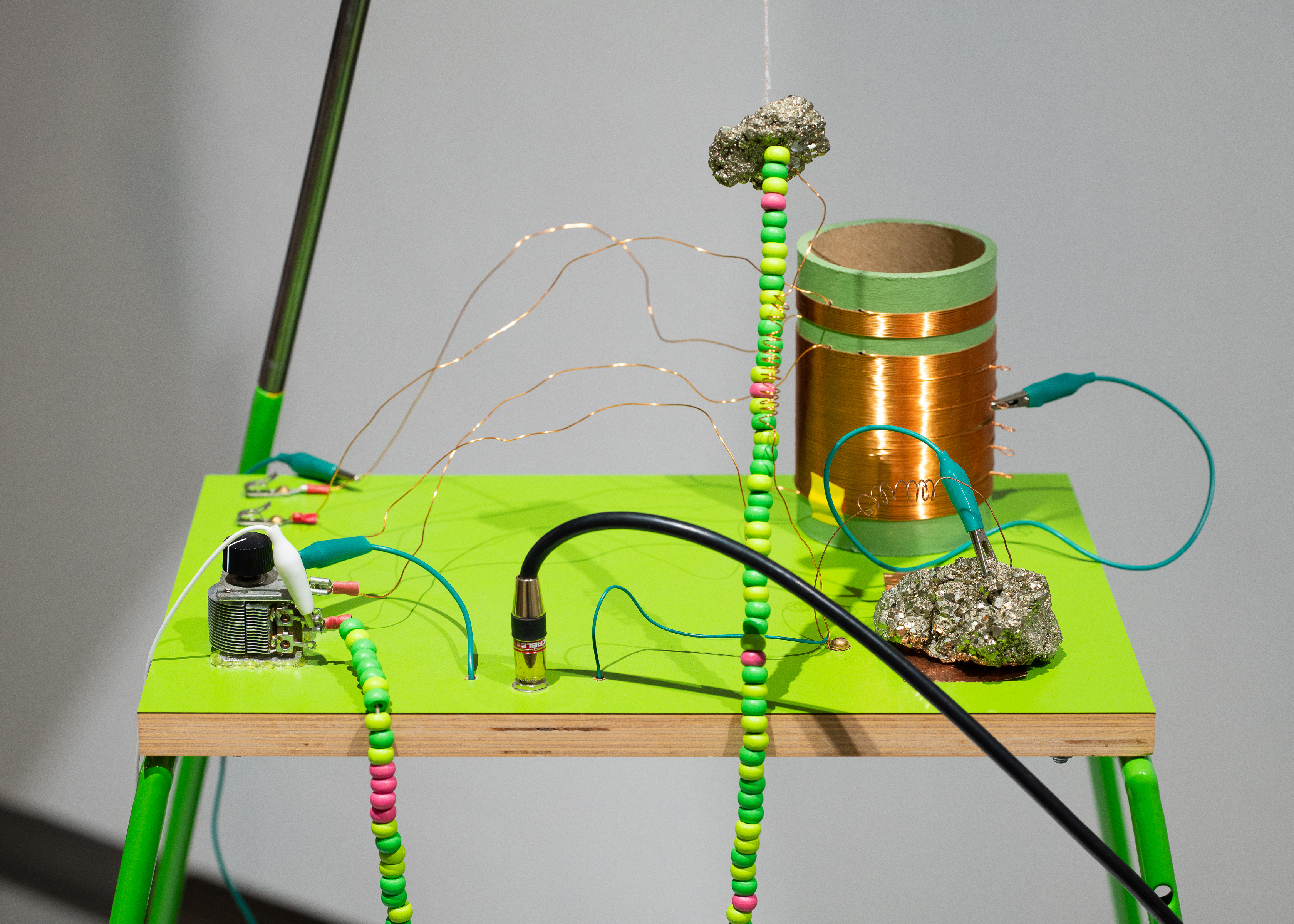 Peter Simensky, “green frog,” 2020. (Photo by Joel Tsui, courtesy of the ICA at MECA&D)
They also aren’t sculptures per se in that they are not about forms in space and do not affect the area they occupy in the way that most sculpture does. They tend to look more like science experiments and give the impression that Simensky (who died tragically at 48 in 2023) was part artist and part (perhaps even a larger part) mad scientist.
And yet they tackle some pretty heady subject matter: for starters, how we value what we value, who has access to that which we value and who does not, how regulation is power and how transgressive thinking can undermine that power, and how collaboration and communication are so precious that they easily displace material wealth of any kind. If you can let go of all expectation, Simensky has a lot to say that merits our attention.
The artist was born and raised in Maine. He taught for a time at MECA (now MECA&D) but eventually moved West and became chair of the Graduate Fine Arts MFA program at California College of the Arts in San Francisco. Simensky’s interests latched onto pyrite through the history of the Gold Rush, when the mineral became known as “fool’s gold” because prospectors confused it with gold, eventually dashing their hopes of a get-rich-quick windfall. Some despaired enough to commit suicide.
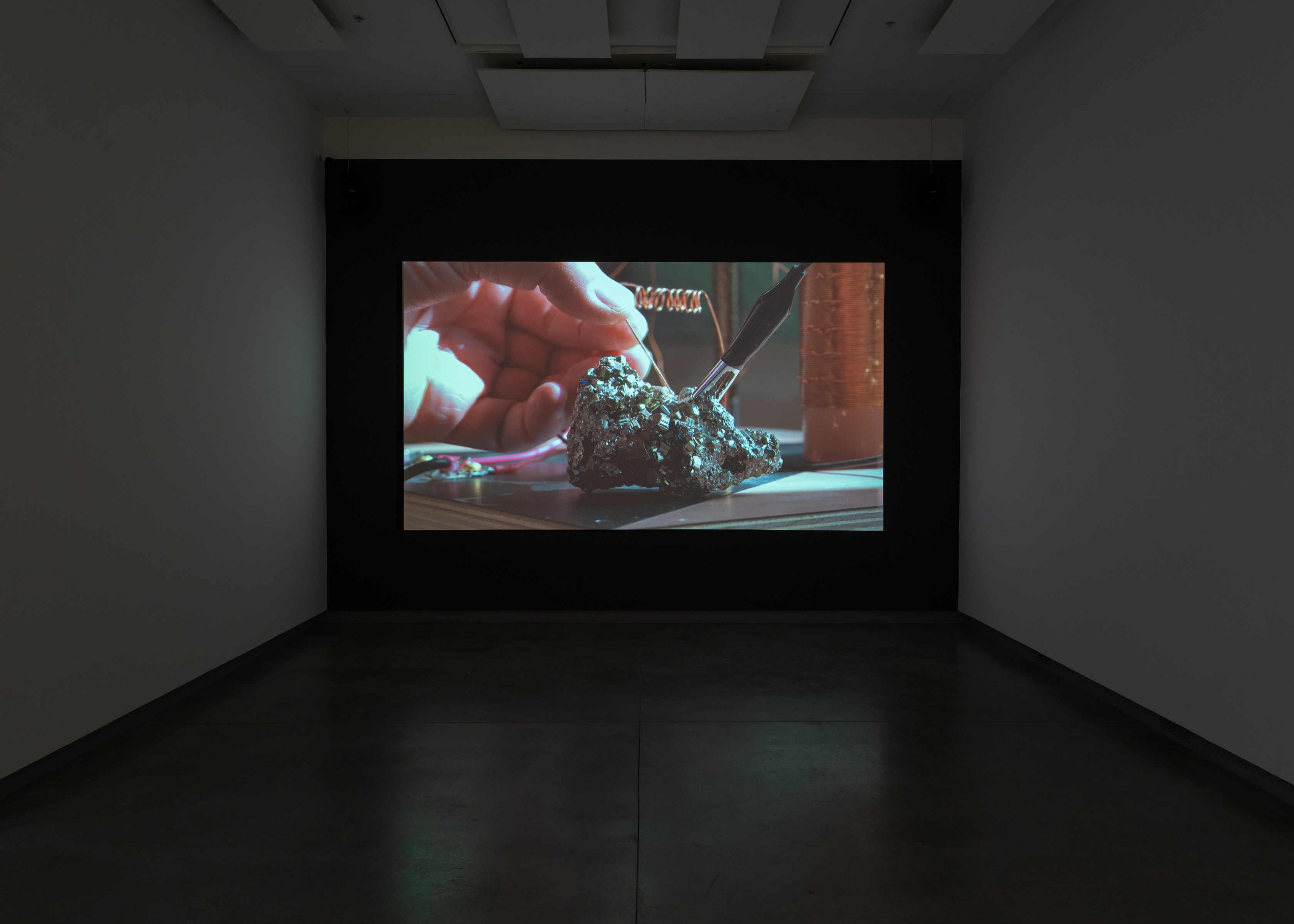 Peter Simensky, “Pyrite Radio (still),” 2021. (Photo by Joel Tsui, courtesy of the ICA at MECA&D)
 This history both pointed up for him the insubstantiality of our ideas about material value and sparked a contemplation about what value is more fundamentally inherent to human nature (such as collaboration, communication and human interaction). A parallel inquiry had to do with crystal radio hobbyists of the early 19th century, who used pyrite as a mineral detector in radio receivers.
The latter raised questions for Simensky regarding who owns the radio waves and about how regulation restricts what types of sounds and communications people can tune into. This put me in mind of the 2009 film “Pirate Radio” (nicely synergistic with the exhibition title), about a band of DJs forbidden by the British government to broadcast the music of their generation because England feared it would incite youthful revolution (which, of course, it did). The DJs sequester themselves on a ship and broadcast their music illegally from the middle of the ocean, incensing British officials.
In “Pyrite Radio,” we can intuit this same attitude of insouciant rebellion, albeit with more serious intellectual and political grounding. Unlike the irreverent band of DJs in the film, Simensky was no slack or stoner. He was dead serious about provoking us to consider a range of issues. A video in the ICA’s middle gallery shows him working at a coastal site in the Bay Area with concentrated intent, moving wires from place to place to determine where he could best intercept radio waves from nearby AM stations. We understand why the works we have just seen in the first gallery seem so haphazard: the work was intuitive, not planned out in any way, and developed as it was being created according to the reception in the area.
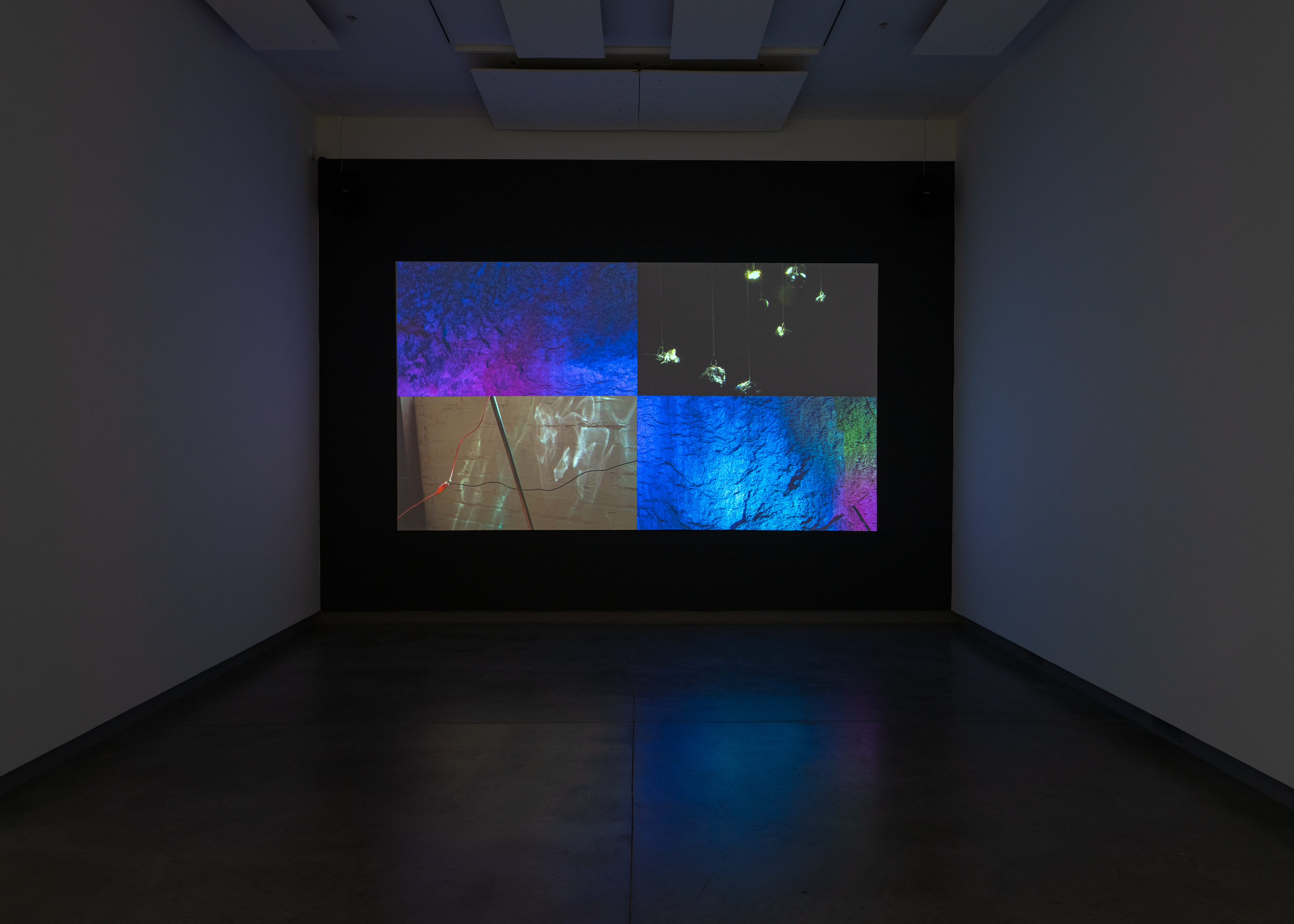 Peter Simensky, “Pyrite Radio (still),” 2021. (Photo by Joel Tsui, courtesy of the ICA at MECA&D)
The video also documents a commission by the de Young Museum in San Francisco, which gave him almost shocking liberty to create one of his pyrite radios. We stare almost in disbelief when we see Simensky using Rodin’s bronze statue “The Thinker” as a conductor by applying gaffer’s tape to attach receptors and conductors to the iconic work — all in order to tap into a local Mexican ranchera music AM station. The film cuts to Confederate monuments that are being toppled in the wake of BLM protests (in which he participated).
The film also chronicles performance pieces Simensky did. One of these involved releasing gold dust (real gold, not fool’s gold) into the air as a way of articulating the ephemerality of things (and, by extension, things we value). A wall text nearby quotes Simensky’s own words:
“A speck of gold is nothing, and in a vial packed on top of each other at the cost of several hundred dollars, it still feels somewhat insignificant. But once cast off as a sea of particles moving in the air, it opens up, becomes a mass, a sculptural form, a column of light, a dancing, vibrating hive — simply to go away again. The drama is in those moments of coming together, but ultimately, the work resides as well in the falling away, residue, absence, or memory.”
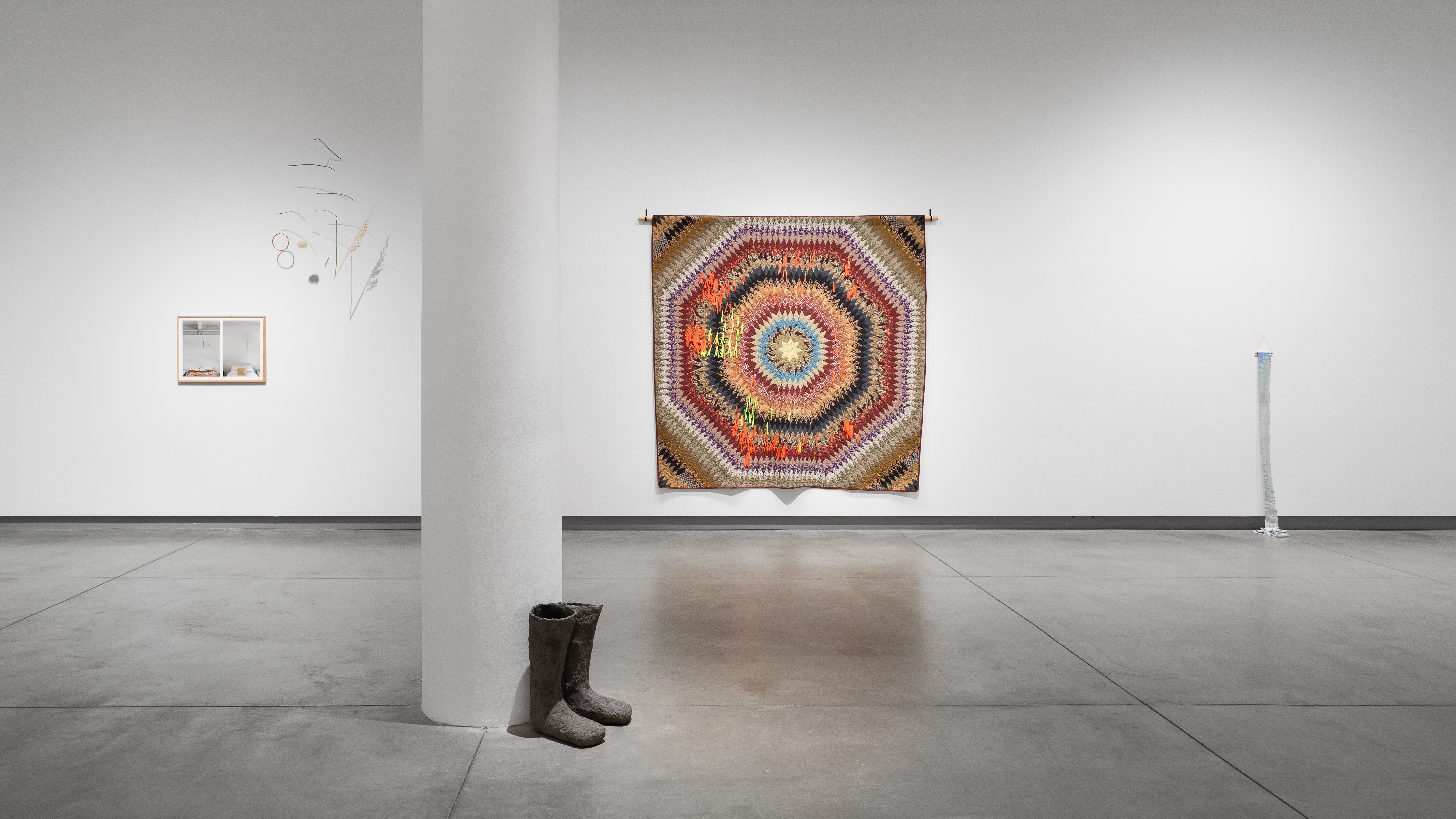 Installation view of “A Sea of Particles,” with works by Cara Levine, Jess Perlitz, Sunny A. Smith and Emily Squires. (Photo a by Joel Tsui, courtesy of the ICA at MECA&D)
This is a poetic segue point into a second exhibition, “A Sea of Particles,” in the back gallery. Simensky was a collaborator and networker who often created his own works in conjunction and/or consultation with others. Radio nerds, for instance, would help him work through technical problems, though he would deliberately undercut their advice at times to create something more closely approaching “art” than simple sound transmitters. He reveled in distortion rather than perfect reception as a way of challenging the viewer/listener to question ideas of what is harmonic sound, dissonant sound, cacophony and so on.
I cannot review “Sea of Particles” in this space. It highlights of work by some of Simensky’s collaborators as well as work inspired in part by his own. It is far ranging and requires more explanation than I have room for. But I will cite the work of Cara Levine, a good friend of Seminsky’s, for its affective and profoundly emotional quality. Particularly poignant are two pictures juxtaposed in the same frame.
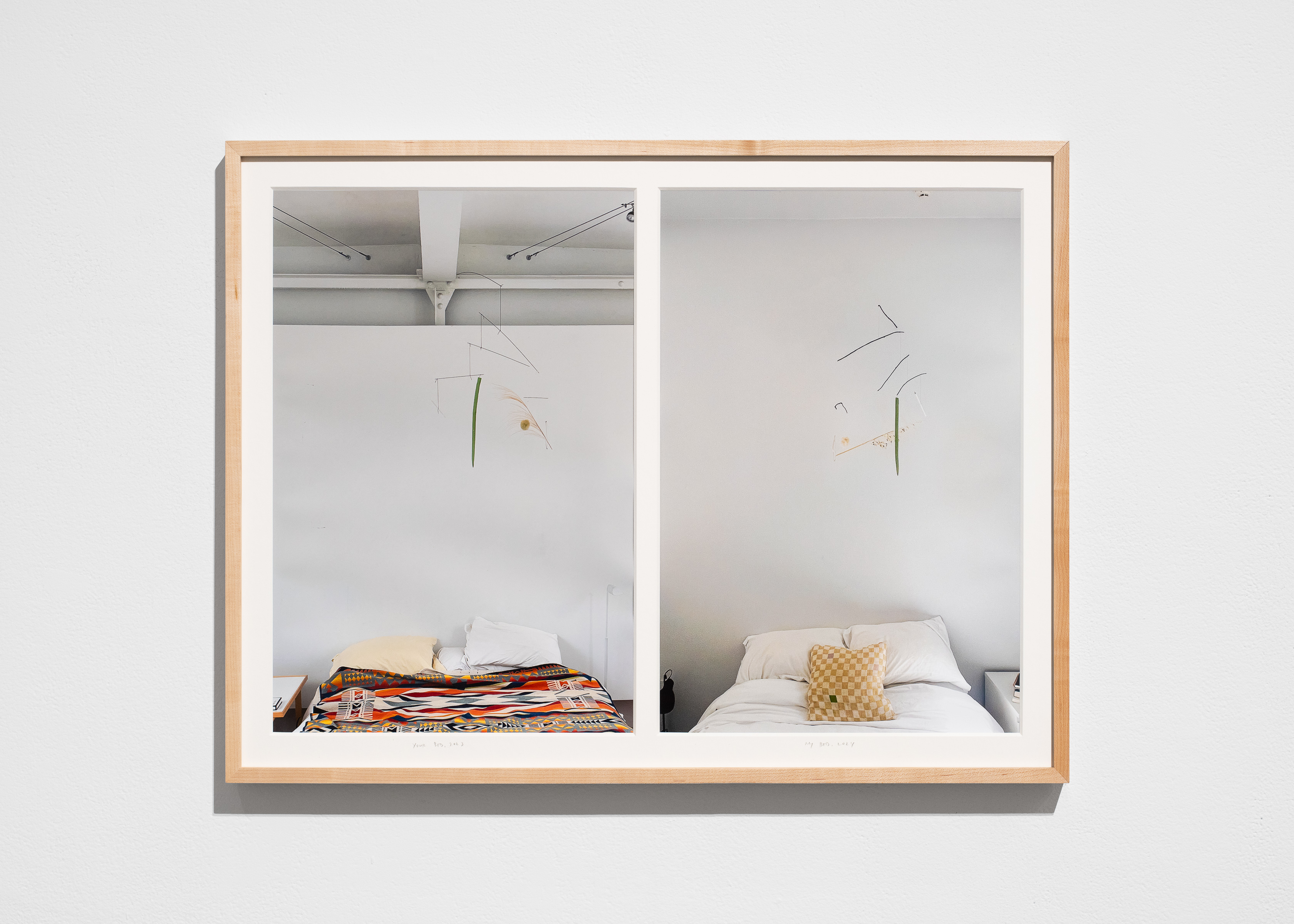 Cara Levine, “Me Catch You: Dream Catcher Replica Mobile for Peter (detail),” 2024. (Photo by Joel Tsui, courtesy of the ICA at MECA&D)
One is of Simensky’s bed, which shows a mobile suspended above it. Levine re-creates her friend’s mobile using her own materials (the actual piece hangs next to the frame), suspends it above her own bed and takes another photo. Placing them side by side, one labeled “Your Bed” and the other “My Bed” transmits such grief and longing that we come to appreciate Simensky’s extraordinariness, as well as the extraordinariness of his outsized impact on people.
The sense of loss is almost unbearable. It reminded me of Felix Gonzalez-Torres’s photo of an empty bed with rumpled sheets that he posted on billboards around New York City in the 1990s. They were about the absence of bodies that once occupied those beds and left their impressions on those pillows. This work commented upon the politics around the AIDS epidemic and sexuality. But like Levine’s piece, they feel like the gut punch of emptiness left in our soul when someone we love passes. That sensation of loss is everywhere at the ICA… hand in hand with Simensky’s ebullient spontaneity and joy.
Jorge S. Arango has written about art, design and architecture for over 35 years. He lives in Portland and can be reached at [email protected]. This column is free to access through support by The Dorothea and Leo Rabkin Foundation.
“Pyrite Radio” and “A Sea of Particles”, Institute of Contemporary Art at Maine College of Art & Design, 522 Congress St., Portland. Through Sept. 13. 11 a.m. to 5 p.m. Wednesday, Friday-Sunday; 11 a.m. to 7 p.m. Thursday; First Fridays until 8 p.m. Free admission, donations welcome. For more, call 207-899-5029 or go to meca.edu/ica
| # | Наименование новости | Тональность | Информативность | Дата публикации |
|---|---|---|---|---|
| 1 | This Maine photographer is taking on a new mission: Paying it forward | 0 | 37.48 | 10-07-2026 |
| 2 | Visita gratis las exposiciones de Walker Evans y Pérez Siquier en Barcelona | 0 | 8.02 | 08-05-2026 |
| 3 | Colby College acquires rare Henri Matisse screenprint | 0 | 46.28 | 22-07-2026 |
| 4 | Exhibition Tour: What Photographs Look Like (Public) | 5 | 7 | 09-07-2026 |
| 5 | Introducing ‘rage-iation,’ America’s next mental health crisis | Opinion | 0 | 38.36 | 23-07-2026 |
| 6 | Will Platner go back to the sea or into the fire? | Opinion | 0 | 36.67 | 17-07-2026 |
| 7 | Yuri Bosco - Everyday Life at the Stalingrad Hydroelectric Power Station (1959–1960) | 0 | 24.8 | 29-07-2026 |
| 8 | Portland’s Umbrella Cover Museum turns 30 | 0 | 34.49 | 27-07-2026 |
| 9 | Какие мероприятия буду в «ШКАФу» на этой неделе? ВЫСТАВКИ 🔶[https://vk.com/@shkaflib-techenie|«Течение»], ... | 0 | 10 | 14-07-2026 |
| 10 | Michael E. Smith, the Elusive Sculptor-Poet, Opens Up After a Decade of Dodging Interviews | 0 | 16.19 | 14-08-2026 |