Просмотр новости
Найдите то, что Вас интересует
 Спутники
 РН
РН SpaceX
 Роскосмос
 NASA
NASA
СпутникиРНSpaceXРоскосмосNASAFossil footprints from Kenya suggest Paranthropus boisei grew much larger than previously believed and may have traveled in all-male groups 1.4 million years ago.
An international team of scientists from the United States and Kenya has discovered a set of 1.4-million-year-old fossil footprints along a lakeshore in East Turkana, northern Kenya, that reveal something unexpected about an extinct human cousin: it was significantly bigger than anyone had assumed.
The tracks, left by eight individuals of Paranthropus boisei, a close evolutionary relative of modern humans that lived in Africa during the Pleistocene, were excavated and analyzed using footprint methods pioneered by the same team in 2024. The study was published July 27, 2026, in the Proceedings of the National Academy of Sciences.
Here is what makes this find unusual. Until now, scientists' best estimates of Paranthropus boisei's body size came almost entirely from skulls and jaws. Its enormous molars and crested skull earned it the nickname "Nutcracker Man," but little was known about the rest of its body.
These newly discovered footprints suggest Paranthropus boisei was much larger than previously believed, placing some individuals in the same size range as modern humans. The discovery also provides the first direct evidence that this species may have traveled in all-male groups, a social behavior not previously documented in ancient hominin fossils.
Who, What, Where, When, Why and HowThe study examined fossilized footprints left by eight adult Paranthropus boisei individuals, most believed to be male, that were preserved in ancient lakeshore sediments in East Turkana, northern Kenya, about 40 kilometers from another site where similar tracks have previously been found.
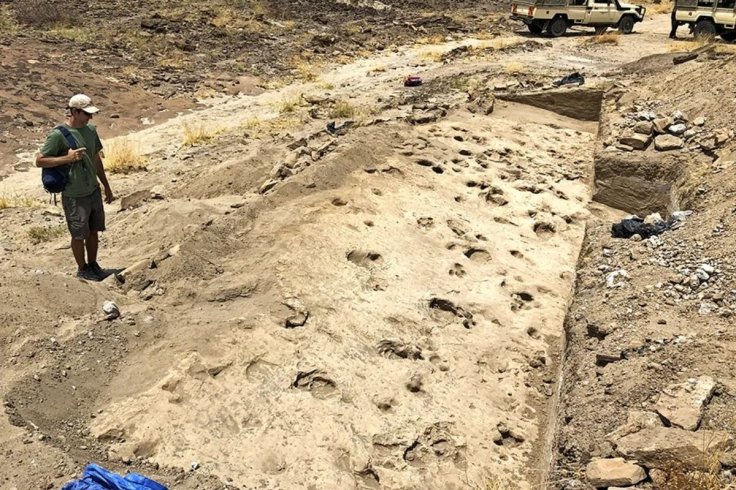 An overview of the excavated track surface with a mix of deeper hippopotamus and antelope footprints and shallower hominin tracks visible.
Kay Behrensmeyer/Max Planck Institute for Evolutionary Anthropology
An overview of the excavated track surface with a mix of deeper hippopotamus and antelope footprints and shallower hominin tracks visible.
Kay Behrensmeyer/Max Planck Institute for Evolutionary Anthropology
The footprints, made approximately 1.4 million years ago, were analyzed using a footprint-analysis technique the researchers developed in 2024. The method enabled the team to identify the species from its foot anatomy and gait while refining estimates of the individuals' physical characteristics based on the preserved tracks.
The study sheds new light on a species that lived alongside early Homo populations while following a separate evolutionary path, offering fresh evidence about the diversity of ancient human relatives.
What the Scientists SaidLead author Kevin Hatala of Chatham University and the Max Planck Institute for Evolutionary Anthropology said in a Max Planck Institute for Evolutionary Anthropology press release that the footprint dimensions came as a genuine surprise.
"The sizes of the footprints indicate human-like body sizes, up to 1.8 meters tall and around 75 kilograms."
Hatala noted that earlier studies suggested Paranthropus boisei was much smaller than its contemporary Homo erectus, a possible ancestor of modern humans. The new footprints challenge that long-held assumption.
Co-author Neil Roach of Harvard University said in a Max Planck Institute for Evolutionary Anthropology press release that the apparent group of eight mostly adult males offers rare insight into the species' social organization.
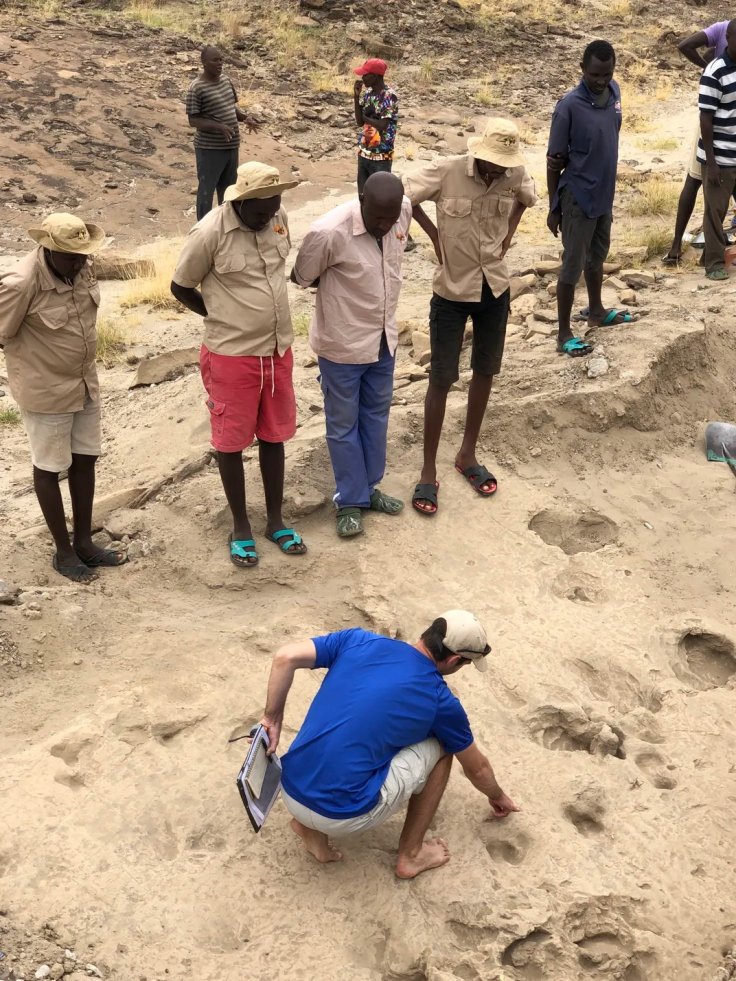 Study lead Kevin Hatala, an associate professor of biology at Chatham University in Pittsburgh, and an associate researcher at the Max Planck Institute for Evolutionary Anthropology in Leipzig, Germany, pointing out footprints of hominins among deeper hippopotamus tracks
Kay Behrensmeyer/Max Planck Institute for Evolutionary Anthropology
Study lead Kevin Hatala, an associate professor of biology at Chatham University in Pittsburgh, and an associate researcher at the Max Planck Institute for Evolutionary Anthropology in Leipzig, Germany, pointing out footprints of hominins among deeper hippopotamus tracks
Kay Behrensmeyer/Max Planck Institute for Evolutionary Anthropology
"The fact that eight, mostly adult male, Paranthropus boisei individuals seemingly traveled together as a group, without females or children, hints at a complex social structure in this species."
He added:
"They may have lived in large groups, where males competed for mates, but also tolerated each other at times for safety in a dangerous environment."
Why the Lakeshore and What Comes NextSmithsonian Institution researcher and study co-author Kay Behrensmeyer said that the repeated discovery of ancient lakeshore deposits points to a broader pattern across the Turkana Basin.
"To me, it is amazing that we have the same kind of lake margin deposits in two areas of East Turkana that are 40 kilometers apart, at about the same age," Behrensmeyer said in the Max Planck Institute for Evolutionary Anthropology press release.
Researchers have now documented hundreds of hominin footprints across more than six sites in the region, suggesting these ancient lakeshores served as important landscapes for multiple early human relatives over a span of more than 100,000 years.
Purity Kiura of the National Museums of Kenya said the discovery reinforces Lake Turkana's importance to understanding human evolution.
"The discovery of these fossil footprints along the margins of Lake Turkana reinforces the region's global importance in understanding human evolution, preserving remarkable evidence of how our ancient relatives lived 1.4 million years ago," Kiura said in the Max Planck Institute for Evolutionary Anthropology press release.
The research team plans to return to Kenya to continue excavating additional footprint sites.
| # | Наименование новости | Тональность | Информативность | Дата публикации |
|---|---|---|---|---|
| 1 | В Кении нашли следы крупного предка человека возрастом 1,4 миллиона лет | 0 | 10.35 | 29-07-2026 |
| 2 | 1,4 Milyon Yıllık Ayak İzleri, İnsan Akrabasının Yaşamını Anlatıyor | 0 | 9.29 | 02-08-2026 |
| 3 | Загадочные гоминины оставили большие следы на берегу древнего озера в Африке | 0 | 7.47 | 28-07-2026 |
| 4 | These 773,000-year-old fossils may reveal our shared human ancestor | 0 | 7.96 | 07-02-2026 |
| 5 | Ученые пересмотрели представления о размерах древних парантропов | 0 | 10 | 27-07-2026 |
| 6 | Stunning fossil discovery in Ethiopia rewrites human origins | 0 | 9.88 | 16-05-2026 |
| 7 | The ancient human ancestor ‘Little Foot’ gets a new face | 0 | 6.1 | 02-03-2026 |
| 8 | Story of human evolution rewritten as new evidence reveals a far more complex origin | 0 | 7 | 07-07-2026 |
| 9 | 150-million-year-old dinosaur footprints reveal something strange about its walk | 0 | 10.42 | 11-08-2026 |
| 10 | A 236-million-year-old fossil could rewrite the story of mammalian birth | 0 | 7.75 | 13-08-2026 |