Просмотр новости
Найдите то, что Вас интересует
 Спутники
 РН
РН SpaceX
 Роскосмос
 NASA
NASA
СпутникиРНSpaceXРоскосмосNASA
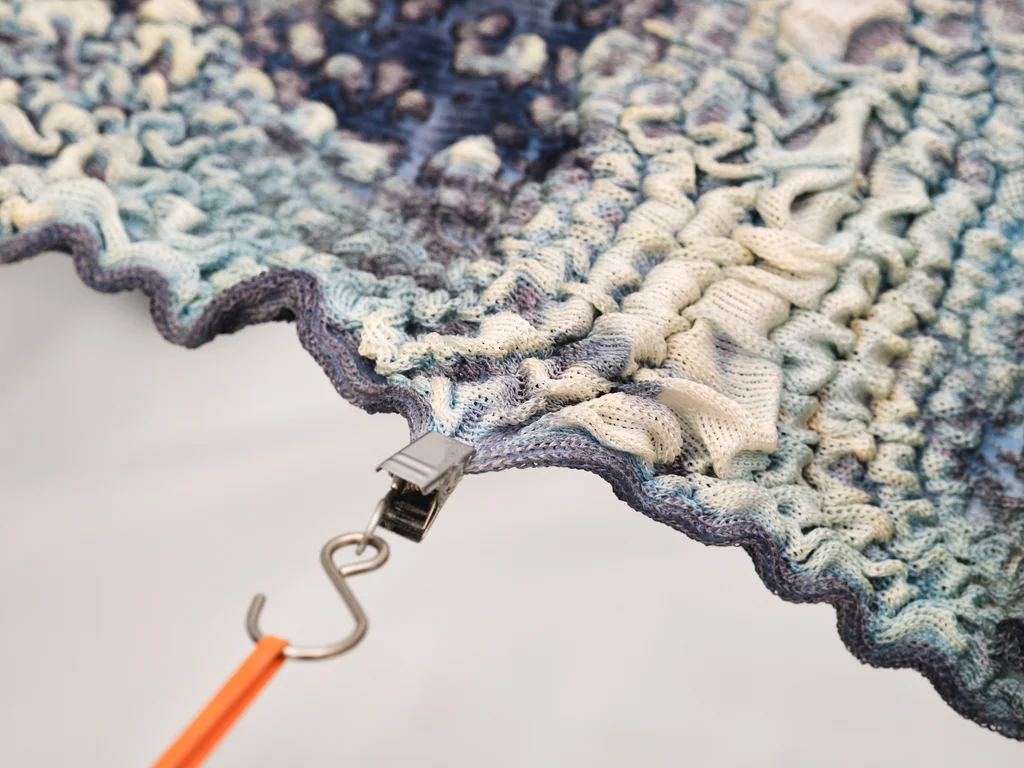
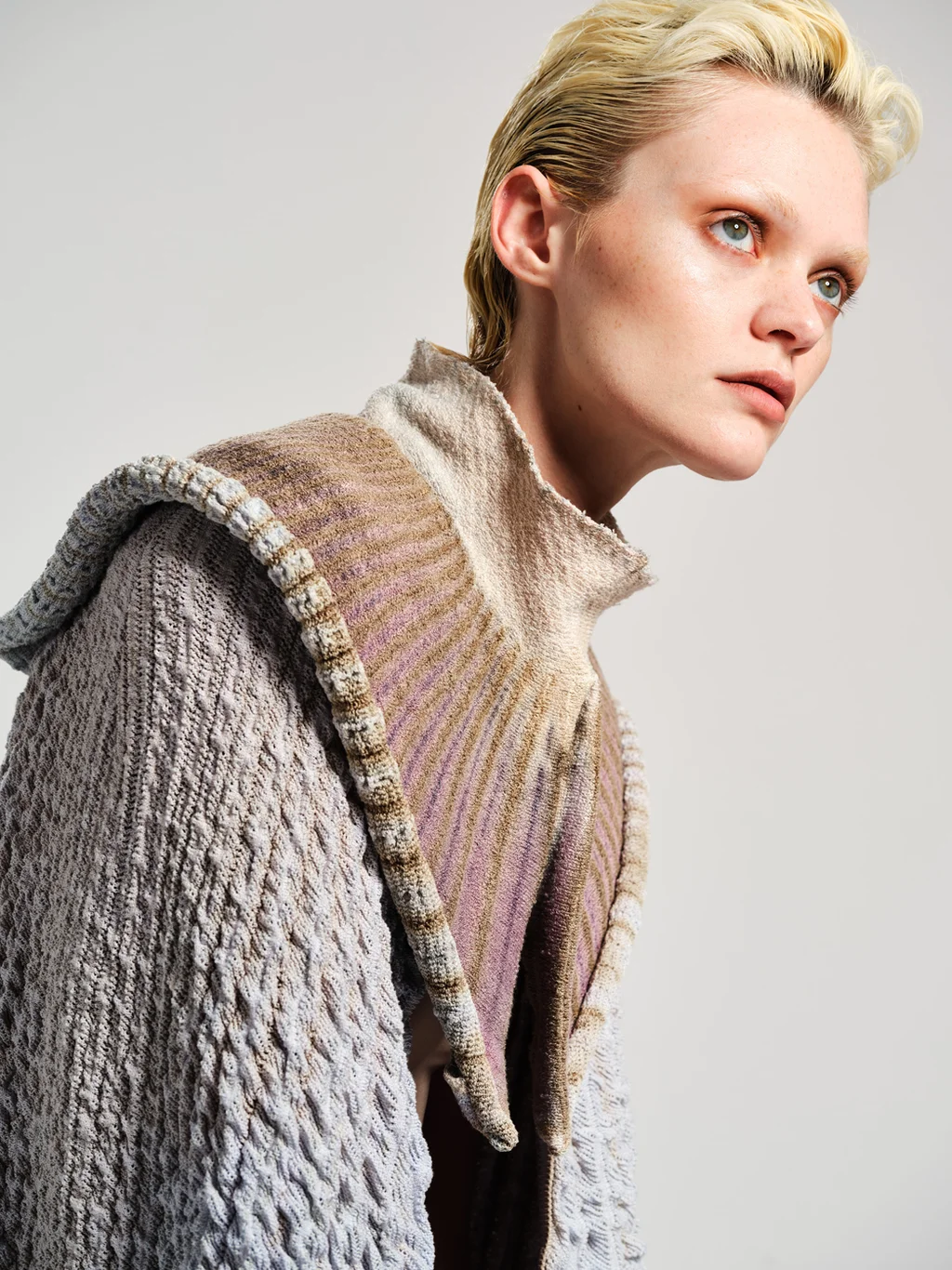
At OXMAN, a New York design studio, you’ll find four capes. They hang off a mannequin in soft folds, each knitted from strands of silk. Their color is uneven. Deep indigo collects in the ridges of the material, black shades in the valleys, blues appear in slightly crooked lines. The pigment is streaked and faded, so no two sections look the same. A commercial dye house would call this a defect and throw it out. But here, the inconsistency is the point.
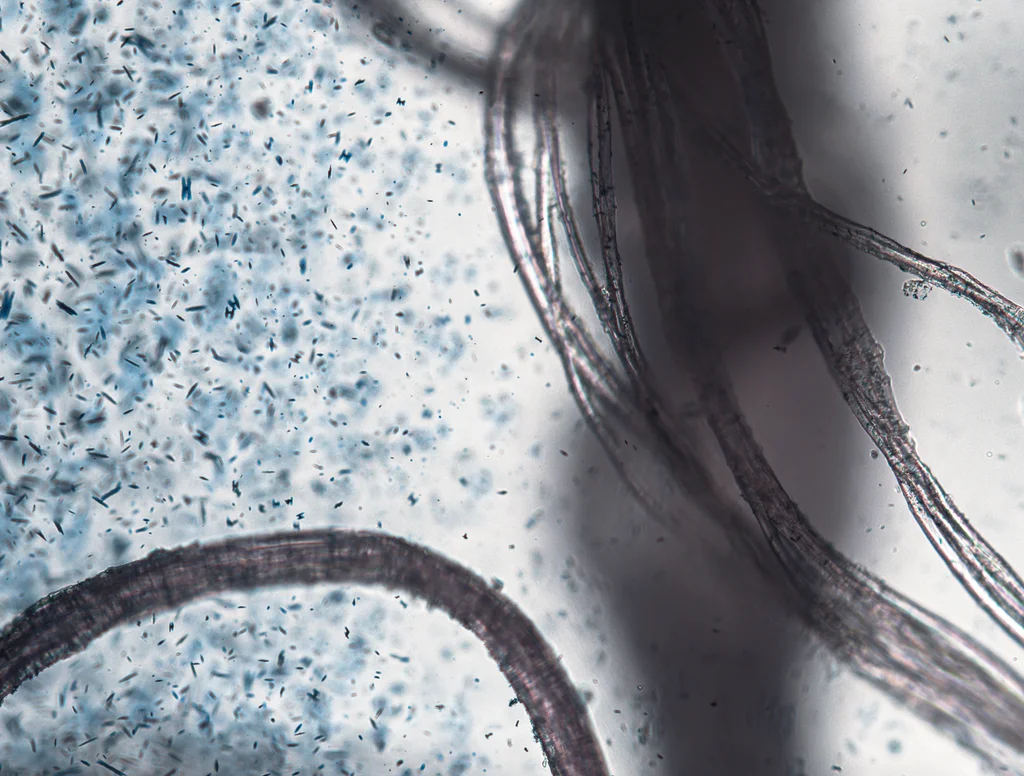
The color on the fabric was not produced by dyeing. Instead, it’s a process that mimics the way nature gives fruits, flowers, and animals their color. The hues on the garments were grown into the material over the course of 24 hours by billions of E. coli bacteria engineered by OXMAN’s team of designers and scientists.
[Photo: Nicholas Calcott]
For Neri Oxman, the former MIT Media Lab professor who launched OXMAN in 2020, this project—called Vigils—offers a radical alternative to the way the apparel sector dyes clothing. But it also provokes us to think more broadly about how the fashion industry’s status quo is to extract and exploit nature. Oxman wants us to imagine a world where fashion works alongside nature to co-create in ways that are beneficial to both humans and the planet.
[Photo:Oxman]
“There’s a wide array of relationships between design and nature spanning extraction and generation,” Oxman says. “You can extract dyes from flowers and use them in textiles, or you could replicate the exact genetic code in a bacteria to express that color.”
The traditional dyeing industry is highly toxic and polluting. Textile dyeing and finishing accounts for up to 20% of the world’s industrial water pollution, translating into a trillion gallons of polluted water discharged into the ocean. While several biotech firms have created more sustainable dyes, plugging cleaner chemicals into existing dye houses, OXMAN’s approach reimagines dyeing from the ground up, treating dyes and fabrics as living organisms that can be grown.
And while the Vigils project is still experimental, Oxman’s long-term goal is to commercialize and scale the technology, reshaping the future of fashion.
[Photo: Nicholas Calcott]
A Lab That Works Alongside Nature
After five years of building it in stealth, Oxman opened her new studio in Hell’s Kitchen last year. Together with her husband, Bill Ackman, who runs the hedge fund Pershing Square, Oxman has invested upwards of $100 million in the studio so far. Inside, roughly two dozen researchers work on projects at the intersection of engineering, data science, biotechnology, and design.
For Oxman, whose background includes degrees in architecture and design computation, the lab is a wonderland. One room reconstructs the atmosphere in New York on a specific day in 1864. In another room, scientists monitor an ancient oak-tulip tree forest to see whether they can rewild ancient ecosystems.
“You can move from a robot to a computer to a pipette in 30 seconds,” Oxman says, noting that the lab’s mission is “nature-centricity”—treating nature as a collaborator, rather than a resource to be extracted from.
Before Vigils, her most recent project was O°, a shoe made entirely from PHA, a biodegradable plastic that is produced and broken down by bacteria. The shoe is engineered to decompose in soil or seawater within weeks. Oxman says the pigmentation research that emerged from the shoe project provided the spark that led to Vigils.
[Photo: Nicholas Calcott]
How to Grow Color
Oxman has a fascination with bacteria, which she believes can be engineered in creative ways. It’s possible to program the genetic code of a microbe to build almost anything. In this case, her team has inserted genes that instruct E. coli to produce two pigment classes—indigos and melanins—the same molecules behind the blue in denim and the brown-black of hair and skin. “Bacteria is the workhorse of synthetic biology,” she says.
[Photo: Nicholas Calcott]
For Marcus Walker, a synthetic biologist who worked on Vigils, it’s important to consider where color comes from in the living world. A tiger’s stripe or the swirl in a fingerprint aren’t painted on; individual cells read their position and identify what pigment they should produce. “If you think about how nature dyes things, it comes from the inside out,” Walker says.
Borrowing from this logic, the Vigils team coats fibers with a chemical that the bacteria can sense. They then spray the whole garment with a bacterial culture, and the pigment appears only where those coated fibers have been knitted in, which allows the team to create patterns in the fabric.
“You cover the whole textile in those bacteria,” Walker says. “But only where we’ve knitted particular coated fibers will you [get] the pigment response that you’ve encoded into the bacteria.”
[Photo: Nicholas Calcott]
Vigils doesn’t depend only on the bacteria to work. It also requires thinking about the texture of the fabric. Textile engineer Jessy Lu knits the capes on an industrial 3D machine—the kind used to knit sneaker uppers—from silk whose filaments are close to the scale of the bacteria. “The materials offer scaffolding for the process that we’re doing with the bacterial pigmentation,” she says.
[Photo: Nicholas Calcott]
It’s an approach that’s very different from those of other companies on the market that produce more sustainable dyes.
Pili, the French company behind Citizens of Humanity’s bio-based Eco-Indigo, ferments engineered microbes in tanks, filters out finished dye, and drops it into existing dye machines. The British startup Colorifix, which has worked with Pangaia, grows pigment in a fermenter and applies it through a conventional dyeing setup. Both aim for a more eco-friendly, scalable replacement, which is designed to produce the uniform result consumers are used to seeing in clothing.
[Photo: Nicholas Calcott]
“You get a homogenous material that is yellow or purple that is visually indistinguishable from something dyed through traditional chemicals,” Lu says.
But the goal with Vigils is different. The point is to grow color directly onto the material, rather than to saturate the material with color. And ultimately, this process will result in retaining the inconsistency and variation that we see in the colors in the natural world. Oxman’s team wants to create patterns that aren’t possible through industrial approaches. “There’s variation that is always interesting,” Walker says.
[Photo: Nicholas Calcott]
Reimagining the System
For now, the capes at OXMAN look like a stunning art exhibit. But the lab’s founder believes the process of bacterial pigmentation can be commercialized and incorporated into the fashion industry.
To do so will require more research. But perhaps more daunting, it will require companies and factories to reimagine how they operate. This will be hard because the fashion supply chain—including industrial dyeing—has operated the same way for decades, if not centuries. Oxman’s vision is to reimagine the entire process of dyeing, rather than to improve it incrementally.
“We’re not in the business of adding on,” she says. “We’re in the business of rethinking the industry.”
[Photo: Nicholas Calcott]
This means treating color, decomposition, and texture as properties that can be manipulated and written into a garment’s genetic code from the start. “It’s inventing a completely new language of craftsmanship that is authored by genetics,” she says.
None of this will happen fast. Oxman estimates it will take decades for her vision to become a reality. But she believes future generations will expect the process of making clothes to be less extractive and polluting, proclaiming, “I believe in all of my 230 bones that the future of fashion is the future of science.”
At OXMAN, a New York design studio, you’ll find four capes. They hang off a mannequin in soft folds, each knitted from strands of silk. Their color is uneven. Deep indigo collects in the ridges of the material, black shades in the valleys, blues appear in slightly crooked lines. The pigment is streaked and faded, so no two sections look the same. A commercial dye house would call this a defect and throw it out. But here, the inconsistency is the point.
The color on the fabric was not produced by dyeing. Instead, it’s a process that mimics the way nature gives fruits, flowers, and animals their color. The hues on the garments were grown into the material over the course of 24 hours by billions of E. coli bacteria engineered by OXMAN’s team of designers and scientists.
 [Photo: Nicholas Calcott]
For Neri Oxman, the former MIT Media Lab professor who launched OXMAN in 2020, this project—called Vigils—offers a radical alternative to the way the apparel sector dyes clothing. But it also provokes us to think more broadly about how the fashion industry’s status quo is to extract and exploit nature. Oxman wants us to imagine a world where fashion works alongside nature to co-create in ways that are beneficial to both humans and the planet.
 [Photo:Oxman]
“There’s a wide array of relationships between design and nature spanning extraction and generation,” Oxman says. “You can extract dyes from flowers and use them in textiles, or you could replicate the exact genetic code in a bacteria to express that color.”

Subscribe to the Design newsletter.The latest innovations in design brought to you every weekday
The traditional dyeing industry is highly toxic and polluting. Textile dyeing and finishing accounts for up to 20% of the world’s industrial water pollution, translating into a trillion gallons of polluted water discharged into the ocean. While several biotech firms have created more sustainable dyes, plugging cleaner chemicals into existing dye houses, OXMAN’s approach reimagines dyeing from the ground up, treating dyes and fabrics as living organisms that can be grown.
And while the Vigils project is still experimental, Oxman’s long-term goal is to commercialize and scale the technology, reshaping the future of fashion.
 [Photo: Nicholas Calcott]A Lab That Works Alongside Nature
After five years of building it in stealth, Oxman opened her new studio in Hell’s Kitchen last year. Together with her husband, Bill Ackman, who runs the hedge fund Pershing Square, Oxman has invested upwards of $100 million in the studio so far. Inside, roughly two dozen researchers work on projects at the intersection of engineering, data science, biotechnology, and design.
| # | Наименование новости | Тональность | Информативность | Дата публикации |
|---|---|---|---|---|
| 1 | This category-changing sticker patch instantly mends fabric | 0 | 12.86 | 24-07-2026 |
| 2 | AI shopping is coming to your favorite brand’s website | 0 | 10.18 | 29-07-2026 |
| 3 | Fungus-made fashion—researchers turn living organisms into textiles | 0 | 12.94 | 24-07-2026 |
| 4 | From Fast Fashion to Digital Fashion: Environmental and Economic Consequences of Virtualization of The Fashion Industry | 0 | 6.16 | 15-06-2026 |
| 5 | ‘Almost everyone is having an existential crisis’: Designers share how they’re surviving an industry in constant flux | 0 | 10.21 | 29-07-2026 |
| 6 | Why the hottest brands are starting to look like reality TV | 0 | 10.19 | 29-07-2026 |
| 7 | Figma CEO says AI superintelligence is not a looming threat to the company | 0 | 5 | 31-07-2025 |
| 8 | NEW UNI PHIL ????!!? YOU NEED TO SEE THIS https://www.instagram.com/p/DaS-T5BnT99 | 9 | 1 | 02-07-2026 |
| 9 | I accidentally did a Wikipedia binge about 1st wave feminism and fashion and stumbled upon the 1890s… | 2 | 4 | 03-07-2026 |
| 10 | Top 10 Emerging Technologies of 2024 | 5 | 7 | 29-06-2026 |