Просмотр новости
Найдите то, что Вас интересует
 Спутники
 РН
РН SpaceX
 Роскосмос
 NASA
NASA
СпутникиРНSpaceXРоскосмосNASAA tale of AI woes and possibilities
By Gregory Walker
Generative AI has seemingly come of age. AIVA’s Music Generator can create its own orchestra music, Splice Sounds’ plug-ins compensate artists whose works are used for training, and 34 to 44 percent of the music uploaded to Spotify is now fully AI–generated. This technology has its fans. “It presents some really fantastic opportunities to help empower artists to make the world a better place,” according to Dr. Tina Tallon, an assistant professor of AI and music composition at Ohio State University. But at one Stratus Chamber Orchestra rehearsal in Denver, Colorado, last April, nobody was feeling it.
We were rehearsing a new piece called DarkRace for Orchestra, Electric Violin, and AI. I composed it, maybe as an experiment, maybe to self-medicate—a way to work through my own personal apprehension about us musicians, the future of artificial intelligence, and the possibility people weren’t going to be able to tell the difference between the two. The piece is programmatic, tracing the legend of John Henry, the Black convict laborer whose race against a new steam-powered rock drill deep into a mountain tunnel inspired ballads and blues in the 19th century. In addition to using laptop software to create or “improvise” passages within the pre-composed music—representing my idea of a steam-powered drill—there would be a lot of other moving parts for the May 3 premiere at Denver’s Kenneth King Academic and Performing Arts Center. Literally, because, as the electric violin soloist representing John Henry, I’d get to improvise blues fiddle in a choir loft while flute players wandered the aisles wearing mining headlamps.
But last April, instead of creating gentle woodwind harmonies to accompany our flute players, Suno AI, a generative audio AI platform with DAW capabilities, started blasting out something more like the soundtrack to K-Pop Demon Hunters. The rehearsal sputtered to a halt.
***
Not unrelated: In a 20VC podcast last year, Suno CEO Mikey Shulman said, “The majority of people don’t enjoy the majority of the time they spend making music.”
“That’s not true, first of all,” Tallon tells me. Tallon herself has explored AI as a composer, including with a 2025 opus, utterances, wanderings. She programmed a Max visual language that “listens” to string players and adapts, creating new score modules for them to improvise with. Even the audience is invited to join in. “In a time when AI is increasingly playing an exploitive role in music making, this piece aims to demonstrate that when used thoughtfully, it can be a tool for collaboration and co-creation,” she says.
***
As the orchestra started to pack up at the end of our rehearsal, I looked down at my own rig. The Denver audience was supposed to download a vocal synthesis app called Wandrous for the performance. And I was using a popular online platform best known for taking simple prompts and making, well, pop songs.
If there’s any great skill involved with this software, it’s not necessarily coming up with the right prompts, like many of us try to do with ChatGPT. Rather, it’s about finding the right negative prompt to discourage the software from say, creating K-Pop in the middle of a symphony. However, in a world where technology can put a man on the moon and even Snowball the cockatoo can keep a steady beat on YouTube, Suno actually cannot yet generate music in a specific tempo. Which means not only did the AI have an annoying habit of creating spastic pizzicati in the middle of DarkRace’s climactic contest between man and machine, if its virtual fiddle ended up going quarter note = 200, I was going to have to find a way to keep up on the electric violin.
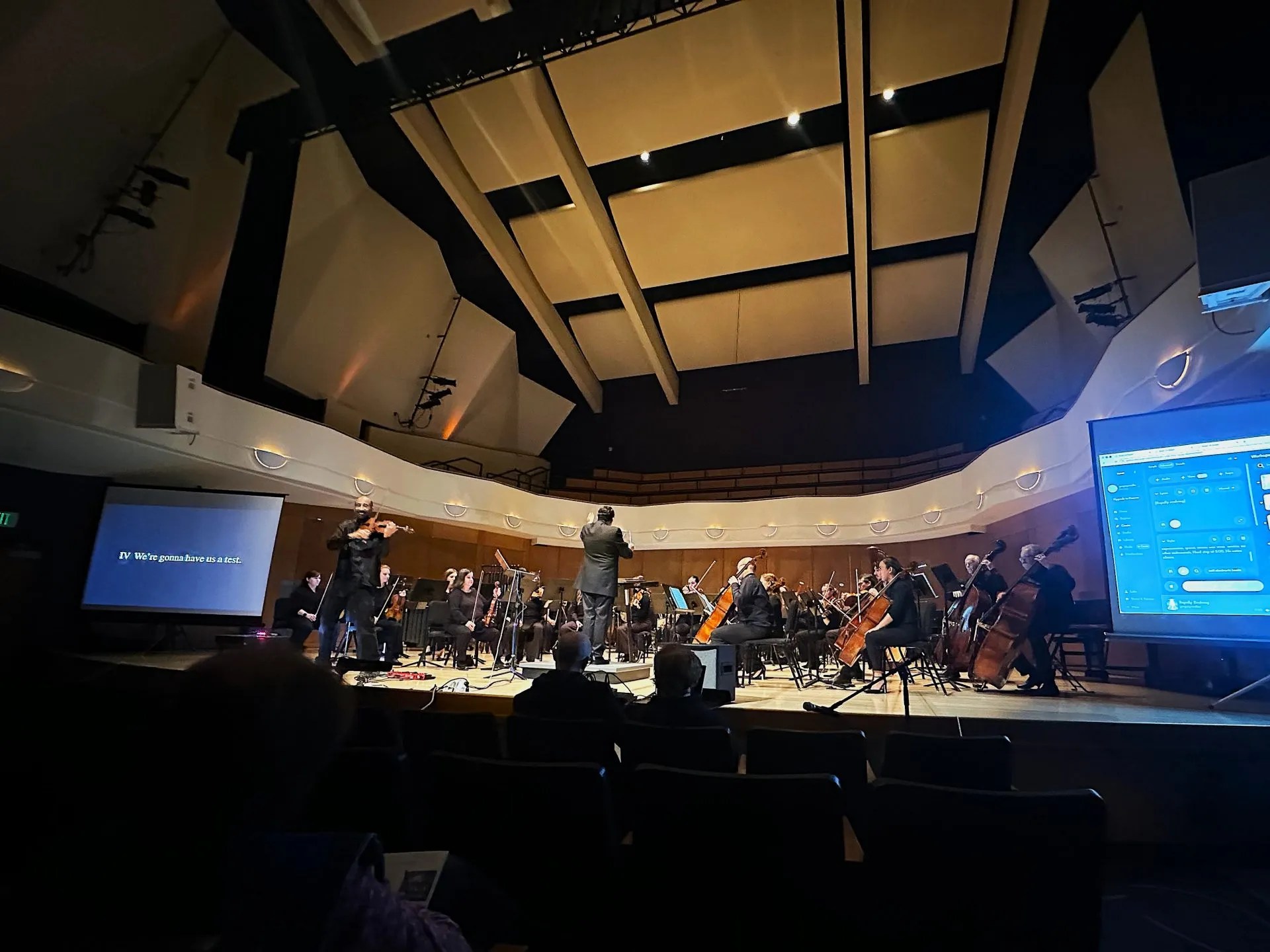 Stratus Chamber Orchestra and Gregory Walker. Image courtesy Lori Walker
***
Dr. Tallon listed human innovators who are figuring out how AI can make life easier for musicians, like Cornelia Fermüller at the University of Maryland, who’s been working on a computer vision app. “It will look at things such as your head tilt, such as whether your wrist has collapsed inward, whether your wrist is straight.”
She reminisced, “I had a teacher who used a thumb tack—she called it ‘the beehive’—to make sure that your wrist didn’t collapse when you were holding up the fingerboard!”
***
Still wondering whether Tallon and Shulman might have had the same violin teacher, I arrived at the dress rehearsal two days after the K-Pop disaster. This time, when Stratus music director Adam Torres and I reached the point where the electric violin is run through various pedals and used to improvise a choral accompaniment to a singing AI voice, Suno started spitting out its own odd accompaniments. We were running out of time, and there was no way I had the cognitive ability to solve all of these problems. Even if Suno generated a solo voice once, there was no guarantee it could do it twice in a row, and a random bass line would be an artistic disaster for me.
Not unrelated: After his race with the steam hammer, they did actually end up burying poor John Henry.
Naturally, I turned to ChatGPT: “Copy this structure exactly and only change instrument names or techniques: ‘Acoustic instrument laboratory test recording. Not a musical composition. Not a song. No arrangement. No ensemble performance.’”
***
“I do have a veto button in my Max patch, if there are some things going on,” Tallon said. “Rather than just relying on the machine learning, I put in what we call a ‘heuristic’ on top of it . . . where I can say, nope, we’re going to force it into some new materials.”
As she spoke about how she and others are cancelling Spotify because of all the AI slop and the proliferation of toxic data centers, she emphasized that the future of AI can be “teacher-led and student-led. I do think that we can fight back against things that are unethical and harmful. And that pressure on companies, pressure on governmental organizations, can make a difference.”
Thinking back to her utterances, wanderings, she got a little introspective. “There are so many things in life that we are not in control of and in some ways, for me, being able to adjust the level of randomness at play in these algorithms is actually, you know, in some ways an expression, an artistic expression.”
***
Sure enough, while trying to negative-prompt my way out of Suno’s random pizzicati, I had an artistic epiphany. What if I was wrong and the AI was right? Maybe all that plucking was just what the piece needed to tie in the earlier blues fiddle riff.
At the May 3 premiere, with the audience in their seats using their Wandrous apps to sing along, Suno suddenly exploded out of the gates at quarter note = 246. It was impossibly fast. I was confused and disoriented in the score during the climactic contest. But in the enveloping reverberance of that concert hall, an amazing thing started to happen: You could feel the sound of the orchestra gradually rise up with a crescendo on all sides so loud that it was burying both the electric violin and the AI.
And thank goodness people weren’t going to be able to tell the difference between the two.
***
“I need to apply for a grant, so if anybody wants to fund me, I will shamelessly solicit,” Tallon told me. I laughed. The object of the grant: a pair of “very fancy eye-tracking glasses.”
“There’s a growing body of research on eye-tracking studies for musicians reading scores. What happens if we can actually detect when somebody gets confused, when they get disoriented in a score?” She went on: “Is that potentially an early warning sign of cognitive decline?”
Perhaps a more practical use of AI. Looks like Dr. Tallon and I are going to be working together for the foreseeable future.
An American Academy of Arts and Letters Fellowship recipient and International Musician cover artist, Gregory T.S. Walker’s compositions include Rock, Pop, and Hip-Hop Fantasies for Two Violins (available from the Subito Music Corporation) and Bad Rap for Electric Violin and Chamber Orchestra (Keiser Music).
| # | Наименование новости | Тональность | Информативность | Дата публикации |
|---|---|---|---|---|
| 1 | Ai and all it brings | 0 | 5 | 07-07-2026 |
| 2 | The tragedy of the commons, AI edition | 0 | 7.51 | 06-08-2026 |
| 3 | Innovations in energy and finance are further inflating the AI bubble | 0 | 5 | 15-01-2026 |
| 4 | The future of AI in law: Trends and innovations to watch | 0 | 7 | 11-08-2025 |
| 5 | Искусственный интеллект и информационный суверенитет: новые вызовы нашего времени» | 0 | 10 | 05-06-2026 |
| 6 | Building The Future Of Software In The AI-Native Era | 0 | 17.78 | 19-11-2025 |
| 7 | AI and the Turing test: Where are we headed? | 0 | 5 | 11-07-2025 |
| 8 | How AI is breaking the British state | 0 | 10 | 06-08-2026 |
| 9 | Lessons from the frontiers of AI adoption | 0 | 5 | 01-12-2025 |
| 10 | The future of shopping | 0 | 10 | 17-05-2026 |