Просмотр новости
Найдите то, что Вас интересует
 Спутники
 РН
РН SpaceX
 Роскосмос
 NASA
NASA
СпутникиРНSpaceXРоскосмосNASABox office success and Academy accolades don’t guarantee that an original score will make its way into the repertoire of string players.
By Brian Wise | From the March/April 2026 issue of Strings
As awards season reaches its climax with the Academy Awards in March, it remains to be seen if the best original score winner finds a way into the repertoire of string players. We’ve seen this picture before. Countless violinists have played at least one of the suites or concertos linked to John Corigliano’s Oscar-winning score to The Red Violin of 1999. Perhaps no less popular is John Williams’ Theme from Schindler’s List, drawn from the Oscar-winning soundtrack to Steven Spielberg’s 1993 film.
And cellists had taken up Tan Dun’s Crouching Tiger Concerto, which Yo-Yo Ma introduced in 2000, shortly before Crouching Tiger, Hidden Dragon went on to win the Oscar for best original score.
More than a quarter-century later, these pieces continue to circulate on concert programs, showing the associative power of even a decades-old movie. But as composers draw on a wider array of sounds in their music, the best original score winners have steadily become less symphonic in nature. Moreover, the Oscars and other leading awards, including the Golden Globes and the BAFTAs, haven’t always been accurate predictors of concert success. Though Bernard Herrmann’s scores to Vertigo and Psycho are now regularly played by orchestras in both “live-to-film” and concert suite versions, neither won an Academy Award in its day.
These questions swirl just as orchestral gatekeepers show a growing interest in film music, taking cinematic suites out of their longtime “pops” categories and weaving them into “masterworks” concerts. Though the changes have been gradual, audiences are increasingly likely to encounter Williams, Herrmann, Korngold, or Rózsa alongside the core classics.
When Audiences ‘Go Nuts’ for Williams ScoresString players are taking note. The Calidore String Quartet in February released AmericanTapestry, which features a new string quartet arrangement of With Malice Toward None, drawn from John Williams’ Oscar- and Golden Globe–nominated score to Lincoln. Calidore violinist Ryan Meehan says that after the group approached Williams, the composer suggested he arrange the cue from Spielberg’s 2012 biopic. “It has this Appalachian folk feeling to it but is also Copland-esque in some ways,” Meehan says of Williams’ arrangement. “It has a lot of ties to Americana and the classical tradition in America.”
The score sits beside two other Hollywood-linked works: Barber’s First String Quartet, with its famous Adagio (Platoon, The Elephant Man), and Korngold’s Third String Quartet, which features themes from his film scores. (Wynton Marsalis’ First String Quartet completes the album.) “Certainly, there’s always been this stigma that film music is not of the same quality because it’s commercial in some way,” Meehan acknowledges. “But we firmly believe that’s not the case.”
Meehan had done some informal research on Williams’ appeal: When he toured with Mutter’s Virtuosi (led by Anne-Sophie Mutter and hardly a crossover outfit), a Williams encore was a particular crowd-pleaser. “Before they even heard the piece, people went nuts,” he says.
Elsewhere, symphony orchestras from Austin to Toronto and London are juxtaposing Herrmann’s Psycho Suiteor the Scene d’amour from Vertigo with standard repertoire. In February, the Youngstown Symphony in Ohio presented two Williams selections—the Olympic Fanfare and Adventures on Earth from E.T.—alongside works by Berlioz, Sibelius, and Wagner. Erik Ochsner, Youngstown’s music director, says that not only are orchestras becoming more receptive to film music, but Hollywood studios see them as potential revenue streams.
 Gustavo Dudamel and John Williams backstage during the 2019 Oscar ceremony, Photo: Matt Petit / ©A.M.P.A.S.
“For years, film studios didn’t allow complete soundtracks to be performed, perhaps partially due to the difficulty and cost in assembling the scores,” Ochsner writes in an email. “As [screening] technology has grown in power and reduced in size, producers can now show an entire movie from a small laptop.”
Ochsner, who keeps a spreadsheet of some 250 film scores for rent, led a touring production of La La Land in 2017 that was quickly assembled after it won Oscars for best original score and song (“City of Stars”), both by Justin Hurwitz. But such live-to-film productions are discreetly packaged and marketed to movie fans. “When orchestras label their concerts as pops or masterworks, it’s making decisions for ticket buyers in advance, and that can be limiting, instead of encouraging audiences to listen to new and different things,” Ochsner notes.
Lines were once not so sharply drawn. In 1942 Igor Stravinsky was commissioned to produce a score for a film called The Commandos Strike at Dawn, about a Nazi attack on Norway, but he balked at changes requested by the studio (the project went to Louis Gruenberg, whose score was nominated for an Oscar). In terms of film scores, Williams’ “serious” credentials grew with Schindler’s List, conceived for Itzhak Perlman and recorded with the Boston Symphony. As Tim Greiving writes in his new biography, John Williams: A Composer’s Life, the acclaimed score followed Jurassic Park, considered lightweight by some critics.
“Williams was so moved by the film that he summoned his most serious, despairing score to date—which, ironically, became one of his most popular,” writes Greiving. “The themes were permanent fixtures at his live appearances—after the film came out, he wrote an extended, three-movement concert version—and Perlman immediately began performing it at his own concerts, ‘because that’s what people want to hear,’ the musician said.”
Williams is the most-nominated musician in Oscar history, though he hasn’t taken home a statuette since Schindler’s List. Has he been snubbed in recent years? Perhaps musicians seeking a barometer of quality will not find it in major awards. Steven Smith, author of the recent book Hitchcock & Herrmann: The Friendship and Film Scores that Changed Cinema, notes how Hollywood politics and backbiting have infiltrated the best score category.
“Bernard Herrmann was extremely antagonistic towards any situation that he saw as driven by politics and personality over quality,” he says. “And the way he openly confronted many people in Hollywood over that engendered, to a degree, a very understandable enmity towards him. And that was reflected in the fact that he did not receive an Oscar nomination between the years 1946 and 1976.”
Smith believes the best original score category is shaped by other factors as well, such as the tendency to reward films with catchy songs, even if those songs are unrelated to the film’s score. “When voters cast their votes in 1940 for The Wizard of Oz for best original score, I’ll bet they were thinking of songs as much as they were of Herbert Stothart’s underscore,” he says, alluding to the songs by Harold Arlen and E.Y. Harburg. At the 1940 Oscars, Stothart’s score edged out Gone with the Wind, the most celebrated score by Max Steiner. That tendency repeated itself in the 1990s, says Smith, when Alan Menken won best score Oscars for Beauty and the Beast, Aladdin, and Pocahontas. “Alan’s underscore for all of those Disney films is wonderful, but I suspect that the average voter was thinking of the songs.”
Battles over how to define a film score are intricate and sometimes boil down to questions of originality: The Academy ruled in 2008 that Jonny Greenwood’s acclaimed string-centric score for There Will Be Blood was ineligible because it drew liberally on pre-existing music.
Name recognition is another factor. But while some directors seek out known quantities like Williams or Elfman, others make stars. The Icelandic composer and cellist Hildur Guðnadóttir has thrived after her music for Joker won the Academy Award for best original score in 2019. Deutsche Grammophon signed her to a contract and released her haunting music for the 2019 HBO miniseries Chernobyl. And the Kronos Quartet recorded an arrangement of her Fólk fær andlit for its 2025 album, Forgive Us For.
“There is a greater variety of types of music being honored, and I think it’s fantastic,” says Smith. “I think it’s partly due to the diversification of Academy membership. It’s also because you don’t even have many orchestral scores anymore outside of those by John Williams, Thomas Newman, Michael Giacchino, and a few others.” (More changes could be coming as the Academy aims to increase the Oscar voting pool, having already seen a nearly 40 percent rise from a decade ago, when #OscarsSoWhite protests first put intense pressure on the organization to diversify.)
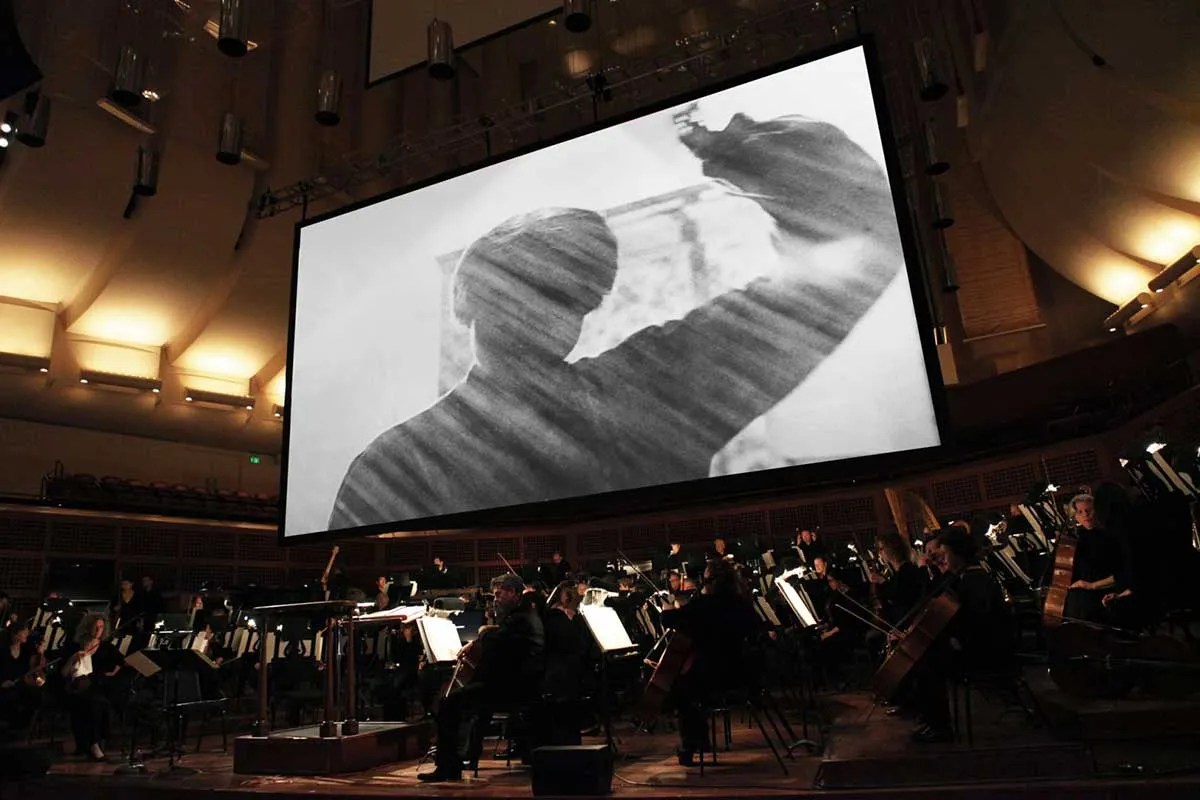 A live-to-film orchestra performance of Psycho, Photo courtesy of SF SymphonyA Mixed Future for Orchestral Scores
 Early in the 2026 awards race, a handful of notable soundtracks featured orchestral sounds, including Greenwood’s prismatic score to One Battle After Another, Alexandre Desplat’s splashy Frankenstein, and Max Richter’s Hamnet. But the lush, swooning string arrangements of decades past have often given way to timbres that are electronically sculpted, processed, and mixed with sound design.
Even a popular, fully symphonic score like Giacchino’s The Fantastic Four: First Steps—his seventh Marvel Studios production—may not land a spot on an orchestra masterworks program. Richard Guérin, director of Philip Glass’ Orange Mountain Music label and an close observer of the industry, sees missed opportunities.
“This is that age-old commercial-artistic success debate that didn’t hurt Verdi but certainly hurt Korngold,” he says, alluding to the way some orchestras remain leery of his Hollywood credentials. And scores are becoming less orchestral. “Recently, I think something happened with film music, and the boat was missed. Yes, John Williams might be an exception, but by and large, film music is still cordoned off into the pops-music format.” While Guérin is pleased to see Bernard Herrmann suites in overture slots, he doesn’t expect them on the second half of a masterworks program.
As for Glass, Guérin sees his film legacy as “on a planet of his own.” Referring to Kundun, The Hours, and Notes on a Scandal, he says, “For him, those major film scores—and those three Oscar nominations—certainly got his name in front of millions of people in a way that wouldn’t be possible in any other venue.”
But others are more optimistic about changing perceptions. Peggy Monastra, the vice president of G. Schirmer, which represents Tan Dun, notes that Crouching Tiger, Hidden Dragon brought him to a new level of popularity while leading to further spin-offs and collaborations between the composer and Yo-Yo Ma. “Tan Dun was already very established in the concert market before the Crouching Tiger Concerto,” she notes, “but it did become one of the most popular pieces in his catalog once it existed.
“The concerto provided a work that smaller-budget orchestras and those with more conservative audiences knew they could program, [based] on the title recognition and with ease due to the smaller orchestration.” She adds, “The film remains a favorite for millions and thus keeps the music in circulation too.”
| # | Наименование новости | Тональность | Информативность | Дата публикации |
|---|---|---|---|---|
| 1 | Review: ‘From Violin to Viola’ Covers All the Essentials | 0 | 7.95 | 20-07-2026 |
| 2 | 5 Minutes with Composer Niles Luther | 0 | 16.64 | 24-07-2026 |
| 3 | Breaking Into Data Centers: What HVACR Contractors Need to Know | 5 | 7 | 01-06-2026 |
| 4 | Хо? Го! // Ресторанная критика с Еленой Ремчуковой | 0 | 1 | 19-07-2026 |
| 5 | Продюсер Ануров: делать ремейки успешных российских фильмов рискованно | 0 | 0 | 18-07-2025 |
| 6 | Спектакли с Макэвоем и Камбербэтчем уже в вашем городе. Где? В кино! | 0 | 0 | 20-02-2020 |
| 7 | What’s the Matter With the Techno-Economy’s Professorial Class? | -5 | 6 | 02-07-2026 |
| 8 | Федор Бондарчук: талантливых людей в российской киноиндустрии можно пересчитать по пальцам | 0 | 0 | 26-12-2019 |
| 9 | Как же бедным кинематографистам найти деньги на кино? | 0 | 2 | 26-06-2026 |
| 10 | Как устроена индустрия кастинга для собак | 0 | 7.66 | 11-07-2026 |