Просмотр новости
Найдите то, что Вас интересует
 Спутники
 РН
РН SpaceX
 Роскосмос
 NASA
NASA
СпутникиРНSpaceXРоскосмосNASAParasite-induced cases of explosive diarrhea are sweeping the United States. Containing the outbreak won’t be easy.
Scientists trying to contain the growing outbreak face unique challenges
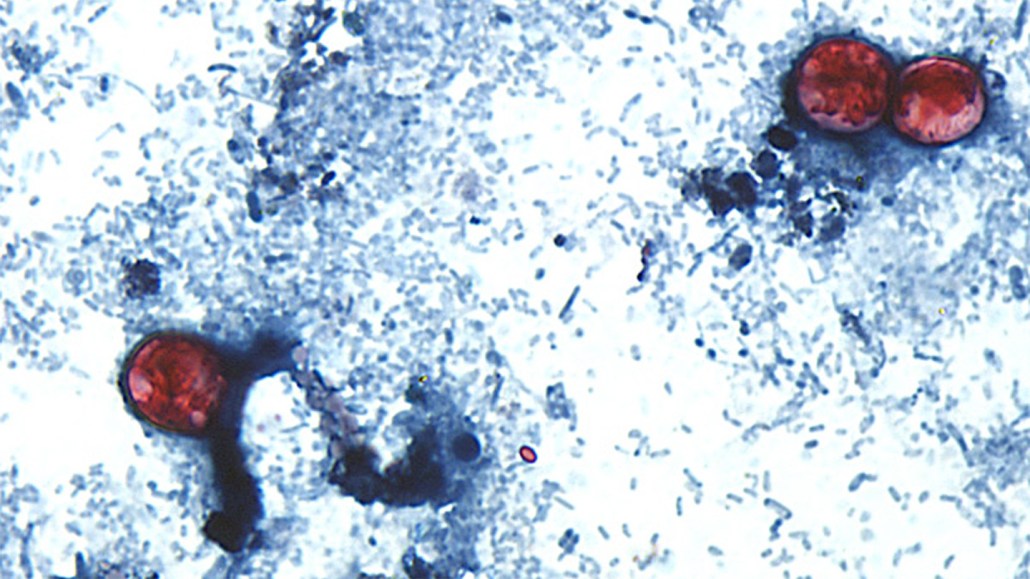
The foodborne parasite Cyclospora cayetanensis (stained red in this micrograph of a human stool sample) can cause extreme gastrointestinal upset. Cases have skyrocketed in the United States this summer and researchers are struggling to pin down the cause.
Melanie Moser/DPDx/CDC
Intense abdominal pain. Extreme fatigue. Explosive diarrhea.
These are just some of the symptoms of cyclosporiasis, a foodborne parasitic infection that has sickened thousands and hospitalized more than 100 people in the United States since May 1. Although public health officials may have finally identified one culprit — shredded lettuce distributed to Taco Bells in some states — the outbreak of the parasite Cyclospora cayetanensis shows no sign of letting up. Researchers are racing to track down what’s driving the surge in cases, but the parasite’s wiliness plus cuts to federal funding for public health presents a unique challenge.
“In terms of this year’s outbreak, we haven’t seen such large, common source outbreaks identified in the past few years,” says epidemiologist Craig Hedberg of the University of Minnesota School of Public Health in Minneapolis.
Of 34 states reporting illness, Michigan has been hardest hit. As of July 17, the state has reported 5,002 cases and 102 hospitalizations — the most of any of the affected states. New York has the second highest case load: 510 as of early July. It is unclear whether the chasm reflects a true difference in infection rates or more awareness among Michigan residents prompting more testing.
The influx is putting a strain on Michigan’s public health infrastructure. The state’s 45 local health districts are responsible for identifying potential cases, collecting human fecal samples and conducting patient interviews. Samples then go to the Michigan Department of Health and Human Services for processing and analysis.
Typically, Michigan logs fewer than 50 cases per year, says MDHHS genomic epidemiologist Heather Blankenship, who is based in Lansing. The deluge of clinical samples has prompted the agency to lean on the state’s Emergency Preparedness Group and the Michigan Department of Agriculture for help. It takes a minimum of three days to process a sample, and with the sheer volume of cases, it is taking the MDHHS much longer, Blankenship says. This backlog delays the work needed to find the outbreak’s origins.
Early results from MDHHS’ investigation point to lettuce and salad greens as potential suspects. On July 16, the U.S. Centers for Disease Control and Prevention and the U.S. Food and Drug Administration announced that they linked some cases in Michigan, Indiana, Kentucky, Ohio and West Virginia to shredded iceberg lettuce served at Taco Bell. The restaurant chain has voluntarily removed lettuce from its menus in the affected states. And Taylor Farms, the company that supplied the lettuce, announced a recall on July 17.
Tracking Cyclospora is trickyOnce a person ingests contaminated food, it can take up to two weeks for symptoms to appear, Hedberg says. Compared with common foodborne illnesses that take just hours or days to develop, the extended timeframe can confound efforts to trace Cyclospora to its source. Public health officials often find that patients have difficulty recalling the food they ate so far in the past.
The parasite’s biology also conspires against finding quick answers.
It can’t be grown in the lab like other foodborne pathogens can, which means more samples from infected people are needed to collect enough parasite DNA to nab its identity. Blankenship and colleagues rely on eight of the parasite’s genes to confirm cases, but that isn’t enough to determine how cases might be related. Sequencing Cyclospora’s entire genome would help, but its relatively large size (it’s about nine times as large as E. coli’s) makes that exceedingly difficult, Blankenship says.
“There’s a lot of unknowns with the investigation,” Blankenship says. “Doing [genetic] characterization is going to help us better understand what is happening.”
The Cyclospora outbreak exposes cracks in food safetyClinical microbiologist Kimberly McCullor, also of MDHHS, says staff are trained to assist in almost all aspects of an investigation. “We’re always kind of looking for the next potential pop-up outbreak,” McCullor says. “We try to limit the surprise, right? We’re able to pivot — we use that word a lot.”
This reliance on pivoting isn’t unique to Michigan and highlights a much larger issue facing the country: The chronic underfunding of public health services. Funding for food safety in particular has been stagnant for years, says epidemiologist Barbara Kowalcyk of George Washington University in Washington, D.C.
Funding pinches are partly behind the CDC’s move in 2025 to reduce its surveillance for Cyclospora along with the foodborne pathogens Campylobacter, Listeria, Shigella, Vibrio and Yersinia. While the move shouldn’t impact the response to the current cyclosporiasis outbreak, it could hamstring responses to future ones, Dan Jernigan, former director of the CDC’s Center for Emerging and Zoonotic Infectious Diseases, told the Washington Post.
Data show that investing in surveillance at the local, state and federal levels leads “to a decrease in the amount of time it takes to identify an outbreak and consequently the number of cases associated with an outbreak,” Kowalcyk says.
| # | Наименование новости | Тональность | Информативность | Дата публикации |
|---|---|---|---|---|
| 1 | Explosive Diarrhea Parasite Is Making People Sick Across the U.S. — Here's What to Know | 0 | 7 | 08-07-2026 |
| 2 | Why experts can't pinpoint source of 'explosive diarrhea' parasite | 0 | 5 | 15-07-2026 |
| 3 | Why experts can't pinpoint source of 'explosive diarrhea' parasite | 0 | 5 | 15-07-2026 |
| 4 | Why experts can't pinpoint source of 'explosive diarrhea' parasite | 0 | 5 | 15-07-2026 |
| 5 | Why experts can't pinpoint source of 'explosive diarrhea' parasite | 0 | 5 | 15-07-2026 |
| 6 | Why experts can't pinpoint source of 'explosive diarrhea' parasite | 0 | 5 | 15-07-2026 |
| 7 | Nearly 1,000 cases of explosive diarrhea illness cyclosporiasis reported in Indiana | 0 | 8.57 | 28-07-2026 |
| 8 | The Explosive Diarrhea Outbreak Is About to Get Much Bigger | -2 | 6 | 15-07-2026 |
| 9 | Cyclospora-Ausbruch: Parasit sorgt in USA für „explosionsartigen Stuhlgang“ | -2 | 6 | 11-07-2026 |
| 10 | Раскрыта опасность американской вспышки «взрывной» диареи | 0 | 10 | 03-08-2026 |